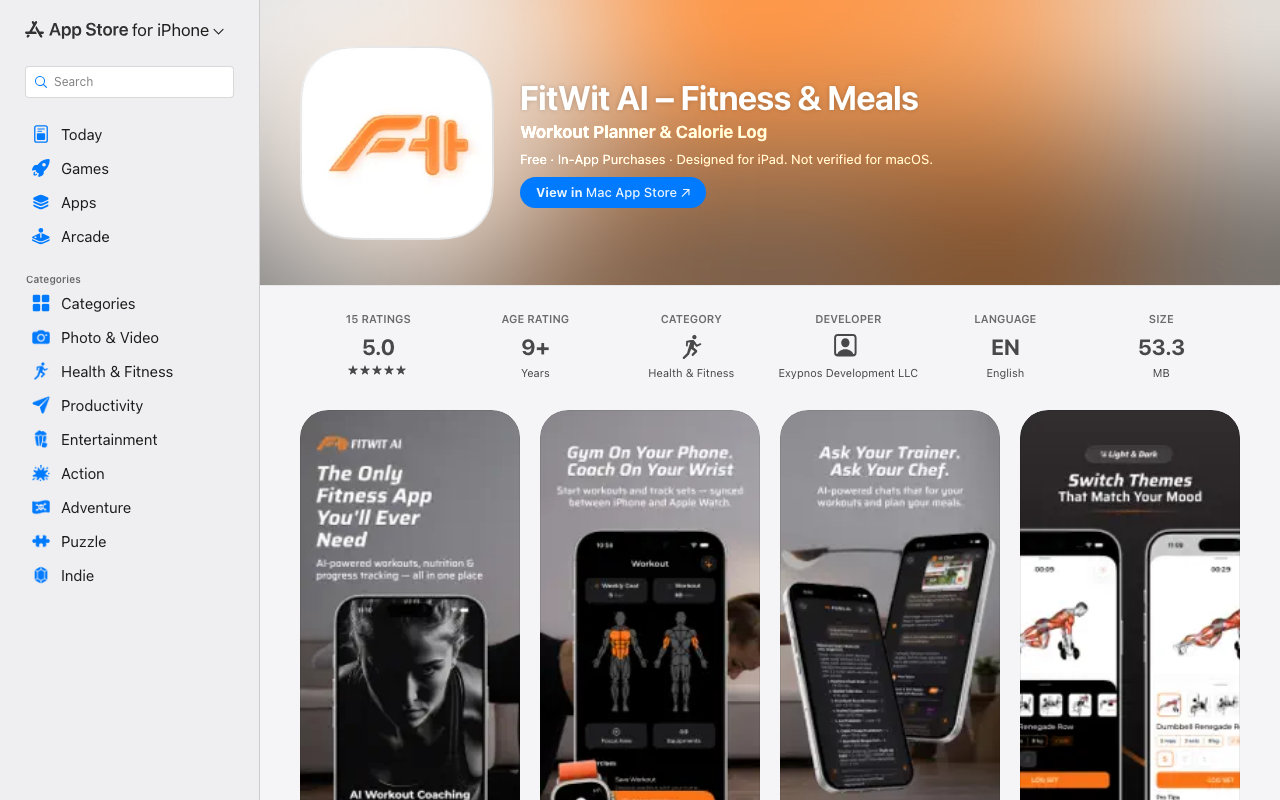
FitWit AI
apps.apple.com/us/app/fitwit-ai-personal-trainer/id6757002413 →A solo dev 'vibe-coded' an AI fitness app — and it actually shipped
WHAT IT SOLVES
Tracking workouts in one app, meals in another, and neither talks to your Watch — most people just quit
WHY IT'S INTERESTING
Workouts + meals + Watch — in one app
Most fitness apps pick a lane — either workouts or nutrition. FitWit does both, adds photo-based food logging via AI, and syncs with Apple Watch for heart rate and exercise tracking. It's one closed loop, which is how fat loss actually works
Watch support isn't a checkbox feature
Adding Watch support means HealthKit permissions, sensor APIs, foreground/background sync — it's a real engineering surface area. The author literally called it 'vibe coded,' meaning no formal architecture, just building as he went. Shipping something that works well enough to earn a 5.0 rating? That's real hands-on skill
「The author literally titled it 'Vibe coded iOS workout app with Apple Watch support' — honest from the first word」
TECH GUESS
Native Swift/SwiftUI, HealthKit for Watch integration, cloud-based AI API for food photo recognition
DEEP DIVE
One App for the Full Fitness Loop
The fitness app market is crowded, but there's a stubborn gap: most people need one app for workouts (Keep, Nike Training Club), another for food logging (MyFitnessPal), and Apple Watch data lives in a separate Health app. FitWit AI tries to close that loop in a single place — training plans, meal tracking with photo-based calorie recognition, and Apple Watch heart rate sync. It's not feature bloat; it's a bet that weight management is inherently one workflow. The App Store shows 15 ratings with a perfect 5.0 score — tiny sample, but at least nobody is angry.
"Vibe Coded" as a Development Philosophy
The HN post title reads: "Show HN: Vibe coded iOS workout app with Apple Watch support." That's unusually honest. "Vibe coded" means no architecture diagram, no technical spec — just building as ideas come. Most indie devs work this way; few admit it publicly. The end result is a 53.3 MB native iOS app supporting iPhone, iPad, and Apple Watch. It shipped, it's live, it has a 5.0 rating. Vibe coding doesn't mean sloppy coding — the underlying skills have to be real. In the thread, hilti asked: "Is this all AI generated?" — referring to the in-app graphics and art design. The developer didn't reply, but the question itself signals the visual quality exceeded expectations.
Apple Watch Integration Is Not a Checkbox
Plenty of fitness apps show a watch screenshot in marketing but only display step counts in practice. FitWit AI claims real-time heart rate and motion sync via Apple Watch. That means HealthKit permission flows, sensor data access (heart rate, accelerometer, gyroscope), foreground/background sync logic, and Complications for watch faces. It's a whole additional technical stack. For a solo developer, this is significant effort. If the 5.0 rating holds up across more users, it suggests the HealthKit integration isn't superficial.
What the HN Community Actually Said
The post earned 8 points and 5 comments — not viral, but the discussion was substantive. User hrvstr wrote: "Hey I was looking for something like this and would give it a spin and a review :)" — exactly what a solo dev wants to hear. carefree-bob raised a sharp product insight: "What would be nice is an AI personal trainer that allows you to record your workout and it will tell you what to do to improve your form." That points to a clear gap in FitWit AI's current scope — plan generation and food tracking are covered, but real-time form correction is missing. Meanwhile, another indie dev chetansorted pitched FitSaver, an app for organizing saved workouts into structured gym routines, confirming the broader pain point: fitness tooling is fragmented, and different developers are attacking different pieces.
Who Should Use It — and What to Watch For
FitWit AI is for users who refuse to juggle three or four fitness apps, own an Apple Watch, and are comfortable treating AI-generated plans as a starting point to tweak manually. The honest limitations: 15 ratings is far too small a sample to trust the 5.0 as a long-term signal; the app is English-only; in-app purchase pricing and feature gating aren't visible from the listing and need hands-on verification; and as a "vibe coded" product, questions about architectural maintainability, data security, and long-term iteration are legitimate. But for a solo developer's side project, wiring together workouts, meals, and a watch into one functional app — that already puts it ahead of most things that never ship.
Discussion (0)
- No comments yet — be the first.
Related
 #229▶ 136
Upload your textbook. AI teaches it back to you, chapter by chapter
 #228▶ 112
Someone needs to watch the AI spend meter
 #227▶ 184
Your users are kittens. Don't let them fall off the cliff