Brain-rot Factory
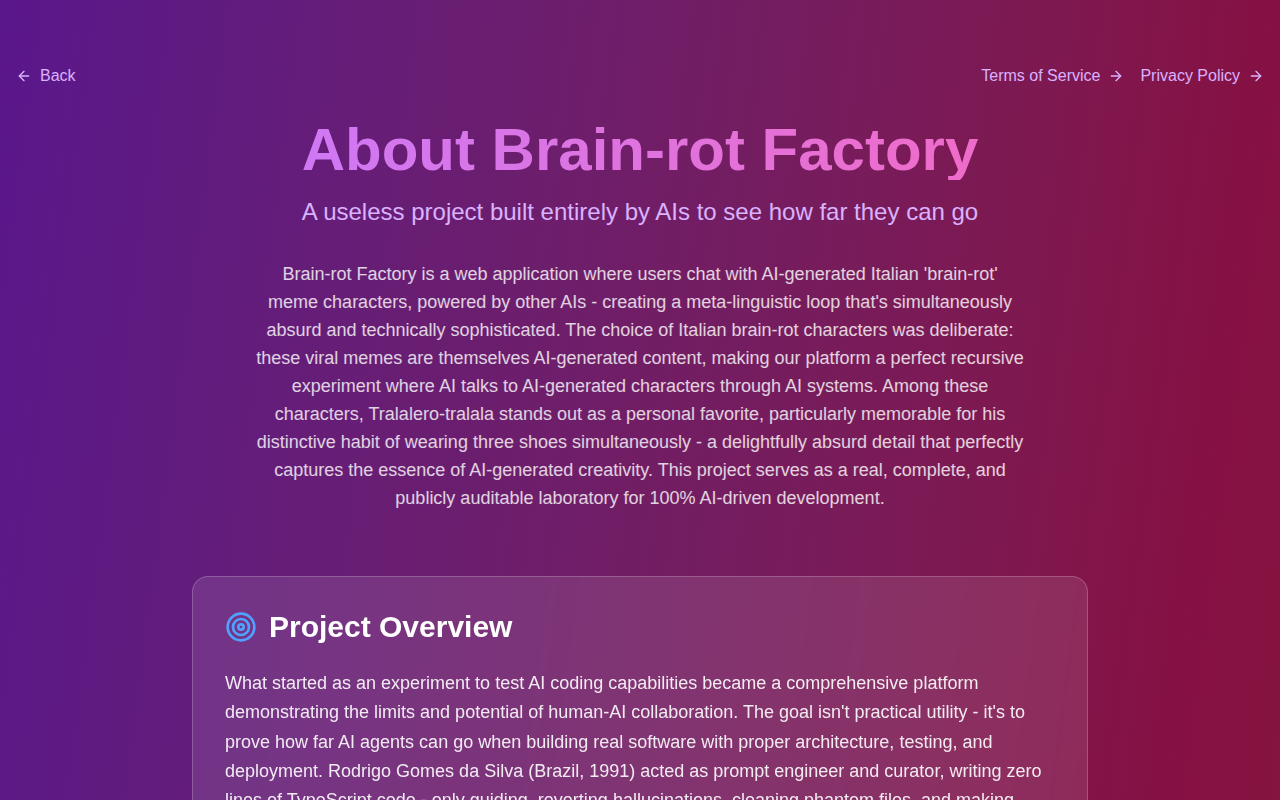
brain-rot-factory.vercel.app/en/about →When AI chats with AI-generated memes, things get delightfully weird
WHAT IT SOLVES
Exploring the recursive loop of AI creativity through absurd Italian memes
WHY IT'S INTERESTING
Choosing AI-generated memes
Deliberately chose Italian brain-rot memes as they're AI-generated, creating a perfect recursive experiment
Three Shoes Detail
Character Tralalero-tralala wears three shoes simultaneously, a deliciously absurd detail capturing AI-generated creativity
「A useless project」
TECH GUESS
Next.js 15, likely with Vercel AI SDK for chat handling
DEEP DIVE
When AI Starts Meming: A Laboratory of Recursive Absurdity
Brain-rot Factory, a self-described “useless project” shown on HN by developer rodrigogs, is a web application that lets you chat with AI-generated Italian “brain-rot” meme characters. While its premise sounds trivial, the project is a cleverly constructed experiment that delves into the recursive nature of AI creativity. Built with Next.js 15, it presents a deceptively simple interface that masks a fascinating meta-loop.
The Recursive Meta-Joke: AI Talking to AI-Generated Memes
The core ingenuity of Brain-rot Factory lies in its deliberate choice of subject matter. The Italian “brain-rot” memes it features are themselves products of AI generation. This sets up a perfect recursive experiment: a user interacts with an AI system (the chatbot) to converse with a character (the meme) that was also created by AI. As the project states, it’s a loop where “AI talks to AI-generated characters through AI systems.” The absurd detail of the character Tralalero-tralala wearing three shoes simultaneously isn’t just a joke; it’s a direct artifact of AI-generated creativity, capturing the unpredictable, logic-defying “emergence” that can occur in generative models. The entire platform is a live, public audit of this phenomenon.
The “Useless” Utility: Developer Intent and Tech Stack
Labeling it “a useless project” is a deliberate statement. Amidst a landscape of AI tools focused on productivity and utility, Brain-rot Factory intentionally explores the “useless use” of AI—its capacity for absurdity, self-reference, and pure experimentation. The developer positions it as a “real, complete, and publicly auditable laboratory for 100% AI-driven development.” Technically, the choice of Next.js 15 is clear for the frontend. The chat functionality likely leverages something like the Vercel AI SDK for streaming responses, keeping the implementation lean. The goal isn’t a complex backend, but a rapid proof-of-concept for the “AI-generated character + AI-powered chat” loop.
The Experience and Its Honest Limitations
The user experience is a direct reflection of the project’s focused scope. Its strength is its conceptual purity and immediate impact—you grasp the recursive absurdity within minutes. However, its limitations are equally clear and honest. The functionality is monolithic: it’s just chat, with no deeper narrative or interaction layers. The recursion has limited depth; the meme characters are static AI generations, and the chatbot AI remains basic, preventing any complex, evolving “meme universe.” Its audience is niche, primarily appealing to those interested in AI cultural phenomena, memetics, or the development experiment itself. For users seeking utility or deep engagement, it is indeed “useless.”
Conclusion: A Funhouse Mirror for AI Creativity
Brain-rot Factory’s value isn’t in what it does, but what it represents. It acts as a funhouse mirror, reflecting a peculiar slice of the current AI-Generated Content (AIGC) ecosystem: AI not only producing content but also consuming and interacting with content produced by its peers, forming a cultural closed loop. For developers, it serves as a lightweight example of how to quickly scaffold an AI concept validation (PoC) project using modern web stacks. For product people, it poses a thought-provoking question: In an age saturated with AI tools, do projects that focus on exploring cultural phenomena and experiences, however “useless,” also help define the boundaries of what AI applications can be? This HN project, with its modest 2 points and 0 comments, might have found its unique value precisely in its focused absurdity.
Discussion (0)
- No comments yet — be the first.
Related
 #229▶ 136
Upload your textbook. AI teaches it back to you, chapter by chapter
 #228▶ 112
Someone needs to watch the AI spend meter
 #227▶ 184
Your users are kittens. Don't let them fall off the cliff