CalcBin
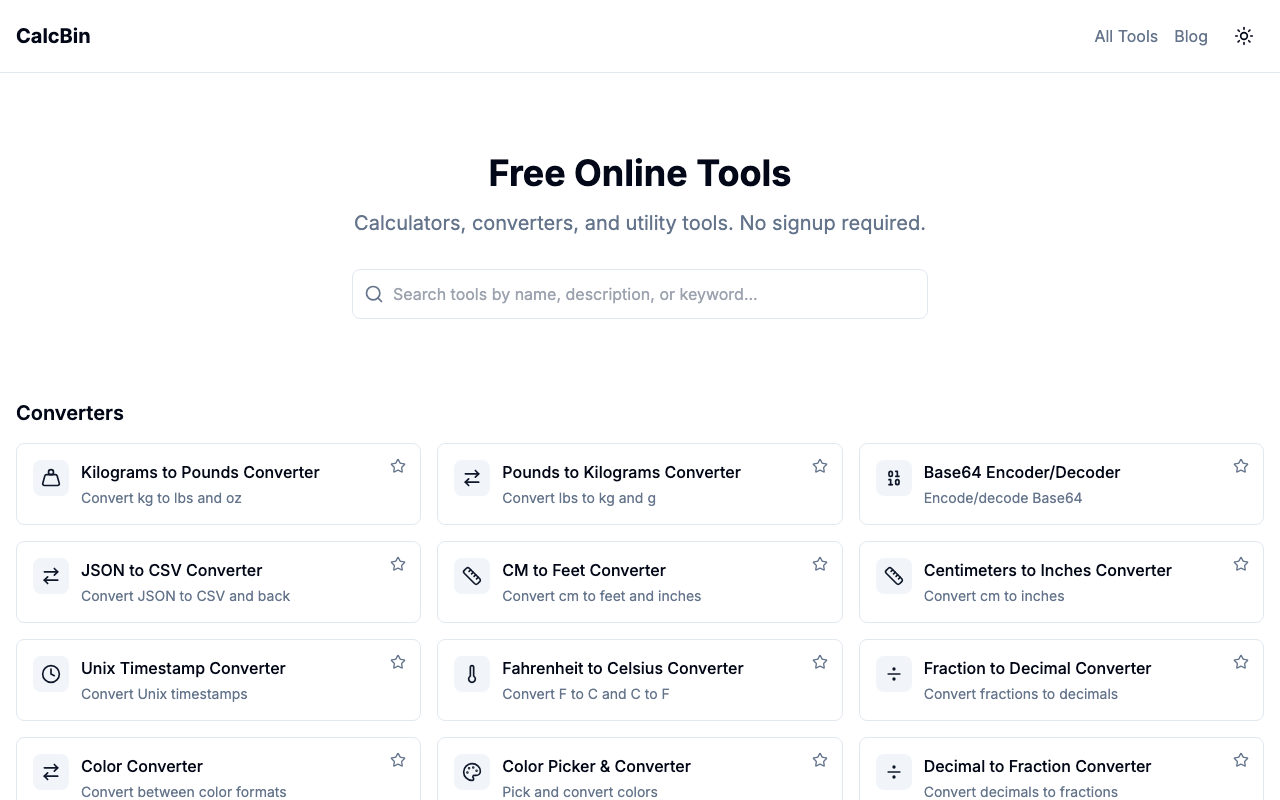
calcbin.com →Vibecoded 177 tools, just for himself
WHAT IT SOLVES
Online calculators and converters are everywhere — but most want your email, serve ads, or just don't have that one weird unit conversion you actually need
WHY IT'S INTERESTING
"For my own use" is the most honest product statement
The HN title says it plainly: "for my own use." Not a startup pitch, not a growth play — just a dev who wanted his own toolkit. No signup walls, no popups, open and go. The simplicity actually builds trust
177 tools, from kg-to-lbs to Unix timestamps
Unit conversions, Base64 encoding, JSON↔CSV, color format switching — the range is wide. The keyword is vibecoded: the author openly says AI helped build these. 177 isn't artisanal craft — it's an experiment in how far one person can stretch a toolbox with AI assistance
「"I vibecoded 177 tools for my own use"」
TECH GUESS
Likely Next.js or Astro static site generation + Tailwind — 177 pages screams SSG
DEEP DIVE
A Toolbox Built "For My Own Use"
The title of CalcBin is refreshingly honest: "I vibecoded 177 tools for my own use." No grand vision, no "empowerment" or "revolution"—just a developer (diNgUrAndI) who aggregated the converters and calculators they personally needed. On HN, it received 15 points and 4 comments. The modest traction underscores its core value: it wasn't built to chase a "market," but to solve a specific problem for a specific person (the developer themselves). Online tools are often plagued by ad pop-ups, forced sign-ups, or simply lack that one niche function you desperately need.
177 Tools: An AI-Assisted "Batch Wheel-Reinvention" Experiment
"Vibecoded" is the project's defining keyword. It explicitly states these 177 tools were rapidly generated with the help of AI coding tools. The range is eclectic: practical unit conversions (kg/lb, cm/inch, F/C), timestamp converters, developer utilities like Base64 encoding/decoding and JSON-to-CSV, and design-related color format converters. This isn't a meticulously polished single product; it's more like an AI-driven experiment to see how large a personal toolbox can become. Technically, such a pure front-end collection is likely built with Next.js or Astro for Static Site Generation (SSG) and Tailwind CSS, enabling rapid deployment and blazing-fast load times.
Community Feedback & Lightning-Fast Iteration: The Indie Dev Advantage
The HN discussion, though brief, perfectly showcases the power of direct developer-user interaction. User chromehearts asked, "Why is the search bar only on /tools?" Developer diNgUrAndI responded immediately: "Good catch. I just fixed it!" Another user, henryhale, suggested: "allow users to pin or star tools for quick access." The developer again replied swiftly: "You got it. Just pushed the change. Check it now." This feedback-to-live-update cycle measured in minutes is something large teams can rarely match and is the magic of indie projects.
Honest Limitations: What It Is, and What It Isn't
It's crucial to understand that CalcBin is not the "precision blade in the Swiss Army knife." With 177 tools AI-generated in batch, the depth and user experience of each likely vary. It solves the "existence" problem, not the "excellence" problem. You won't find advanced features of professional calculators or exceptionally polished interactions here. Its value lies in this: when you suddenly need to convert a Unix timestamp to readable time or quickly turn JSON into CSV, you can open it directly, free from the hassle of sifting through junk websites—no sign-up, no distractions.
Who Is This For? And What Does It Represent?
CalcBin is best for two groups: first, "tool consumers" like the developer who need quick, clean conversions; second, indie developers and product managers, for whom it serves as an excellent case study on using AI to productize personal needs and gain rapid community validation. It represents a new development paradigm in the AI era: shifting from "building products for the market" back to "building tools for oneself," then sharing them with others who have the same needs. In this model, the power to define a product returns to the individual developer.
Discussion (0)
- No comments yet — be the first.
Related
 #229▶ 136
Upload your textbook. AI teaches it back to you, chapter by chapter
 #228▶ 112
Someone needs to watch the AI spend meter
 #227▶ 184
Your users are kittens. Don't let them fall off the cliff