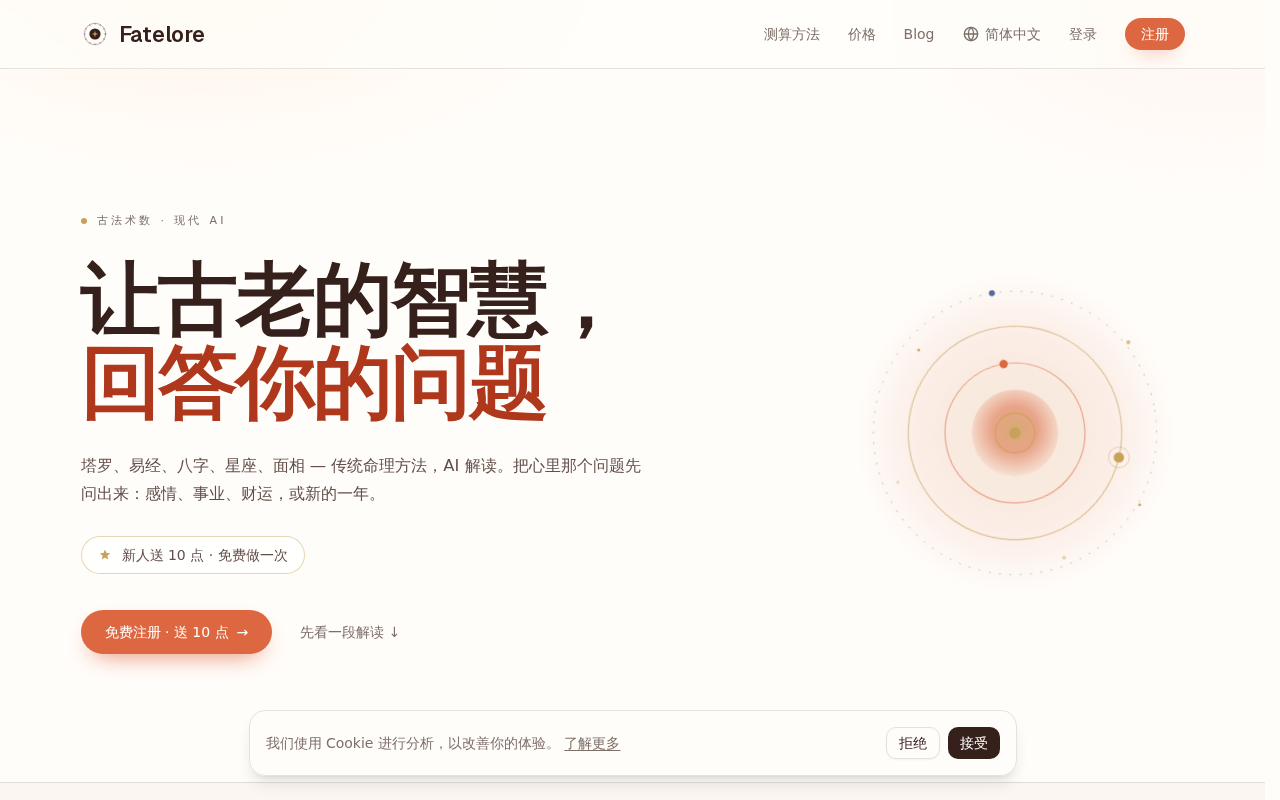
Fatelore
fatelore.com/zh →One dev vibe-coded a full AI fortune-telling app
WHAT IT SOLVES
Getting a tarot or I Ching reading means booking a practitioner or wading through shady sites buried under paywalls
WHY IT'S INTERESTING
Five divination methods, one clean funnel
Tarot, I Ching, BaZi, astrology, face reading — most indie devs ship one method and call it done. This site folds all five into a single funnel, cross-recommending by life question (love, career, wealth, life). It's not feature bloat; it's actually thinking about how a confused user picks the right tool
The sample reading feels legit
The three-card sample says things like 'you keep thinking of someone but the words won't come out' — that's not raw GPT output, that's prompt-tuned. Show a convincing sample first, then hand you 10 free credits to pull you in. Smart onboarding
「vibe-coded an AI fortune-telling app」
TECH GUESS
Next.js frontend, OpenAI API on the backend, Stripe or similar for credits
DEEP DIVE
\n## One Dev's Ambitious Vibe-Coded Project: Five Fortune-Telling Arts in One Place\n\nOn V2EX, the developer casually described Fatelore as “vibe coded an AI fortune-telling app.” But opening the site reveals ambition far beyond a simple wrapper. It tackles a real pain point: the traditional fortune-telling world is fragmented and intimidating. An ordinary person curious about a reading faces Tarot, I Ching, BaZi, astrology, and physiognomy, with no idea where to start or whom to consult. Fatelore’s solution is to reframe the problem. It integrates all five methods and organizes them not by tradition, but by the four life questions users actually care about: love, career, wealth, and life path. This isn’t feature bloat; it’s a product insight. Users come with specific worries (“What does she really think?” or “Should I change jobs?”). The app’s job is to recommend the right “tool” for the question, not force the user to study the tools themselves.\n\n## The Art of the Sample Reading: Evidence of Prompt Craft\n\nMany AI apps fail at first impression. Fatelore is smart: it shows a sample Tarot three-card reading before you sign up. The language is telling: “You’ve been thinking of someone lately, but the words get stuck whenever you try to speak.” “You already know the answer in your heart, you just haven’t admitted it yet.” This doesn’t read like raw, unedited GPT output. It has emotional resonance and a literary touch, pointing to deliberate prompt engineering. This “show the model home first” strategy builds trust: users first appreciate the AI’s interpretive quality, then are guided to register. The 10 free points offered upon signup are precisely calibrated—enough for 1-2 full readings, lowering the trial barrier while preventing infinite free consumption of resources.\n\n## A Textbook “AI Underdog”: Applying New Tools to an Old Trade\n\nThis project is a perfect slice of the “independent developer in the AI era.” The developer is likely a solo or tiny team who leveraged modern AI coding tools (the “vibe coding” likely involving Cursor, Copilot, etc.) to rapidly build a full-stack product: a frontend (probably Next.js) for slick interactions, a backend calling LLM APIs (like OpenAI) to generate readings, and a payment system (like Stripe) for point purchases. The core value isn’t in the algorithm, but in integration and packaging—using AI as a “translator” and “story generator” to wrap ancient divination knowledge into a product modern users can easily consume. The HN community’s reaction was telling: some appreciated the creativity, while others noted, “Fortune-telling is a probability game anyway; AI is just a fancier random number generator.” This reflects the product’s essence: it sells not scientific accuracy, but psychological comfort, entertainment, and narrative experience.\n\n## Target Users and Honest Limitations\n\nThe target audience is clear: young, internet-savvy users interested in astrology, self-exploration, and divination, but who are unable or unwilling to consult a traditional practitioner. It offers an instant, private, low-cost (compared to offline sessions) “fortune-telling experience.” However, limitations are stark. First, verifiability is impossible; AI interpretations are fundamentally pattern-matching and text generation, lacking the deep, contextual reasoning of a skilled human practitioner. Second, knowledge depth is questionable; fusing five vastly complex systems likely results in a “stylized” presentation rather than rigorous exposition for any single one. Third, the business model relies on repeat purchases; once the free points are gone, whether users will pay for continued “psychological comfort” is critical to survival. It’s an interesting product experiment, not the future of divination, but rather a “vibe-coded” application of AI to the realm of emotional consumption." }
Discussion (0)
- No comments yet — be the first.
Related
 #229▶ 136
Upload your textbook. AI teaches it back to you, chapter by chapter
 #228▶ 112
Someone needs to watch the AI spend meter
 #227▶ 184
Your users are kittens. Don't let them fall off the cliff