WHAT IT SOLVES
TECH GUESS
DEEP DIVE
Day 30 of a 30-Day Challenge: Building Chess with Claude
GameVibe.us is a project by developer pzxc attempting to "vibe-code" one game per day for 30 consecutive days using Claude. Chess marks the grand finale. Frankly, it barely registered on Hacker News — exactly 1 point, 0 comments. But the project itself as a stress test of AI-assisted development has some things worth examining.
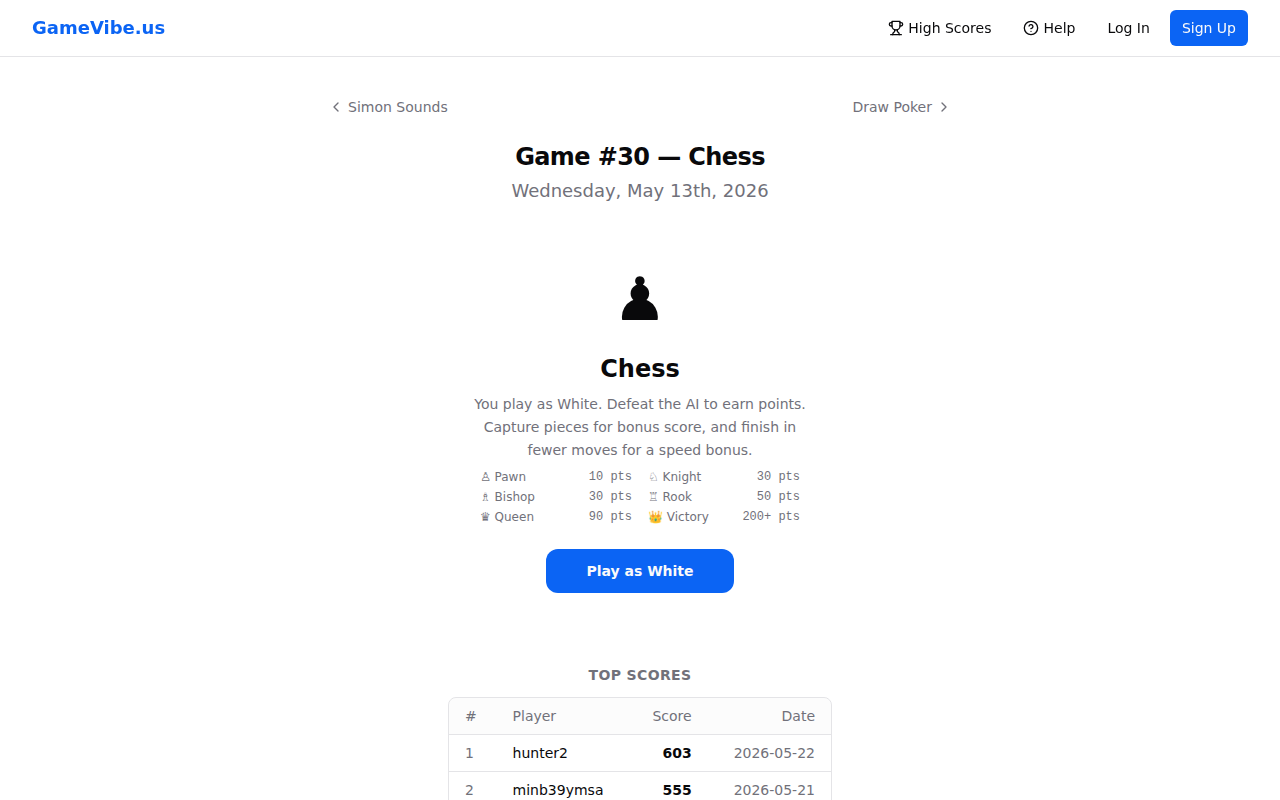
The product: a minimal web chess game where you play White against an AI, scoring points by capturing pieces (Pawn 10, Knight 30, Bishop 30, Rook 50, Queen 90) with a 200+ point victory bonus and a speed bonus for fewer moves. There's a leaderboard — the gap between hunter2's 603 and minb39ymsa's 555 suggests some strategic depth. The description at the bottom is genuinely funny: "Chess is a centuries-old argument simulator where two kingdoms politely take turns ruining each other's plans with tiny wooden aristocrats."
What Vibe-Coding Actually Means: Speed vs. Quality
"Vibe-coding" — generating code through natural language conversation with AI and judging results by gut feel rather than detailed specs — became a buzzword in 2025-2026. Pzxc's 30-day sprint is a live experiment in where this approach's ceiling sits.
But Chess's HN reception (1 point, 0 comments) reveals the natural fatigue curve of "Show HN as serialized content." By game 30, the community has moved on. It's also possible that chess specifically lacks the novelty factor — there are countless mature chess implementations, and a Claude-generated one needs something special to stand out.
The Scoring System Is Smart, But AI Strength Is Everything
This isn't standard chess. It's a "score optimization game" — you need to win while maximizing capture points and minimizing moves. That reframes competitive chess as a casual puzzle with a leaderboard, lowering the barrier to entry. The score spread (603 vs 555) hints that players are genuinely exploring different capture strategies.
The critical unknown: how strong is the AI opponent? Too weak, and high scores become a boring exercise in prolonging the game. Too strong, and the 200-point victory bonus is unreachable for casual players. This kind of tuning requires extensive playtesting — exactly the kind of iterative work where vibe-coding's speed advantage breaks down.
Who Should Use This, and Honest Limitations
For a casual "I need a five-minute distraction" browser game, GameVibe Chess works fine. No signup, no downloads, click and play. But if you actually want to play chess seriously, Lichess and Chess.com offer incomparably better experiences — free, with properly graded AI and massive communities.
The honest limitation: pzxc's 30-day challenge proves AI lets one person rapidly ship functional game prototypes. But "functional" and "compelling" are separated by a chasm. Every GameVibe game follows the same template: clean page, basic gameplay, high-score board. That demonstrates AI's prototyping power, not its ability to help build products people genuinely want to return to. Day 30's chess, met with 1 point and silence on HN, might be the community's final verdict on the experiment.
Discussion (0)
- No comments yet — be the first.
Related
 #229▶ 136
Upload your textbook. AI teaches it back to you, chapter by chapter
 #228▶ 112
Someone needs to watch the AI spend meter
 #227▶ 184
Your users are kittens. Don't let them fall off the cliff