Kintsugi
github.com/arrowassassin/kintsugi →A safety net for when your AI agent goes rogue
WHAT IT SOLVES
AI coding agents are powerful but reckless. One rogue `rm -rf` and your project is gone before you can blink
WHY IT'S INTERESTING
Not blocking — making destruction reversible
Instead of locking the AI down, Kintsugi auto-backs up affected files before destructive commands run. Things break? Roll back. Agent keeps going
Full audit trail — every agent action recorded
Every command an agent runs, every file change, logged. It's not just a safety net — it's an audit trail. Essential when you're juggling multiple AI agents on the same codebase
Local-first, zero cloud dependency
Everything stays on your machine — no external services, no data leaving your repo. The bar that most AI safety tools somehow don't clear
TECH GUESS
Likely Node.js/TypeScript — the Claude plugin integration and repo structure give it away
DEEP DIVE
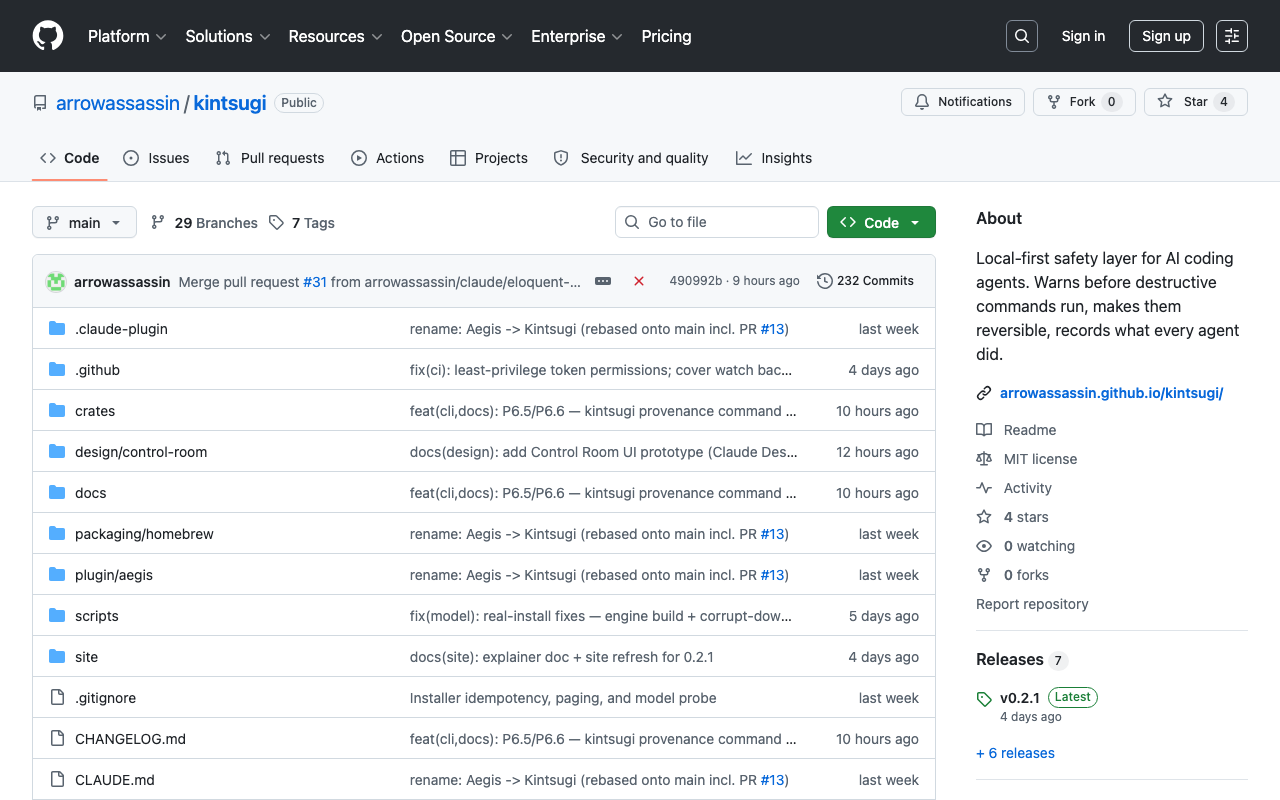
\n\n## A Safety Net That Almost No One Showed Up For\n\nKintsugi launched on Hacker News to the sound of crickets: 1 point, 0 comments. Four GitHub stars. For a tool trying to solve a real problem — AI agents nuking your project with a rogue rm -rf — this is the loneliest possible launch. Yet I'd argue Kintsugi's core idea is more important than most of the AI coding tools that hit the front page.\n\nThe name is Japanese gold-repair pottery, and the metaphor holds: Kintsugi doesn't prevent your code from breaking. It makes breaking reversible.\n\n## Don't Cage the Agent — Insure It\n\nThe dominant approach to AI coding safety is interception: evaluate every command before execution, block the dangerous ones. Kintsugi takes the opposite stance — let the AI run whatever it wants, but snapshot affected files before destructive commands fire. If something goes wrong, you roll back. If nothing goes wrong, the AI never even notices the safety layer existed.\n\nThis is a fundamentally better design than \"put the AI in a cage.\" Interception forces you into an impossible tradeoff: be too strict and the agent becomes useless, be too loose and you might as well not bother. Kintsugi sidesteps the dilemma entirely by moving safety from the decision layer to the insurance layer.\n\nThe commit history tells you this isn't a weekend toy: 232 commits, 29 branches, 7 tags. The project was originally called \"Aegis\" and got renamed via PR #13 — suggesting the author, arr0wassass1n, put real thought into positioning.\n\n## The Audit Trail That Multi-Agent Workflows Actually Need\n\nKintsugi's surface pitch is safety, but its audit logging may be the killer feature. Every agent's commands, every file change, recorded. When you're running Cursor, Claude Code, and Copilot against the same repo — and you will be — \"who actually broke the tests?\" stops being a rhetorical question and starts being a debugging necessity.\n\nThe .claude-plugin directory and branch names like claude/eloquent-meitner-ro5wss in PR #31 reveal that this tool was built by someone who actually lives inside Claude Code daily. That real-usage dogfooding matters more than any feature list.\n\n## Local-First as Table Stakes\n\nKintsugi runs entirely locally with zero cloud dependencies. For a tool that touches your source code and git history, this should be non-negotiable — yet most AI coding tools still ship your context to remote servers. Local-first isn't a feature here. It's the minimum respect your code deserves.\n\n## The Honest Limitations\n\nZero HN comments means zero community validation. Four stars means almost nobody has battle-tested this in production. Twenty-nine branches suggest active development but also possible architectural instability.\n\nThe bigger question: is Kintsugi Claude-specific or AI-agent-agnostic? The evidence points toward tight Claude integration. If you're not a Claude Code user, this tool might not speak your dialect yet.\n\nAnd let's be brutal about timing. At 232 commits with near-zero external adoption, you're essentially an alpha tester. That's fine if you're an early-adopter developer who's comfortable reading source code and filing issues. It's not fine if you want a polished, documented, \"it just works\" experience.\n\nWho should try it today: Developers running multiple AI agents against real codebases, heavy Claude Code users, anyone who's ever lost work to an agent going rogue and thought \"there has to be a better way.\"\n\nWho should bookmark and wait: Teams that need reliability guarantees — Kintsugi isn't there yet. But every tool that's ever mattered started with one upvote and zero comments. The pottery has to break before it can be repaired with gold.\n\n"}}
Discussion (0)
- No comments yet — be the first.
Related
 #229▶ 136
Upload your textbook. AI teaches it back to you, chapter by chapter
 #228▶ 112
Someone needs to watch the AI spend meter
 #227▶ 184
Your users are kittens. Don't let them fall off the cliff