MandoCode
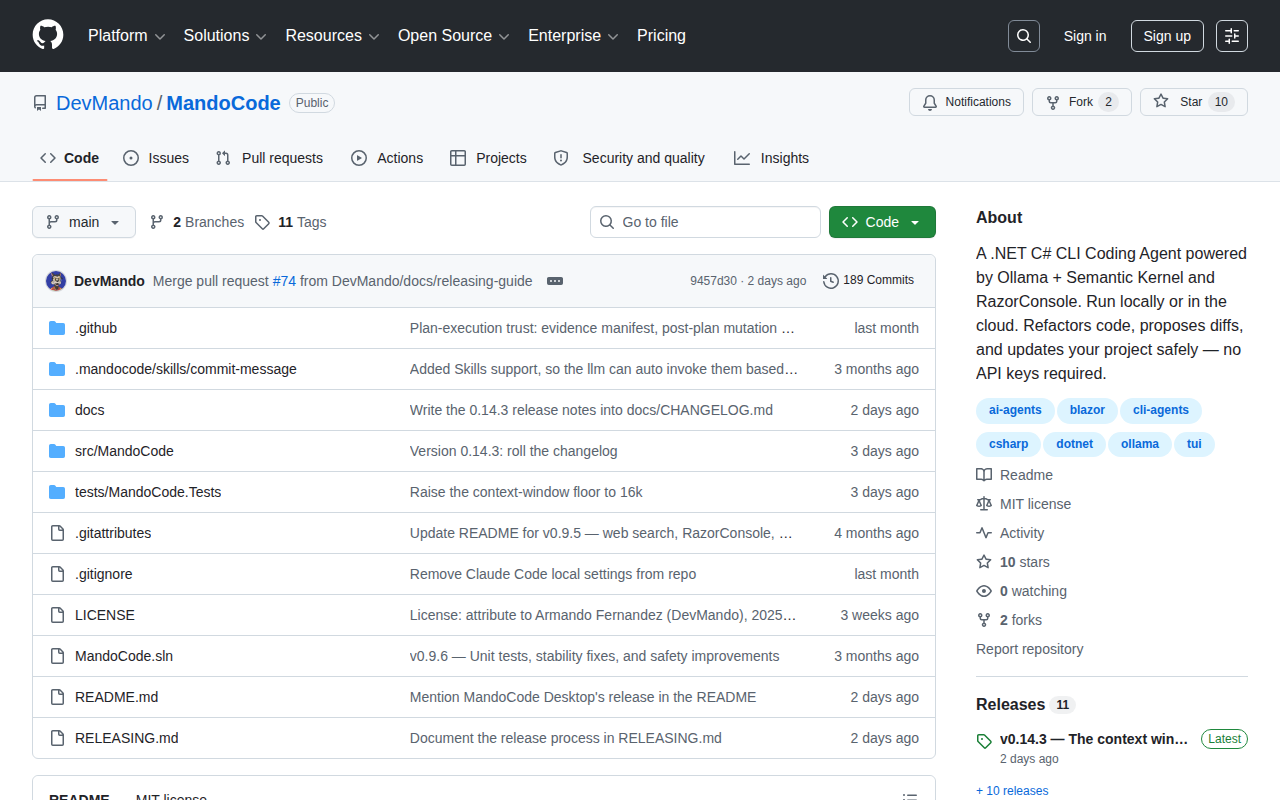
github.com/DevMando/MandoCode →A .NET dev built his own local AI coding agent — no API keys
WHAT IT SOLVES
Most AI coding tools either need cloud APIs and a credit card, or they live entirely in the Python world — .NET devs get left out
WHY IT'S INTERESTING
189 commits — solo-built
Plugs Semantic Kernel into Ollama, pipes it through RazorConsole for terminal UI, then wraps it with diff preview and safe file writes. Not a wrapper demo — a real CLI tool with 189 commits behind it
Shows you the diff before touching your files
Refactoring doesn't just overwrite your files — it proposes a diff for you to review first. This kind of 'show me before you touch it' thinking is something plenty of big-name tools still get wrong
Pure C# stack, no Python needed
While everyone else reaches for Python, this guy built the whole thing in C# and .NET. Semantic Kernel for orchestration, Ollama for local inference — all Microsoft-stack tools
「Run locally or in the cloud — no API keys required」
TECH GUESS
C# / .NET, Semantic Kernel, Ollama, RazorConsole
DEEP DIVE
\n## A .NET Developer's Solo Quest: How MandoCode Fills an Ecosystem Gap\n\nIn an era where AI coding tools are dominated by the Python ecosystem and OpenAI APIs, a .NET developer decided to take matters into his own hands. MandoCode is a local-first AI coding agent written entirely in C#, built on Microsoft's Semantic Kernel and Ollama to run locally without any API keys. Its core promise is to safely refactor code, propose diffs, and update your project directly. By the time it was posted on HN, the project had already seen 189 commits. Despite receiving only 2 points and 0 comments, this silence underscores the solitary effort of an indie developer trying to fill a specific niche in the ecosystem.\n\n## More Than a Shell Demo: A Serious CLI Tool\n\nMany \"Show HN\" projects are proof-of-concepts or wrapped demos, but MandoCode's commit history suggests serious intent. It uses RazorConsole to handle terminal interaction, creating an interactive environment for collaborating with the AI agent. The most critical design choice is the \"diff-first\" approach: before making any changes, MandoCode generates a diff preview for user confirmation. This is a step many big-name tools haven't perfected—they either apply changes directly or hide the diff in complex UIs. For developers who value code control and safety, this manual confirmation step is vital.\n\n## Why the Full C# Stack?\n\nThe developer chose a less-traveled path: building the entire stack from scratch in C# and .NET. In the AI tooling world, Python is the de facto standard, but MandoCode proves the .NET ecosystem is capable. It leverages Microsoft's Semantic Kernel as an orchestration layer for AI interactions, paired with Ollama for local large language model inference. This means the entire toolchain lives within the Microsoft ecosystem, making integration more natural for developers already in the .NET world. This choice isn't just about filling a gap; it's a demonstration of .NET's capabilities in the AI space.\n\n## Who Is MandoCode For?\n\nThe target audience is clear: .NET/C# developers who want to leverage AI-assisted coding but have been left out by existing tools. It's especially suited for privacy-conscious developers who don't want to send code to cloud APIs, or those working in network-restricted environments. MandoCode offers \"local or cloud\" flexibility, but its core selling point is local-first operation. It's designed for developers who want a lightweight, focused CLI tool rather than a bloated IDE plugin.\n\n## Honest Limitations and Unanswered Questions\n\nDespite its highlights, MandoCode's challenges are evident. First, the zero-comment HN engagement shows it received virtually no community feedback, which might indicate that the .NET community's demand for such tools isn't widely perceived, or that the project lacked effective outreach. Second, reliance on Ollama and local models means its performance is constrained by the user's local hardware and chosen model, potentially lagging far behind cloud-based models like GPT-4. Finally, as a solo project, long-term maintenance and feature iteration are uncertain. It solves the \"does it exist?\" problem for .NET developers, but \"is it good enough?\" still requires more real-world testing." }
Discussion (0)
- No comments yet — be the first.
Related
 #229▶ 136
Upload your textbook. AI teaches it back to you, chapter by chapter
 #228▶ 112
Someone needs to watch the AI spend meter
 #227▶ 184
Your users are kittens. Don't let them fall off the cliff