makememe
github.com/dhruvmehra/makememe →A CLI that turns your Claude Code into a meme factory
WHAT IT SOLVES
You want to drop a meme in a PR comment or Slack — but doing it by hand is slow, and AI agents can't draw
WHY IT'S INTERESTING
Not a meme generator — it's an agent's body language
Most meme tools are UIs for humans. This one flips it: the CLI exists purely for agents to call. A skill file teaches Claude Code when to deploy a meme and which template fits. It's not a tool — it's a social instinct bolted onto AI
v0.1.10 deliberately killed the lazy path
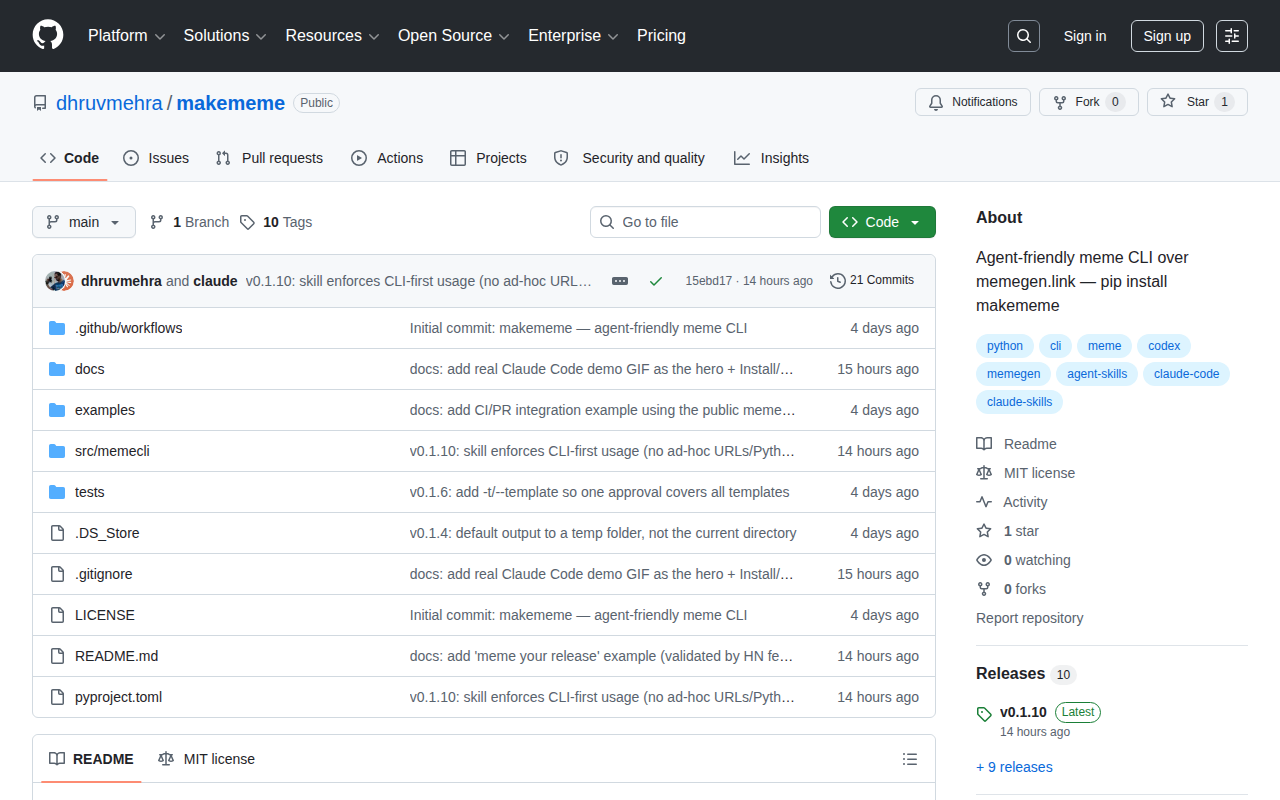
The commit log for v0.1.10 says: 'skill enforces CLI-first usage (no ad-hoc URLs/Python).' The author caught agents bypassing the CLI to hand-craft URLs or write Python scripts — and shut that door. Most projects wouldn't bother policing that edge case; this one did
Built on memegen.link — zero deploy cost
No self-hosted image rendering — it leans on the open-source memegen.link API. pip install and go, no Docker, no API keys. Smart laziness
TECH GUESS
Python CLI wrapping the memegen.link REST API, shipped with a Claude Code skill file for agent integration
DEEP DIVE
\n## Teaching AI to \"Meme\": Giving Claude Code a Social Instinct\n\nMost developers build meme tools to help humans create images faster. Dhruv Mehra took the opposite approach — his makememe is a pure CLI tool designed for AI agents (especially Claude Code) to call. The goal is clear: let AI automatically drop memes in PR comments, Slack messages, or test reports, without humans manually visiting meme generator sites. The project only has 1 point and 2 comments on HN, but it reveals an overlooked need: AI's \"social body language.\"\n\n## Core Insight: AI Needs \"Meme Limbs\"\n\nmakememe's design philosophy isn't \"build a better meme generator,\" but \"give AI an interface to express emotion.\" The developer demos it with Claude Code: a natural language command like create a meme about this PR where CI failed triggers the CLI to select a fitting template (e.g., Distracted Boyfriend or Success Kid), fill in text, and generate an image URL. This process is fully automated — no human touches any UI.\n\nThe author uses a skill file (Claude Code's extension mechanism) to teach the AI when and how to use the CLI. In other words, makememe isn't just a command-line tool; it's a set of \"social behavior guidelines\" telling the AI which memes to use in which scenarios. This is an interesting approach: rather than teaching AI all human social rules, give it one concrete, executable \"meme-dueling\" capability.\n\n## Enforcing CLI-First: Blocking AI's \"Shortcut Paths\"\n\nA detail in the commit history: v0.1.10's update note is skill enforces CLI-first usage (no ad-hoc URLs/Python). This suggests that during testing, the developer found AI agents sometimes \"cheating\" — they might directly construct memegen.link URL parameters or write small Python scripts to generate images instead of properly calling the makememe command.\n\nThe developer chose to block this loophole, forcing AI to interact via CLI only. This design is pragmatic: if AI bypasses the tool to DIY, you lose unified management, error handling, and logging. It also reflects a deeper question: how do you ensure AI works along the developer's intended path? makememe offers a simple answer by updating skill files.\n\n## Smart Laziness: Using memegen.link as Foundation\n\nTechnically, makememe doesn't build its own image rendering engine; it wraps the open-source memegen.link REST API. This means pip install makememe works immediately — no Docker, no API key, no server deployment. For a lightweight tool, this is the most pragmatic choice. The developer focused effort on AI integration and behavior control, not reinventing the wheel.\n\nHowever, this brings a limitation: relying on an external service means if memegen.link goes down or changes its API, makememe is affected too. But for its use cases (internal tools, PR comments), this risk is acceptable.\n\n## Who Should Use It? Honest Limitations\n\nmakememe suits teams heavily using AI agents in development workflows, like Claude Code for code review or automated test feedback. It adds a human touch to cold CI/CD processes — e.g., celebrating a merged PR with a meme, or dumping a \"This is fine\" dog image on test failures.\n\nBut its limitations are clear: First, it's highly dependent on memegen.link's template library — you can't customize images. Second, meme quality depends on template selection and text generation; AI sometimes picks wrong templates or writes unfunny captions. Finally, it currently only supports Claude Code; other AI agents (like GitHub Copilot Chat) can't use it directly.\n\nOverall, makememe is a small, fun experiment exploring how AI integrates into human non-technical communication. Though HN reception was muted (1 point), it raises a thought-provoking question: when AI can write our code, can it also \"meme\" for us?" }
Discussion (0)
- No comments yet — be the first.
Related
 #229▶ 136
Upload your textbook. AI teaches it back to you, chapter by chapter
 #228▶ 112
Someone needs to watch the AI spend meter
 #227▶ 184
Your users are kittens. Don't let them fall off the cliff