Gaokao Mentor Wisdom
github.com/dongsheng123132/gaokao-mentor-wisdom →105 Zhang Xuefeng quotes on gaokao, now in a PDF you can generate yourself
WHAT IT SOLVES
Gaokao advice is scattered and unstructured, making it hard for students to navigate
WHY IT'S INTERESTING
Structured data, built for AI integration
All quotes are stored in JSON, making it easy for developers to integrate with apps or train AI models—this shows the author thinking ahead for developers
Tackles PDF generation for CJK content
Built a JSON-to-PDF tool specifically for CJK characters, avoiding common layout and encoding issues—a detail others often overlook
TECH GUESS
Likely uses Node.js or Python with PDF libraries and Claude AI for development
DEEP DIVE
When Zhang Xuefeng Meets Claude: A PDF Generator Built on 105 JSON Quotes
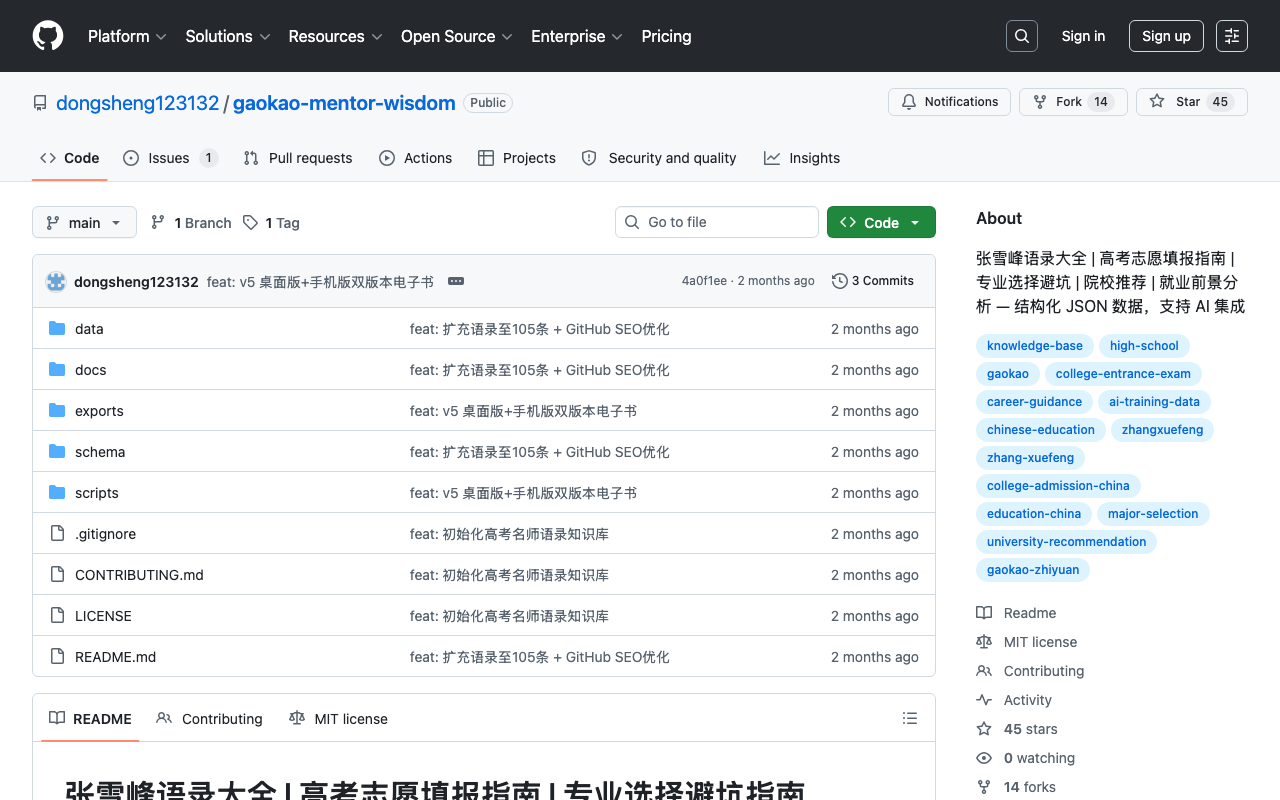
Every June, gaokao (China's national college entrance exam) sparks an information war. Zhang Xuefeng, a viral education commentator, gives career advice in short videos that get endlessly forwarded in parent group chats — scattered across platforms, unstructured, hard to reference. Developer dongsheng123132 did something straightforward yet oddly neglected: compiled 105 of Zhang's quotes into structured JSON, then used Claude Code to build a toolchain that generates dual-format PDFs (desktop and mobile). The project was posted on HN as "Show HN: JSON-to-PDF e-book generator for CJK content, built with Claude Code" — earning 4 points and 1 comment. That lone comment from ronak_parmar is telling: "was looking for something like this for soo long, great work." The subtext: CJK PDF generation remains an underappreciated pain point.
JSON-First Design: Built for AI Consumers, Not Just Humans
The real value isn't the PDF — it's the data layer. All 105 quotes live in the data directory as JSON files, with a schema file defining the field structure. This means developers can plug the dataset directly into their RAG pipelines, fine-tuning datasets, or AI agent knowledge bases. The author clearly understands something many "resource curators" miss: since 2024, data consumers aren't just people — they're AI systems. The quotes were expanded from an initial version to 105 entries, and the commit messages mention "GitHub SEO optimization," showing the author wants to be discoverable by search engines and AI retrieval alike. This isn't personal notes; it's an intentionally built open dataset.
CJK PDF Generation: A Small Problem Big Companies Ignore
Generating Chinese-language PDFs from a web tech stack sounds simple but is full of pitfalls: font embedding, line-breaking rules, punctuation handling, layout consistency. Popular PDF libraries (jsPDF, Puppeteer, etc.) are optimized for Latin scripts; throw CJK characters at them and you get garbled text, truncation, or broken layouts. The author specifically built generation scripts in the scripts directory to address this, outputting both desktop and mobile layouts. The HN title puts "CJK content" front and center — the author knows the niche differentiator. This is a small but real demand across overseas Chinese communities, study-abroad documentation, and Chinese textbook digitization.
Claude Code as Dev Partner: A Productivity Experiment for Solo Builders
The author explicitly tags the project as "built with Claude Code" — both a technical claim and a methodology statement. For solo developers, Claude Code's value isn't writing elegant code; it's rapidly turning ideas into working software. From JSON schema design to PDF styling iterations, AI absorbs the trial-and-error cost. The project itself is a case study: one developer + structured data + AI coding tools = a functional open-source project with real utility. The 45 stars and 14 forks show it reached its target audience.
Honest Limitations: Content Depth and Maintenance Risk
Two clear shortcomings. First, 105 quotes barely scratch the surface — gaokao involves hundreds of majors and thousands of institutions, and Zhang Xuefeng's public output is far larger. This is more a sample than a complete database. Second, content maintenance depends entirely on manual curation; there's no automated scraping or community contribution pipeline (the CONTRIBUTING.md exists, but PR count is zero), raising freshness concerns — gaokao policies shift annually, and last year's "pitfall advice" may be outdated. The PDF generator's generality also needs validation: no mention of support for Japanese, Korean, or more complex layouts. If you need a quick starting point for structured gaokao data, worth forking. If you need production-grade infrastructure, there's significant work ahead.
Discussion (0)
- No comments yet — be the first.
Related
 #229▶ 136
Upload your textbook. AI teaches it back to you, chapter by chapter
 #228▶ 112
Someone needs to watch the AI spend meter
 #227▶ 184
Your users are kittens. Don't let them fall off the cliff