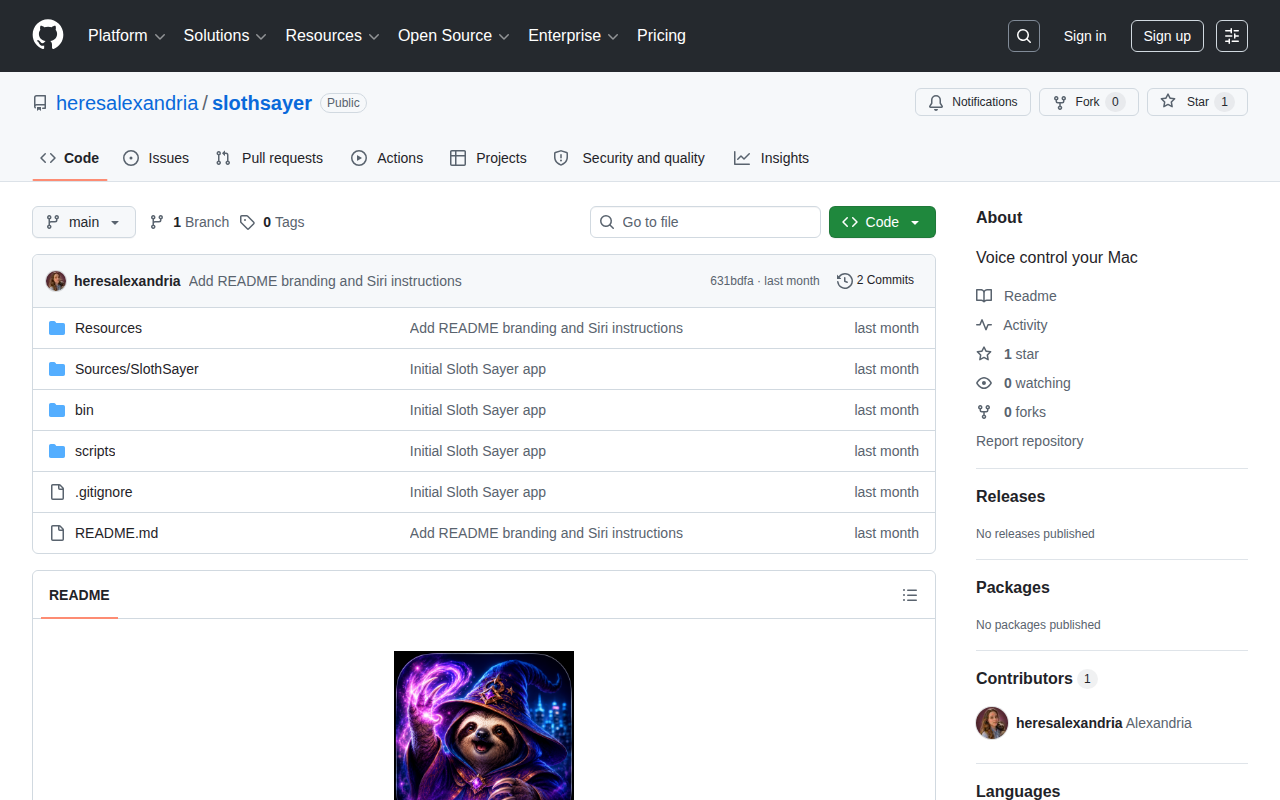
GitHub - heresalexandria/slothsayer: Voice control your Mac · GitHub
github.com/heresalexandria/slothsayer →WHAT IT SOLVES
TECH GUESS
DEEP DIVE
\n## A Skeletal \"Sayer\": What is Sloth Sayer?\nIn an era saturated with mature voice assistants, a macOS voice control tool named “Sloth Sayer” has appeared on GitHub and the “Show HN” board. Its core proposition is simple: voice control your Mac. However, a glance at its GitHub repository (heresalexandria/slothsayer) reveals a project in its bare infancy: merely 2 commits and an just-initialized structure. This is a super early-stage prototype, more of a proof-of-concept shell than a usable tool. Public demonstration and discussion are virtually non-existent. Posted as “Show HN,” it garnered only 2 points and 0 comments—a near-total silence from the community.\n\n## The Problem: Echoes of Dissatisfaction with Existing Solutions\nThe author (anais9) leaves no detailed technical docs or motivation, but the name “Sayer” and the blunt “Voice control your Mac” statement hint at an intent: to offer a lightweight alternative to built-in solutions (like Apple’s Voice Control) or heavy third-party tools (like Dragon), perhaps differentiated by privacy, customizability, or sheer simplicity. It enters a space dominated by Apple’s official tools; its potential value could lie in absolute transparency, customizability, or serving as a sandbox for developers to learn voice interaction. Yet, all this remains hypothetical, as no feature list or screenshots prove what it can actually do.\n\n## The Silver Linings: Open Source Spirit and a Minimalist Canvas\nWith information scarcity, Sloth Sayer’s main brightness shines through its open-source nature and the experimental spirit of an indie developer. It publicly places the concept of “voice computer control” on GitHub from its very embryonic stage. For other developers exploring this field, the repository offers a minimalist starting point. The project structure includes initial App, bin, Sources/SlothSayer, and scripts folders, suggesting it might be a native client application rather than a web-based wrapper. The author’s act of creating and “Show”-ing it is quintessential indie dev: rapidly validating an idea. The lack of feedback this time doesn’t negate the project’s silent presence, awaiting potential contributors or users.\n\n## Technical Guesses and Real Limitations\nBased on the extremely limited file names (Sources, scripts) and the “voice control” goal, educated guesses are possible. It likely relies on system-level speech recognition APIs (possibly Apple’s Speech framework or a third-party like OpenAI’s Whisper) to capture commands, then executes corresponding system actions (mouse, keyboard, app launching) via scripts or app logic. A commit message “Add README branding and Siri instructions” is intriguing, possibly addressing how to invoke Sloth Sayer via Siri Shortcuts, indicating some thought on system integration.\nThe limitations, however, are profound and fundamental:\n1. Near Zero Usable Functionality: No docs specify supported commands or accuracy rates.\n2. No Security/Privacy Considerations: Voice control requires deep system permissions, yet the project mentions no permission handling or security design.\n3. Lack of Build/Test Instructions: An average user cannot even build and run it.\n4. Community Isolation: The zero comments on HN suggest it currently lacks the information or appeal to spark discussion.\n\n## A Seed Waiting to Be Awakened\nSloth Sayer is not a product; it is a germinating seed. It might be suitable for:\n- Developers curious about “how to build a voice control app from scratch” who can use its architecture as a study or critical learning point.\n- Extremely experimentation-loving “hackers” with the skills to complete all code and documentation themselves, perhaps molding it into their desired end-state.\n- Observers intrigued by voice control who want to see the starting point of a minimalist approach.\nFor the vast majority of users or developers seeking a ready-to-use voice control experience, it currently holds zero practical value. Its significance lies in the open-source world having one more sketch about human-computer interaction. Whether this sketch evolves into a masterpiece or remains forever in the corner of the drafting paper depends entirely on whether author anais9 continues, and whether the community truly needs such an undefined “alternative.”" }
Discussion (0)
- No comments yet — be the first.
Related
 #229▶ 136
Upload your textbook. AI teaches it back to you, chapter by chapter
 #228▶ 112
Someone needs to watch the AI spend meter
 #227▶ 184
Your users are kittens. Don't let them fall off the cliff