Intelligence Emotions
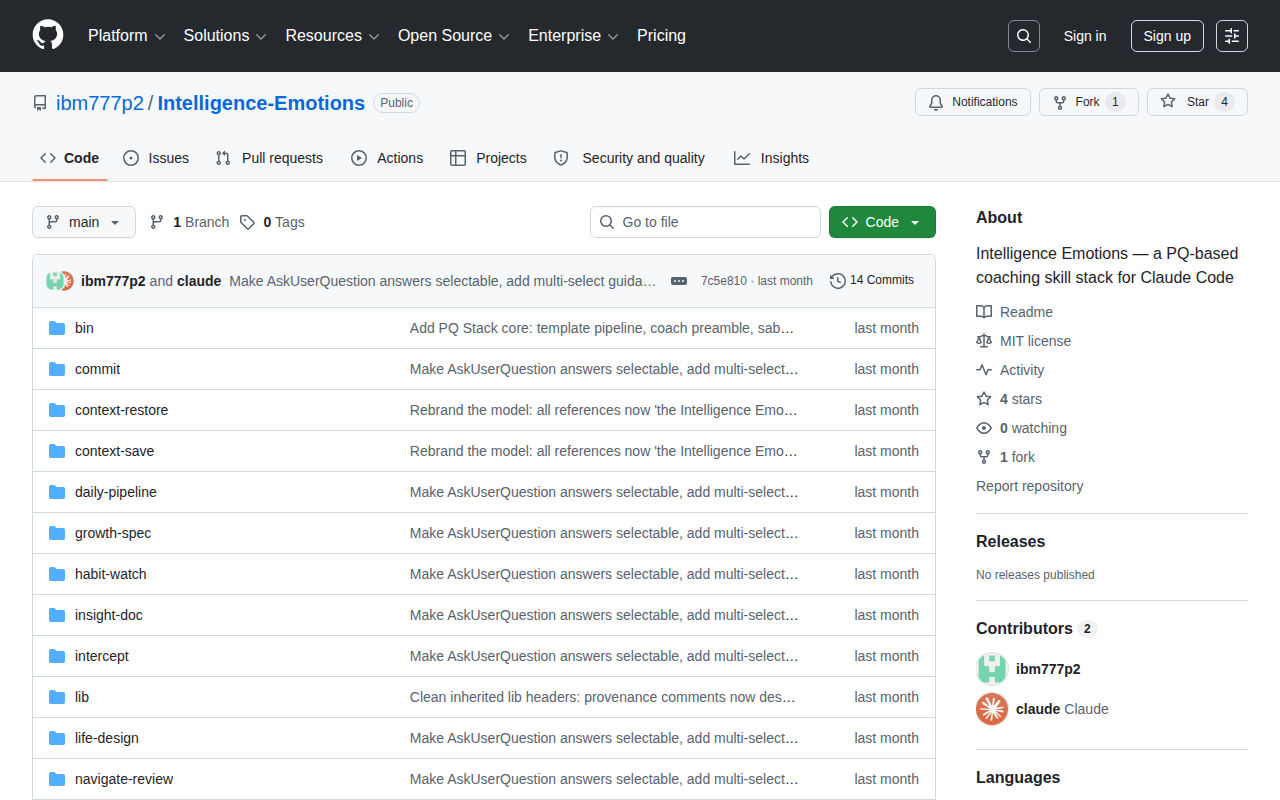
github.com/ibm777p2/Intelligence-Emotions →An AI coaching team inside Claude Code — forbidden from judging you
WHAT IT SOLVES
Most AI tools are cold and mechanical — none of them actually care about your emotional state when you're making decisions
WHY IT'S INTERESTING
Not a chatbot — an emotionally-aware role system
It imports the concept of PQ (Positive Intelligence quotient) into Claude Code. You're not chatting with one AI — you get a full coaching team: a Saboteur mode that identifies your inner resistance, a Sage mode that guides positive thinking. The killer constraint: judgment is forbidden. In a world where AI constantly scores, suggests, and optimizes you, that single rule is a product taste signal
Claude Code skill stack with context restoration
This isn't a prompt you paste into ChatGPT and call it a day. The author built it as a proper Claude Code skill stack — template pipeline, coach preamble controlling role behavior, and a context-restore module for cross-session continuity. 14 commits and counting, including UI-level details like selectable question answers and multi-select guidance
TECH GUESS
Claude Code skill stack (Markdown templates + instruction pipeline), no standalone backend
DEEP DIVE
\n## Stuffing a Psych Coach into a Code Editor: An Experiment in Whether AI Should Judge You\n\nClaude Code is for programmers. PQ (Positive Intelligence Quotient) is for people seeking psychological resilience. Stitching these two together is a counterintuitive move. Intelligence Emotions, by ibm777p2, is a PQ-based coaching skill stack built entirely inside Claude Code. Not a chatbot. Not a standalone app. It's a set of Markdown templates and instruction pipelines that make Claude take on coaching roles while you code.\n\nThe project was posted on HN as \"Show HN: An AI coaching team in Claude Code that's forbidden from judging you\" and received 1 point, 0 comments. Stone cold. But the silence itself reveals something: HN's audience — technical geeks — are unlikely to suddenly want to discuss their \"Saboteur mode\" mid-debugging session. That doesn't mean the project lacks value; it means the target user profile and the HN crowd are severely misaligned.\n\n## Saboteur vs. Sage: Why a Role System Beats a Chatbot\n\nThe core design revolves around two opposing roles: Saboteur, which helps you identify internal resistance — the voices that make you procrastinate, self-doubt, and dodge decisions — and Sage, which guides you to reframe problems through a positive lens. These aren't random names; they come directly from Shirzad Chamine's PQ framework, a psychological model with real-world adoption in executive coaching.\n\nThe harder constraint is the \"forbidden from judging you\" rule. In an era where AI assistants default to giving advice, scoring your work, and pointing out \"better approaches,\" this rule is a deliberate product choice. It acknowledges something most AI tools ignore: sometimes you don't need a solution — you need a non-judgmental space to sort through your emotional state. For developers, the psychological pressure of coding — impostor syndrome, deadline anxiety, tech stack indecision — is real, yet almost no tooling addresses this at the infrastructure level.\n\n## Claude Code Skill Stack: Not Just a Prompt\n\nThis isn't a prompt you paste into ChatGPT and call it done. The author broke it into Claude Code's skill template pipeline, with a coach preamble controlling role behavior and a context-restore module ensuring continuity across sessions. The 14 commits show ongoing iteration — including refinements like making question options selectable and adding multi-select guidance.\n\nTechnically, it's a pure Markdown + instruction pipeline with no backend, no API calls, fully dependent on Claude Code's capabilities. This means near-zero barriers to entry (just needs Claude Code), but also that its ceiling is bounded by Claude Code's own limits. It's not a product; it's closer to a \"usage pattern\" — a methodology for transforming a general-purpose AI coding assistant into an emotionally aware tool.\n\n## Who Should Use It — and Who Shouldn't\n\nFor: developers already using Claude Code who have awareness of or interest in PQ/mindfulness/coaching frameworks and want emotional awareness embedded in their workflow rather than in a separate app. Not for: those expecting a ready-to-use standalone emotional management tool, or technical purists who find the idea of \"embedding psych models into an IDE\" inherently absurd.\n\nLet's be honest about the limitations: the project heavily depends on users' prior knowledge of the PQ framework — there's no built-in teaching explaining what Saboteur/Sage actually mean. It's locked to Claude Code, giving it an extremely narrow audience. HN's cold reception also hints at room for improvement in packaging and distribution — a clearer README, a demo video, or a compelling \"why programmers need emotional coaching in their IDE\" narrative could fundamentally change how it gets discovered." }
Discussion (0)
- No comments yet — be the first.
Related
 #229▶ 136
Upload your textbook. AI teaches it back to you, chapter by chapter
 #228▶ 112
Someone needs to watch the AI spend meter
 #227▶ 184
Your users are kittens. Don't let them fall off the cliff