LastSaaS
github.com/jonradoff/lastsaas →A Go+React SaaS boilerplate, built with Claude Code
WHAT IT SOLVES
SaaS boilerplates are everywhere — but they're all Node/Next.js. Want a Go backend? Build it yourself
WHY IT'S INTERESTING
Go backend — not another Next.js clone
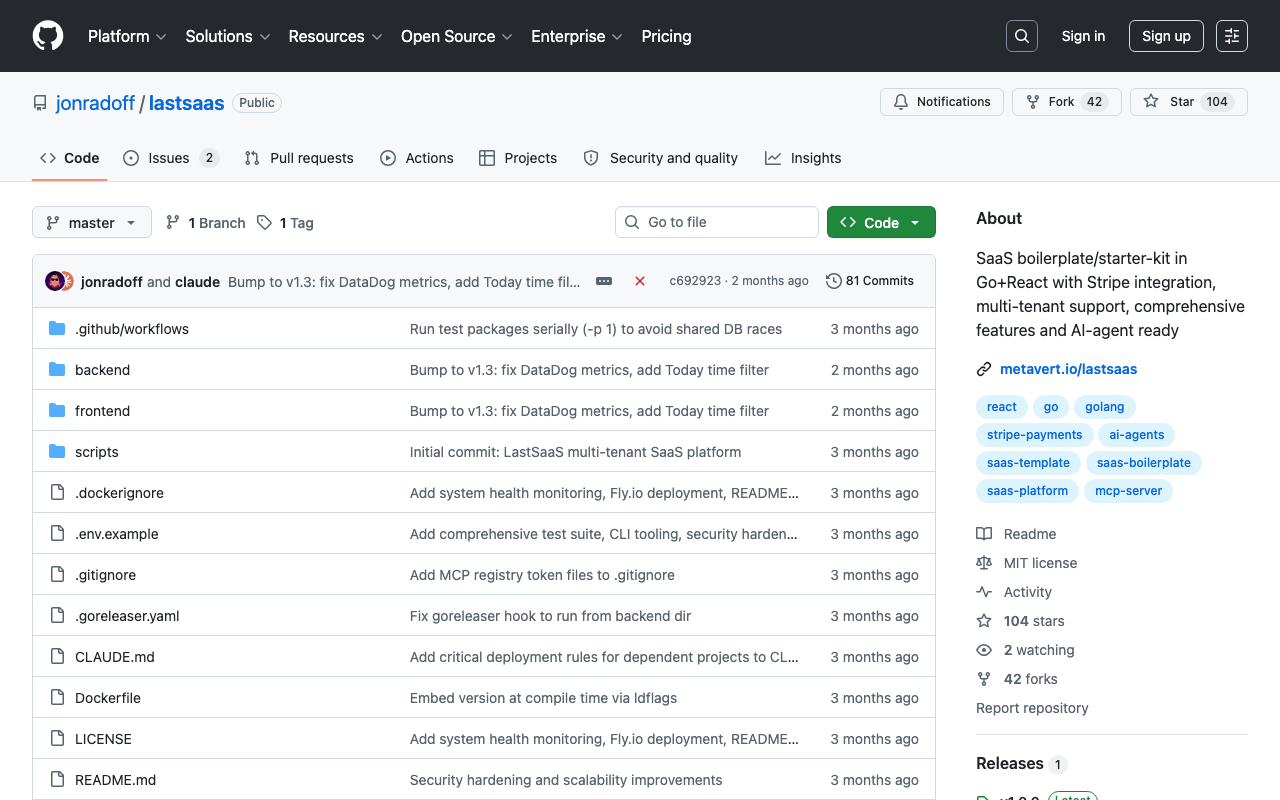
In a sea of TypeScript SaaS starters, the author picked Go for the backend. Multi-tenancy, Stripe payments, DataDog metrics — this isn't a demo-level 'auth + landing page.' The CI even runs tests serially to avoid shared DB races. Someone's been burned before
The git log says 'jonradoff and claude'
The latest commit is authored by 'jonradoff and claude' — this project was literally built line-by-line with Claude Code, not just name-dropped. 81 commits deep, already at v1.3 fixing DataDog metric bugs. Using AI to build an AI-agent-ready SaaS template — the recursion is the story
「Free, open-source SaaS boilerplate; Go+React, built with Claude Code」
TECH GUESS
Go backend + React frontend, Stripe for payments, DataDog for monitoring, most likely PostgreSQL
DEEP DIVE
A Go SaaS Boilerplate in a Sea of Next.js Clones
The SaaS boilerplate market has become a blur of near-identical Next.js starters: Auth.js, Stripe, a landing page, maybe a dashboard shell — then a $169–$599 price tag. LastSaaS breaks that pattern by choosing Go for the backend, and it's free.
Author Jon Radoff explained his motivation on HN: "Every SaaS I've worked on started with the same 3-6 months of commodity infrastructure: auth, billing, teams, permissions, admin tools. Paid boilerplates help a little, but most stop at auth + Stripe and charge $169-599 for incomplete foundations." He's not wrong — most paid starters ship auth and billing as a demo, leaving multi-tenancy, permissions, and admin tooling as exercises for the buyer.
Not a Demo — Production-Scarred Code
The details in this repo suggest someone who's actually deployed SaaS products. The CI configuration runs test packages serially with -p 1, explicitly to "avoid shared DB races." That's not architectural hand-waving — it's a developer who hit database concurrency issues in integration tests and fixed them properly. The v1.3 release fixed a DataDog metrics bug, meaning the monitoring integration isn't just a checkbox; it was running in a real environment.
Feature-wise, LastSaaS covers multi-tenancy, Stripe integration, a permissions system, admin tools, and DataDog monitoring. The author tags it as "AI-agent ready," hinting at future LLM integration points. Tech stack is Go 1.25 backend, React 19 with TypeScript on the frontend — almost certainly PostgreSQL underneath, the standard pairing for Go SaaS projects.
The Meta Detail: "jonradoff and claude"
Here's the Easter egg: the latest commit's author field reads "jonradoff and claude." This isn't a joke in a PR description — Claude Code genuinely co-wrote the codebase. Across 81 commits, from project scaffolding to bug fixes, Claude was an active participant.
An AI coding tool building an "AI-agent ready" SaaS boilerplate is a delightfully recursive loop. What I appreciate about Jon's approach is that he doesn't spin this into a "10x developer" marketing narrative. He simply credits Claude in the git history. For developers curious about how Claude Code performs on real projects, these 81 commits are a transparent, inspectable case study.
Who Should (and Shouldn't) Use This
If you're a developer who specifically wants Go for your SaaS backend, LastSaaS is a rare find. Go's SaaS starter ecosystem is thin — most Go developers are still hand-rolling auth middleware and Stripe webhook handlers from scratch. This gives you multi-tenant architecture, billing, permissions, and monitoring out of the gate.
But know the trade-offs. The Go frontend story is less mature than Next.js; frontend customization may feel more constrained. The community is early: 104 stars, 42 forks, 1 HN comment as of now — don't expect the ecosystem of plugins and tutorials that Next.js starters enjoy. And Go's compilation and deployment model carries a learning curve for indie devs coming from interpreted languages.
The Bottom Line
LastSaaS isn't another reskinned Next.js boilerplate. It's a genuinely Go-native SaaS starter with production battle scars, honestly credited as AI-assisted development. In a market where incomplete starters sell for $599, a free and more complete Go alternative is worth a serious look from developers with Go in their stack — just don't expect Next.js-level community ergonomics.
Discussion (0)
- No comments yet — be the first.
Related
 #229▶ 136
Upload your textbook. AI teaches it back to you, chapter by chapter
 #228▶ 112
Someone needs to watch the AI spend meter
 #227▶ 184
Your users are kittens. Don't let them fall off the cliff