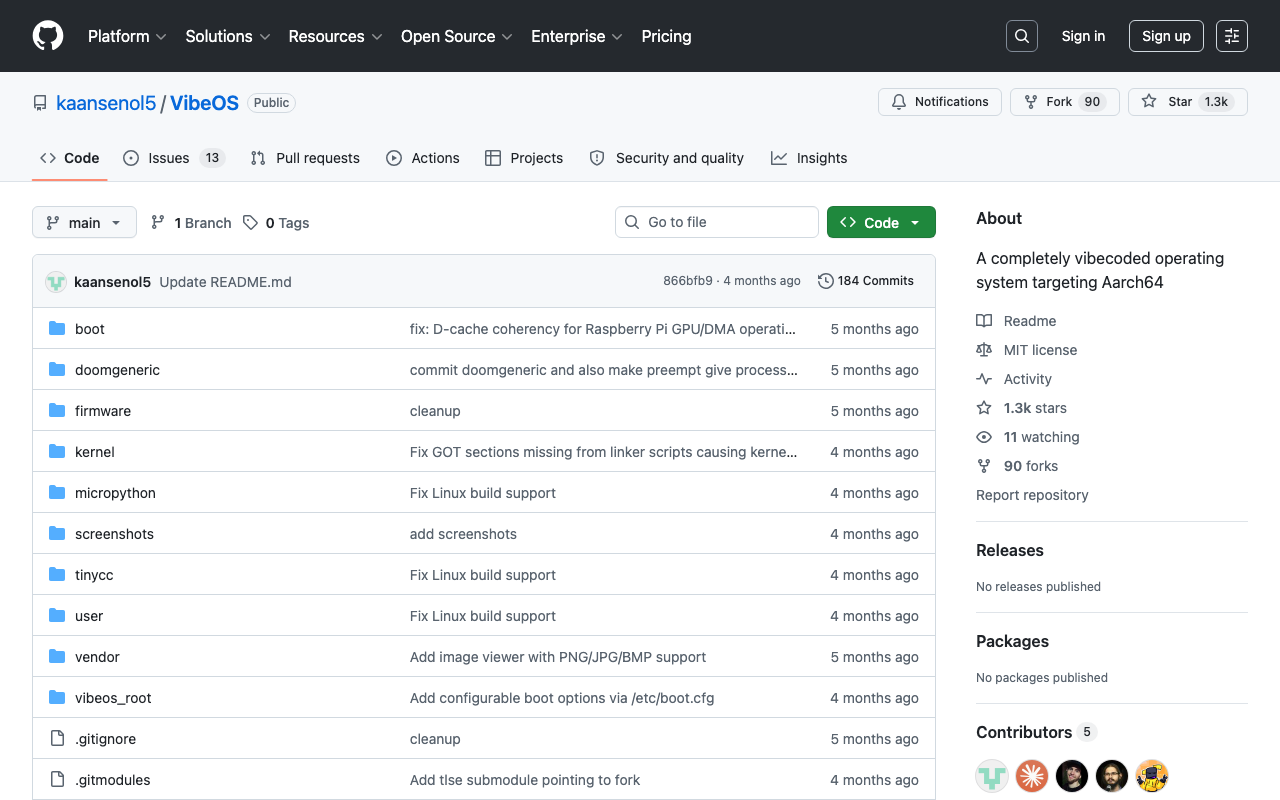
VibeOS
github.com/kaansenol5/VibeOS →An entire OS, written by AI — and it runs DOOM
WHAT IT SOLVES
AI can scaffold a todo app in seconds. But can it write a bare-metal OS that actually boots on real hardware?
WHY IT'S INTERESTING
The git log tells the real story — this isn't a toy
184 commits of actual kernel engineering: fixing D-cache coherency for GPU/DMA operations, debugging GOT sections in linker scripts to prevent kernel hangs, preemptive scheduling with 200ms time slices. Not the kind of stuff a lazy AI demo stumbles into
DOOM + MicroPython: the ultimate 'prove it works' flex
Didn't settle for hello world. Ported doomgeneric (DOOM literally runs on this thing) and embedded MicroPython. Running DOOM is the operating system rite of passage — pulling it off on a vibecoded kernel is genuinely absurd
「"I vibecoded an ARM64 operating system that boots on real hardware"」
TECH GUESS
Likely Rust or C on bare-metal Aarch64 (probably Raspberry Pi 3/4), with AI assistance (Cursor/Claude) driving the entire development process
DEEP DIVE
VibeOS: When AI Writes an OS, But Doesn't Understand Hardware
It's no longer shocking when AI helps generate a simple to-do app. But when a developer claims, "I vibecoded an ARM64 operating system that boots on real hardware," the conversation shifts from casual curiosity to technical skepticism. VibeOS, which appeared on Hacker News with 24 points and 1 comment (a notably quiet reception for a "Show HN" post), pushes AI-assisted development into the deep end of system programming. The project demonstrates that AI can indeed contribute to low-level code, but the resulting system's stability and functionality are still fundamentally constrained by human expertise in hardware engineering.
The Git Log Doesn't Lie: 184 Commits of Hardcore Kernel Work
Browsing VibeOS's commit history reveals this isn't an AI-generated toy. Across 184 commits, developer kaansenol5 tackled problems that are squarely in the domain of systems engineering: fixing D-cache coherency for Raspberry Pi GPU/DMA operations, correcting linker script GOT sections to prevent kernel hangs, and implementing a preemptive scheduler with 200ms time slices. These commit messages—like "boot fix: D-cache coherency for Raspberry Pi GPU/DMA operations"—show a developer with direct understanding of ARM64 architecture and hardware interaction. Here, AI acts as a supercharged assistant, capable of generating boilerplate or suggesting code snippets, but the critical tasks of debugging hardware-specific issues, making architectural decisions, and diagnosing subtle flaws remain firmly in human hands.
The Rite of Passage: Running DOOM and Embedding MicroPython
In OS development, porting DOOM is the ultimate rite of passage. VibeOS doesn't just run a "hello world"; it successfully ports doomgeneric, a minimalist DOOM engine. It also embeds a MicroPython interpreter, adding a high-level programming layer. This "hacker" approach to validation is far more convincing than any checklist demo. It proves that even with an AI-assisted core, building a functional software ecosystem—handling graphics rendering, input devices, memory management for the game, and integrating a scripting language—requires substantial manual effort and specialized knowledge. The AI didn't "vibe code" DOOM into existence; a human developer had to do the heavy lifting of integration and debugging.
The Real Limits: AI as a Tool, Not a Replacement
VibeOS's story shouldn't be romanticized into an "AI writes OS" headline. The project's limitations are instructive. First, OS development demands deep domain knowledge; the developer must understand memory management, process scheduling, and hardware abstraction layers to effectively guide the AI. Second, the muted community response on HN (24 points, 1 comment) may signal that seasoned developers are looking for technical depth beyond the novelty factor. Third, the 13 open issues on GitHub indicate ongoing engineering challenges. AI accelerates coding, but it cannot replace systematic design thinking, hardware adaptation, or long-term maintenance. For independent developers, VibeOS is best viewed as a prototype showcasing AI's potential in complex domains, not as a production-ready operating system.
Who Should Pay Attention?
Primarily two audiences: developers curious about the intersection of systems programming and AI-assisted development, who want to see how far AI can go in "hardcore" domains; and educators or learners who can study the codebase as a case study in ARM64 boot processes and kernel basics. But a caveat is essential: this is not a ready-to-use operating system. Its value lies in the process, not the product—in the inspiration it provides, not its immediate utility. If you expect AI to help you build a Linux competitor from scratch, VibeOS offers a sobering lesson: no matter how powerful the tool, there's no shortcut past the deep river of knowledge that humans must wade through.
Discussion (0)
- No comments yet — be the first.
Related
 #229▶ 136
Upload your textbook. AI teaches it back to you, chapter by chapter
 #228▶ 112
Someone needs to watch the AI spend meter
 #227▶ 184
Your users are kittens. Don't let them fall off the cliff