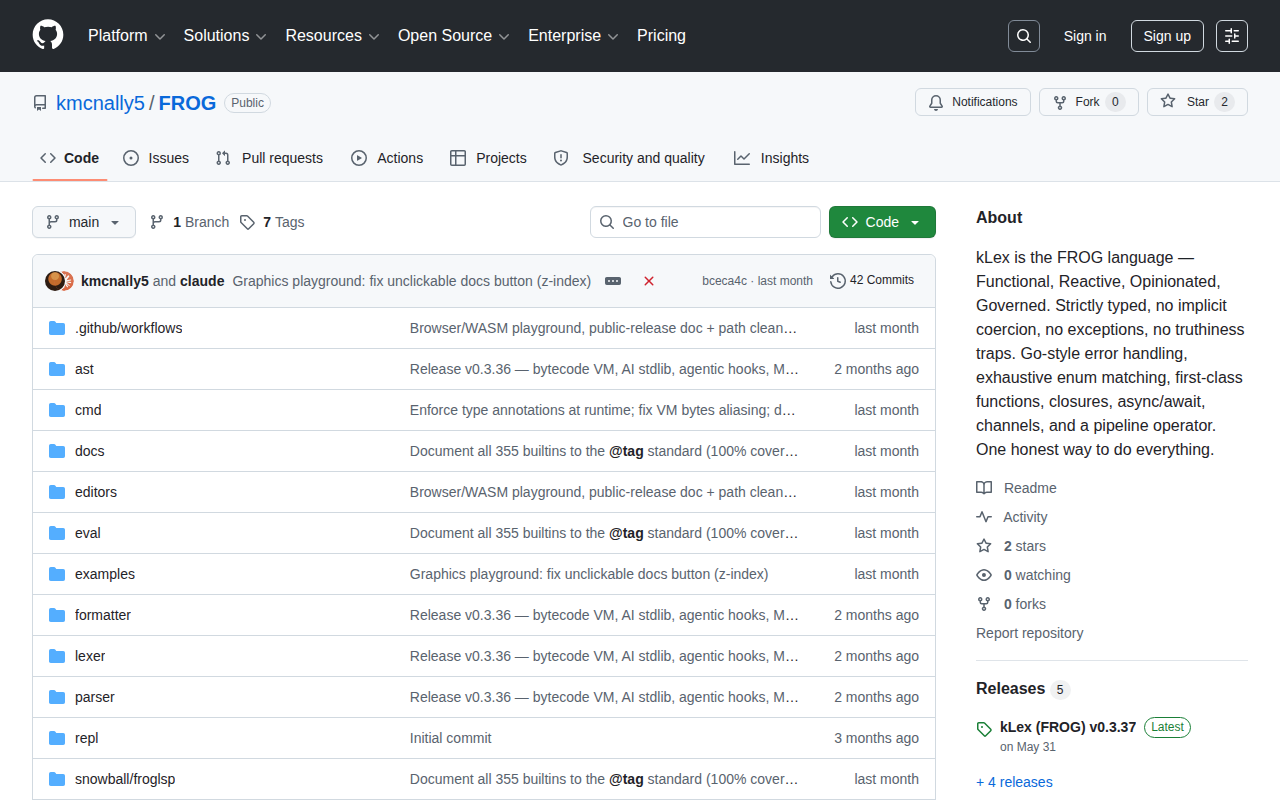
FROG
github.com/kmcnally5/FROG →Claude wrote me a language, now I don't know what to do with it
WHAT IT SOLVES
Language design too permissive? Error handling a guessing game?
WHY IT'S INTERESTING
One honest way to do everything
Strictly typed, no implicit coercion, no truthiness traps, no exceptions—forcing explicit, no-bs handling of everything
Go-style error handling + exhaustive matching
Errors returned instead of thrown, exhaustive pattern matching, first-class functions and async/await rolled into one pragmatic runtime
「Claude wrote me a language, now I don't know what to do with it」
TECH GUESS
Likely a custom compiler in Rust or TypeScript with heavy focus on type inference and semantic analysis
DEEP DIVE
\n## The Creator’s Dilemma and the AI-Generated Artifact\n“Claude wrote me a language, now I don’t know what to do with it.” The Show HN title itself captures a uniquely modern mix of bewilderment and dark humor familiar to indie developers in the AI era. FROG (Functional, Reactive, Opinionated, Governed) is a new programming language whose key collaborator was Anthropic’s Claude. The developer, kmcnally5, states a pragmatic motivation: the ever-increasing costs associated with assistive development technologies were making it prohibitive to write simple, one-off tools that “may or may not see the light of day.” FROG was their attempt to solve this. The goal was specific: create small applications, usually just a few large files, that would be “easier on the LLM” and “token sparing” by enforcing “one way to do something, not ten!” This is a language design hyper-optimized for the AI collaboration era, potentially serving indie developers who feel the cost pressure of iterative code-AI dialogue.\n\n## “One Honest Way to Do Everything”: The Design Philosophy\nFROG’s design is brimming with counter-intuitive constraints. Its mantra is “one honest way to do everything.” This manifests as: strictly typed with no implicit coercion; no exceptions, adopting Go-style error returns that favor explicit handling; no truthiness traps, eliminating ambiguous checks like JavaScript’s if(\"\"). In their place, it mandates exhaustive enum matching, forcing developers to account for every possible case. It also includes first-class functions, closures, async/await, channels, and a pipeline operator. The core philosophy is that a language should avoid offering multiple potentially eversome shortcuts, instead compelling developers to flow explicit processes for every potential issue. This is a conscious sacrifice of “convenience” for the sake of code behavior “predictability.”\n\n## Community Reaction and the Creator’s Own Predicament\nThe project’s reception on Hacker News was notably tepid, earning only 4 points and 1 comment. That comment raised a sharp and relevant question: “So how readable is that Claude-written code?” This directly hits a pain point of AI-generated code— even if the design goal is clarity, the generated code’s own style, structure, and readability can be an unknown realm. More telling is the author’s own confusion, embedded in the title: “…now I don’t know what to do with it.” This reflects a common predicament for many creative projects built with AI assistance: an interesting prototype exists, but what is its market? How to build an ecosystem? What’s the next step? FROG currently is essentially a language specification and likely a prototype implementation (as suggested by Rust and TypeScript tags in the GitHub repo). It lacks community, tooling, and a killer app, evidenced by its lone GitHub stars (just 2).\n\n## An Indie Developer’s AI Experiment: Value vs. Limitations\nFor developers and product builders, FROG’s value isn’t in whether it will become the next Go or Rust. Rather, it’s as an extreme and self-aware experiment. It demonstrates the uniquely divergent path individual developers can take when they position AI as their “core architect.” The problem it solves is specific: reducing the “development friction” and token costs of generating optimized, small-scale, disposable tools with AI. But its limitations are equally stark: an “Opinionated” language requires a strong community to validate those opinions, and FROG has none. Its ideal users might be developers who resonate with its philosophy and primarily build personal, internal tools, not minding learning a new syntax for a potentially more efficient AI collaboration experience.\n\n## Conclusion: A Solitary Signpost Pointing in a Direction\nFROG is like a stone cast into the water, creating a small ripple before settling into stillness. It honestly exposes the cost anxiety in AI-assisted development and offers a creative technical rebuttal. Yet, it also acts as a mirror, reflecting the vast chasm between “using AI to build a cool thing” and “making that cool thing actually useful.” In the AI tide, indie developers’ various experiments will keep emerging. FROG is one such trial, full of thoughtful provocation yet somewhat lonely. Its significance might lie in the question it poses: If we optimize programming languages for AI rather than purely human thought, what do we get? And the answer, clearly, will not be found solely in a language’s syntax." }
Discussion (0)
- No comments yet — be the first.
Related
 #229▶ 136
Upload your textbook. AI teaches it back to you, chapter by chapter
 #228▶ 112
Someone needs to watch the AI spend meter
 #227▶ 184
Your users are kittens. Don't let them fall off the cliff