OpenContext
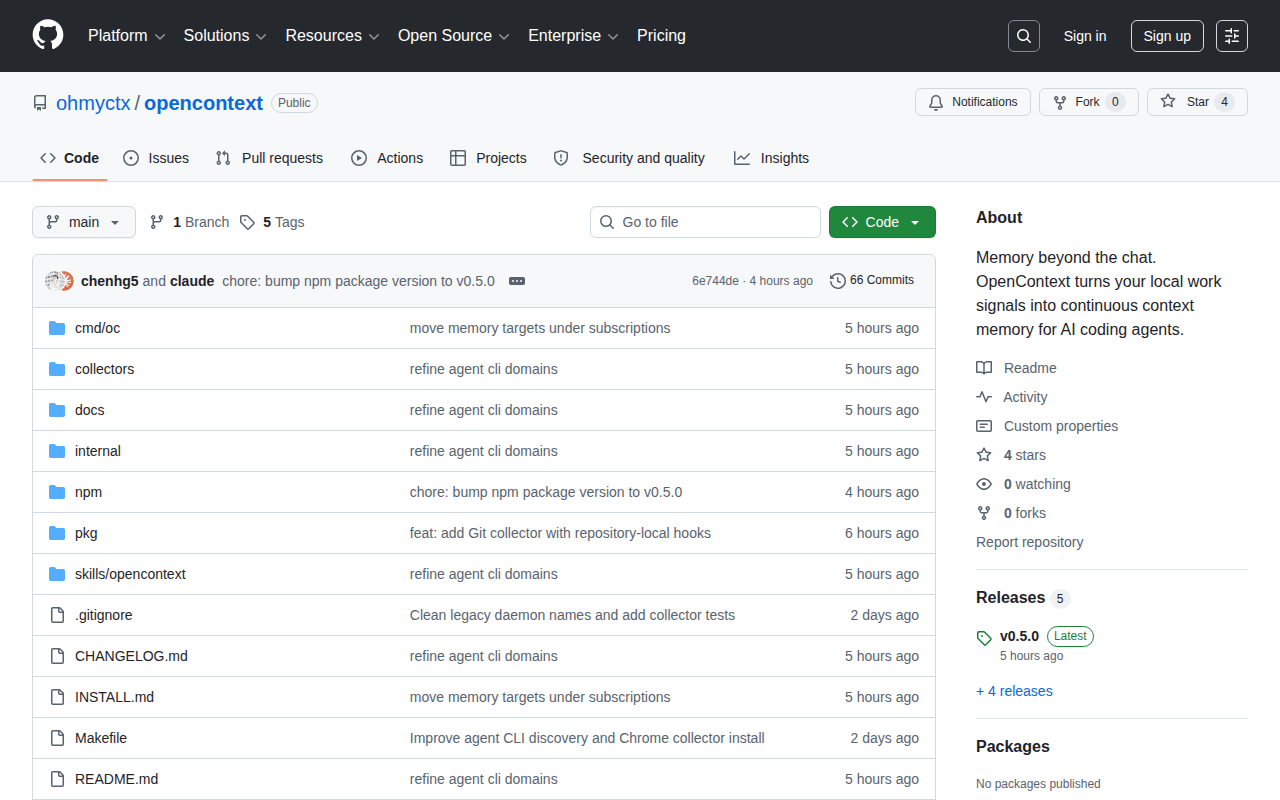
github.com/ohmyctx/opencontext →Your AI coding agent finally has persistent memory
WHAT IT SOLVES
Every new chat session, your AI forgets everything. The code you wrote last week, the bug you hit yesterday, the refactor you're mid-way through—gone. Switch agents? Even worse—it's like talking to a different person who's never seen your work
WHY IT'S INTERESTING
No chat history dependency—it reads your actual work signals
Most AI memory tools dump chat history back into context. OpenContext takes a different path: it watches your local work signals—file changes, command executions, git operations—and converts them into structured continuous context. The memory follows YOU, not a specific chat thread
A unified memory layer that works across agents
The author's v2ex post title asks exactly this: 'How do you make all your agents know what you know, what you've done, what you're doing?' This isn't single-agent memory enhancement—it's building a shared memory substrate across multiple AI coding tools. What Claude Code knows, Cursor can pick up too. Already at v0.5.0 with 66 commits, still actively developed
「How do you get all your agents to understand what you know, what you've done, and what you're doing? I built this tool」
TECH GUESS
Go CLI + npm package, runs locally to collect work signals, stores structured context for AI agents to consume
DEEP DIVE
The Real Problem: Your AI Agent Has the Memory of a Goldfish
If you've used Cursor, Claude Code, or Copilot, you know the drill: every new conversation, the AI starts from zero. Last week's refactoring decisions, yesterday's debugging breakthrough, the branch you're working on — all gone. Switch between tools and it gets worse. You spent an hour discussing architecture with Claude Code, then open Cursor and it has no idea what you're talking about. This isn't a bug in any single tool; it's a structural flaw in how AI coding assistants handle context. A developer who goes by plane posted on V2EX asking exactly this: "How do you make all your agents know what you know, what you've done, and what you're doing?" Then built a tool to answer it.
Skip the Chat Logs, Capture Real Work Signals
Most AI memory solutions today work by storing chat history and feeding it back. OpenContext takes a fundamentally different approach: it captures first-party signals directly from your local work environment. File changes, command executions, git operations — these are objective records of what you actually did, which is more reliable than what you told the AI you did. These signals get structured into continuous context memory that follows you as a developer, not a specific conversation. Swap tools, start a new session — the context carries over. This is memory designed for portability, not for replay.
Cross-Agent Unified Memory Layer: The Actual Differentiator
Adding memory to a single AI assistant isn't novel — plenty of products do that. OpenContext targets something more fundamental: the memory silos between multiple AI coding tools. It's building a shared memory substrate. What Claude Code learns, Cursor can pick up. The project context you accumulate in VS Code doesn't evaporate when you switch editors. For developers juggling two or three AI coding tools simultaneously, this addresses a genuine friction point. The project sits at v0.5.0 with 66 commits by developer chenhg5, still under active development. Technically it's a Go CLI tool paired with an npm package, running locally to collect work signals, structure them, and distribute context to various agents.
Who Should Try It — And What's Not Solved Yet
The ideal user: a developer running multiple AI coding assistants who's tired of re-explaining project context every time. With 4 stars and 0 forks, this is unmistakably early-stage — community adoption hasn't started yet. Honest caveats worth flagging: where's the privacy line for local signal collection? Not every file change deserves to be remembered — how does it filter signal from noise? And at the protocol level, will AI tool vendors have any incentive to plug into a third-party memory layer they don't control? Until these questions find answers, OpenContext may remain more an interesting experiment than a daily driver. But the thesis is sharp: persistent memory for AI assistants shouldn't be a proprietary feature of any single product. It should be infrastructure the developer owns.
Discussion (0)
- No comments yet — be the first.
Related
 #229▶ 136
Upload your textbook. AI teaches it back to you, chapter by chapter
 #228▶ 112
Someone needs to watch the AI spend meter
 #227▶ 184
Your users are kittens. Don't let them fall off the cliff