N.E.K.O.
github.com/Project-N-E-K-O/N.E.K.O →A desktop AI catgirl that reaches out to you first
WHAT IT SOLVES
Most AI assistants sit there dead until you poke them. You're basically talking to a box
WHY IT'S INTERESTING
An embodied emotional engine, not a passive chatbot
N.E.K.O. tracks your media and interaction patterns to initiate contact. The insight is right: the killer feature of an AI companion isn't smarter models, it's the feeling that something is actually *present*
2759 commits and 'Very Positive' on Steam
This isn't a weekend project. Memory system has scoped_forget, participant-isolated recall, and it shipped through Steam's full pipeline. For a solo or small-team effort, the engineering volume is substantial
「Looking for stars and contributors~」
TECH GUESS
Desktop frontend shell + LLM API for memory and conversation, distributed via Steam
DEEP DIVE
The Real Problem: AI Assistants That Just Sit There
Most AI assistants are dead weight. You ask a question, it answers. You don't ask, it doesn't move. It's like talking to a wall with a search engine behind it. N.E.K.O. tackles this head-on: it's a desktop AI catgirl that monitors your media playback state and interaction frequency, then decides on its own whether to initiate conversation.
This direction is fundamentally correct. The competitive moat of AI companion products was never about how smart the underlying model is—it's about presence. Replit's AI feels alive because it codes alongside you. Replika hit millions of daily active users because when you open the app, it greets you first. N.E.K.O. ports that same logic to the desktop layer, with an added "behavioral trigger" system: are you listening to music? Watching a video? The catgirl uses these signals to decide whether to reach out. That's a meaningful leap over the "you ask, I answer" ChatGPT paradigm toward something that actually feels like companionship.
2,759 Commits: This Isn't a Weekend Project
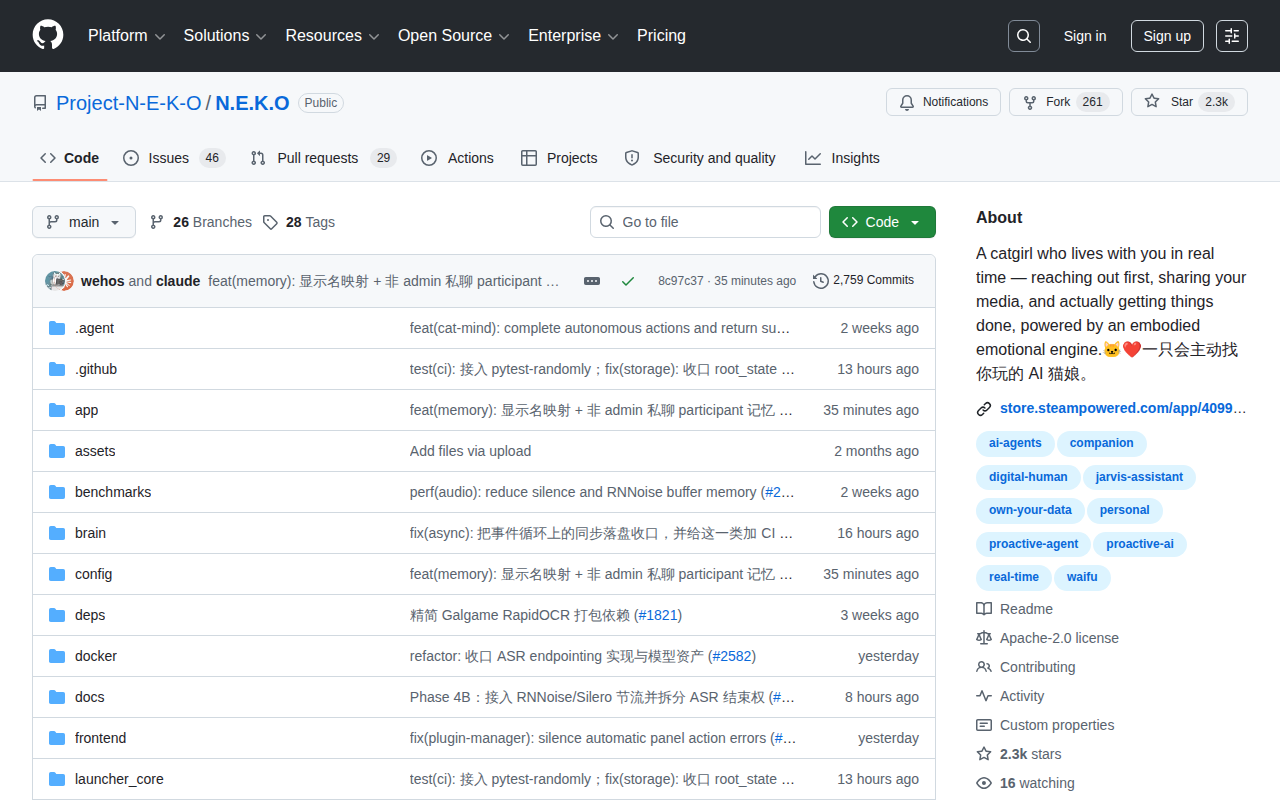
The GitHub stats tell a story: 2.3k stars, 261 forks, 2,759 commits, 46 open issues, 29 pull requests, 28 tags, 26 branches. The most recent commit adds "display name mapping + non-admin private chat participant memory + scoped_forget revoke endpoint."
Just from those terms, you can gauge the memory system's complexity. Scoped_forget means users can selectively erase specific conversations rather than doing a nuclear "clear all" on the AI's memory. Participant memory isolation prevents the catgirl from leaking one user's chat content to another. These aren't trivial features—many commercial AI products don't ship this granularity. An indie dev getting to this level of engineering detail deserves respect.
Beyond GitHub, N.E.K.O. shipped on Steam with "Very Positive" reviews. Steam's publishing pipeline—store page approval, achievements, cloud saves—is a non-trivial gauntlet for solo developers. Clearing that hurdle alone signals a level of polish that most open-source side projects never reach.
The Likely Stack: Desktop Shell + LLM API + Steam Distribution
Based on the repo structure and commit history, N.E.K.O. is probably a desktop client (Electron or similar) that calls LLM APIs (likely OpenAI or a compatible endpoint) for dialogue and memory, while rendering the catgirl's visual presentation on the frontend. Steam as a distribution channel suggests some gamification layer—costume changes, interaction animations, that sort of thing.
The memory system is the technical centerpiece. The recent commits around participant-level memory isolation and scoped_forget indicate a structured memory database rather than naive context-window stuffing. This approach costs more engineering effort but delivers a concrete experience: the catgirl won't accidentally reveal Zhang San's secrets to Li Si, and it won't bring up that embarrassing thing you said three months ago.
The Honest Limitations: Persona Drift and Maintenance Debt
Let's be real about the problems. LLM-driven character roleplay suffers from "persona drift"—chat long enough and the catgirl might forget it's a catgirl and start discussing quantum physics with you. Memory systems mitigate this but can't eliminate it, because the root cause is in LLM generation logic itself.
Maintenance cost is the real killer. 2,759 commits means this project carries substantial code weight. When the underlying LLM API changes pricing, deprecates endpoints, or breaks compatibility, maintenance pressure spikes. An indie developer's time is finite, which is exactly why the dev's V2EX post ends with "looking for stars and contributors"—one person can't sustain a project of this scale indefinitely.
Also worth noting: the Steam "Very Positive" rating needs context. Without knowing the actual review count and approval percentage, we can't tell if this is 50 glowing reviews or 5,000. That distinction matters.
Who Should Try It (And Who Shouldn't)
If you want a desktop companion that's present but not intrusive—one that initiates without being asked—N.E.K.O. is worth trying. The proactive interaction design, memory isolation mechanics, and Steam distribution polish are genuinely rare in the open-source companion space.
But if you expect a stable replacement for a professional AI assistant, or if you demand long-term consistency from an LLM character, temper your expectations. This is a solo developer's project, and update cadence depends entirely on one person's bandwidth. If you want to contribute code, now is actually a good time: the dev is explicitly looking for help, and the project's engineering maturity is high enough that you can onboard without drowning in spaghetti.
Discussion (0)
- No comments yet — be the first.
Related
 #229▶ 136
Upload your textbook. AI teaches it back to you, chapter by chapter
 #228▶ 112
Someone needs to watch the AI spend meter
 #227▶ 184
Your users are kittens. Don't let them fall off the cliff