Claudemux
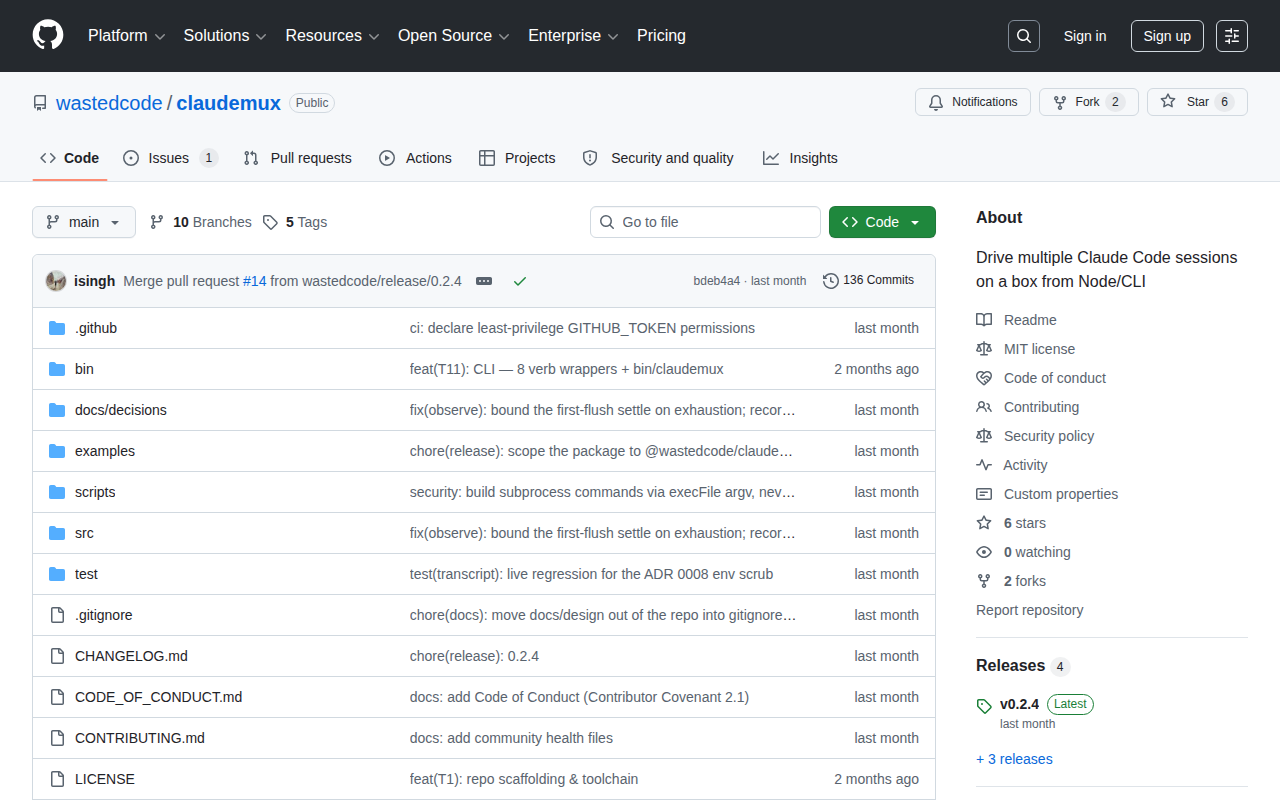
github.com/wastedcode/claudemux →Run 10 Claude Code sessions on one machine without chaos
WHAT IT SOLVES
Claude Code CLI is one session at a time. Want parallel tasks? Enjoy juggling terminals, tangled output, and processes stepping on each other
WHY IT'S INTERESTING
136 commits with architecture decision records
Not a weekend toy. The git log shows ADRs for everything from CLI verb wrappers to observe-boundary fixes. That level of documentation in a solo project? This person actually wants others to maintain it
Node library + CLI — pick your interface
Underneath the CLI is a Node library you can import directly. Want to orchestrate batch tasks or plug into CI? No need to wrap it in shell scripts — just require it
Process isolation and output stream management — the hard part
The hard part of running multiple Claude Codes isn't launching them — it's keeping their outputs and states from bleeding into each other. The settle-on-exhaustion boundary fix proves the author hit this wall in practice
TECH GUESS
Node.js with TypeScript, CLI wrapped via bin scripts
DEEP DIVE
The Parallel Problem Nobody Talks About
Claude Code is a solid tool, but it's fundamentally a one-to-one interactive CLI. You open a terminal, chat with one Claude Code process, finish the task, start another. Fine for daily work. But the moment you want one Claude refactoring your frontend, another fixing API tests, and a third running a data migration simultaneously — you're back to the stone age: three terminal windows, praying they don't step on each other.
Claudemux tackles exactly this. Creator zeppelin_7 described it plainly on HN: "Simple way to programmatically spawn, pause, resume, message, handle permissions, and questions for Claude Code." Notice the verbs: spawn, pause, resume, message. This isn't a glorified process launcher — it's trying to manage the entire lifecycle of Claude Code sessions.
136 Commits and a Notebook Full of ADRs
What caught my eye wasn't the feature set but the engineering discipline. 136 commits, 10 branches, 5 tags — for a solo developer's utility project, that's well beyond "weekend hack" territory.
The commit messages reveal real depth. A docs/decisions directory means the author writes Architecture Decision Records, which is vanishingly rare in independent open-source projects. One commit reads: fix(observe): bound the first-flush settle on exhaustion; record ADR. That single line exposes a genuine technical pitfall — when multiple Claude Code processes output simultaneously, how do you time the initial data flush? The phrase "settle on exhaustion" tells you the author hit an edge case where resources ran dry, then documented the decision. This isn't self-indulgence; it's writing for the next person who might maintain this.
The Hard Part Isn't Launching — It's Not Colliding
Running multiple processes in parallel? Spawning them is the easy bit. The real challenge comes after: each Claude Code session generates output streams, each may fire permission prompts, each might throw questions waiting for answers. Without proper isolation, the user stares at a wall of interleaved chaos.
The CLI design reveals the author's thinking. The commit feat(T11): CLI — 8 verb wrappers + bin/claudemux tells us there are at least 8 verbs corresponding to operations like spawn, pause, resume, message, and observe. This isn't a "run everything and hope" black box — it gives you fine-grained control. You can pause a misbehaving session, send a message to another, observe all their states. It's fundamentally a process orchestrator.
CLI Is the Skin, Node Library Is the Skeleton
Claudemux isn't just a command-line tool. The package is scoped to @wastedcode/claudemux, and the repo structure with its bin/ directory and modular code organization reveals that the core is a Node.js library — the CLI is just a wrapper on top.
This means you can import it and build more sophisticated orchestration in your own Node scripts. Picture this: write a script that distributes ten different tasks across ten Claude Code sessions, collects results, and produces a summary report. Or embed it in a CI pipeline for automated code review by Claude Code. These scenarios are impossible through the CLI alone but entirely feasible as a library.
Who Should Actually Look at This
Let's be honest: this project currently sits at 2 points and 1 comment on HN. Virtually no traction. But low visibility doesn't mean low value — it solves a pain point that will only grow as Claude Code adoption increases.
Who it's for: power users juggling multiple Claude Code tasks simultaneously, developers wanting automated orchestration, anyone tired of managing ten terminal windows. Who should skip it: if you only use Claude Code occasionally for single tasks, the added complexity isn't worth it.
The real limitation to acknowledge: Claude Code itself is iterating fast, and its behavior can change at any time. A tool that relies on Claude Code's internal behavior for process management carries significant maintenance burden. Those 136 commits prove the author is investing real effort right now, but the sustainability question for any solo project never fully goes away.
Discussion (0)
- No comments yet — be the first.
Related
 #229▶ 136
Upload your textbook. AI teaches it back to you, chapter by chapter
 #228▶ 112
Someone needs to watch the AI spend meter
 #227▶ 184
Your users are kittens. Don't let them fall off the cliff