Zero Go knowledge? Built a WeChat bot anyway
WHAT IT SOLVES
Sending automated WeChat messages usually means bloated dependencies or drowning in docs. Can you do it with a single binary?
WHY IT'S INTERESTING
Three trigger modes: CLI, Webhook, and script callbacks
Not just a 'send message' lib. CLI for debugging, Webhook for system alerts, script callbacks for scheduled jobs — the author thought through real use cases instead of shipping a hello world
Single binary, plus a DESIGN.md explaining why
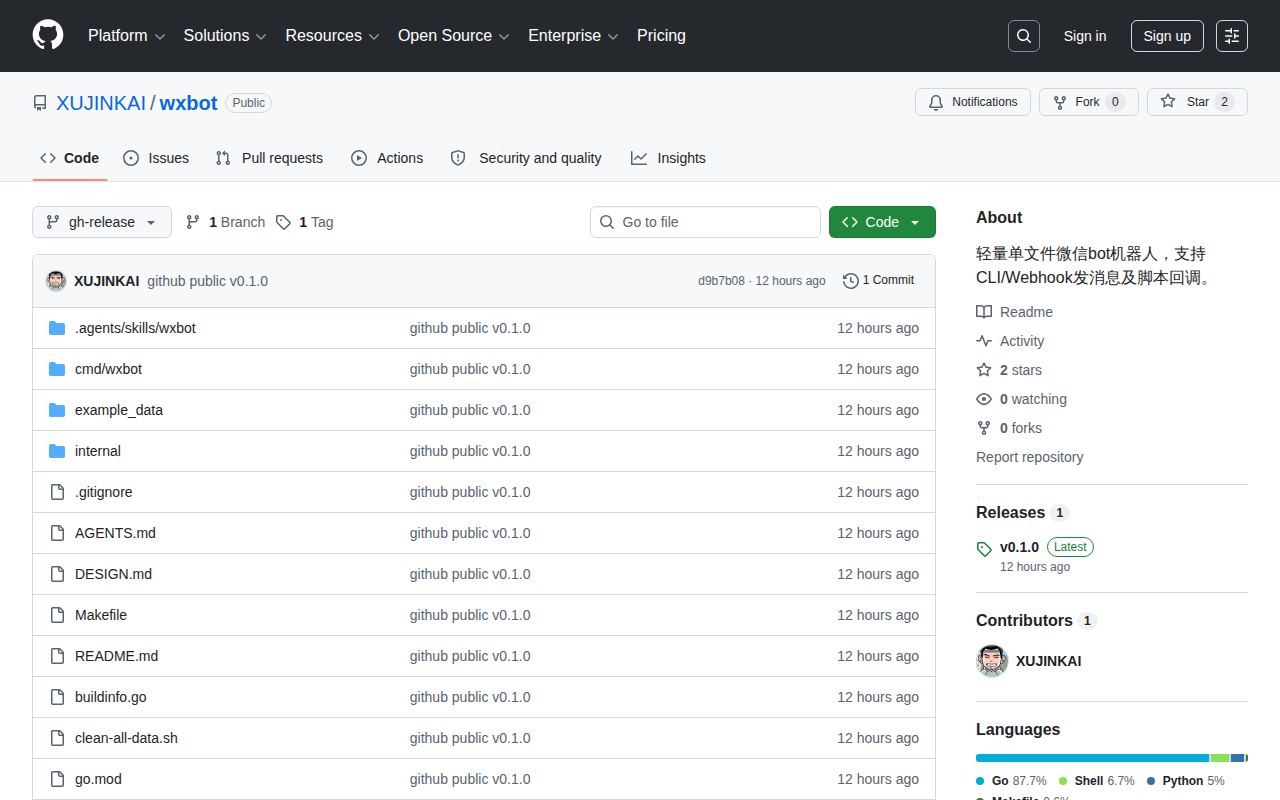
A zero-star personal project with a DESIGN.md explaining architectural decisions. Clean repo layout: cmd, internal, example_data all separated. For someone who 'doesn't know Go,' the engineering discipline is kind of wild
「I don't even know Go, and I built a WeChat clawbot messenger」
TECH GUESS
Go single-binary build, talks to WeChat via the clawbot protocol underneath
DEEP DIVE
"Don't Know Go At All" — Then He Shipped It
A V2EX post titled (translated) "Don't know Go at all, built a WeChat bot for sending messages via clawbot" caught my eye — not for its ambition, but for its honesty. The repo has 1 commit at v0.1.0, 0 HN score with 0 comments, and 2 GitHub stars. Developer XUJINKAI is most likely someone who needed to push automated notifications to WeChat for their own workflow, didn't want to learn Go the traditional way, and chose to bootstrap the entire project with AI coding tools — the presence of an AGENTS.md (a telltale sign of AI-assisted development) confirms this.
This isn't a success story. It's a real-world data point on how far AI coding tools can push someone with zero domain knowledge.
Three Trigger Modes, Not a Toy
The core value proposition is three message delivery modes: direct CLI sending, Webhook for external system integration, and script callbacks for scheduled tasks. These cover the most common automation scenarios — command-line debugging, monitoring/alert pushes, and periodic status reports. The developer clearly thought about "when exactly would I need to push something to WeChat" rather than shipping a hello-world demo.
The Webhook mode is particularly interesting. Many teams use enterprise WeChat bots for alerts, but personal WeChat automation has always been a grey area. wxbot relies on the clawbot protocol under the hood, which bypasses WeChat's official API limitations — but also means it depends on third-party reverse-engineered stability. That's the biggest red flag.
Engineering Hygiene That Punches Above Its Weight
A developer who claims zero Go knowledge somehow produced a repo with a DESIGN.md documenting architectural decisions, an AGENTS.md declaring AI assistance, and a proper cmd/internal/ example_data directory layout following Go conventions. The structure is cleaner than most side projects from people who've written Go for years.
This reveals the real value of AI coding tools: they don't write your business logic (you still need to figure out the three trigger modes yourself), but they scaffold the project correctly — file layout, conventions, documentation. XUJINKAI defined the architecture; AI helped execute it in idiomatic Go. For small projects, this human-decides-AI-implements split is remarkably efficient.
Who Should Use This (And Who Shouldn't)
If you need quick automated message pushes to WeChat without installing a pile of Python dependencies or wrestling with the Node.js wechaty ecosystem, wxbot's single-binary distribution is genuinely appealing. go build produces one file, drop it on a server, and run. CLI mode for quick testing, Webhook for monitoring integration, script callbacks for scheduled jobs — three tools, no more.
But if you need something stable enough to run for months in production, be cautious. The clawbot protocol's reliability is an open question. The project has 1 commit, 0 issues, 0 PRs — if something breaks, you're on your own. WeChat's anti-automation measures could ban your account at any time. This isn't wxbot's fault; it's the inherent risk of all unofficial WeChat automation tools. But you need to know.
A Snapshot of AI-Era Indie Development
wxbot's real significance isn't the tool itself — it will likely never become a popular open-source project. Its value is as a data point: someone with zero Go experience used AI tools to ship a clean, well-documented, functional CLI utility to GitHub in what was probably a few days. Three years ago, this required weeks of Go learning curve. Now it takes a DESIGN.md, an AGENTS.md, and one commit.
This isn't "everyone can code" optimism. It's something more specific: AI has reduced the friction of "idea to working prototype" to near zero. The remaining bottlenecks — protocol stability, WeChat's anti-bot policies, long-term maintenance — are still human problems. The tooling changed. The hard parts didn't.
Discussion (0)
- No comments yet — be the first.
Related
 #229▶ 136
Upload your textbook. AI teaches it back to you, chapter by chapter
 #228▶ 112
Someone needs to watch the AI spend meter
 #227▶ 184
Your users are kittens. Don't let them fall off the cliff