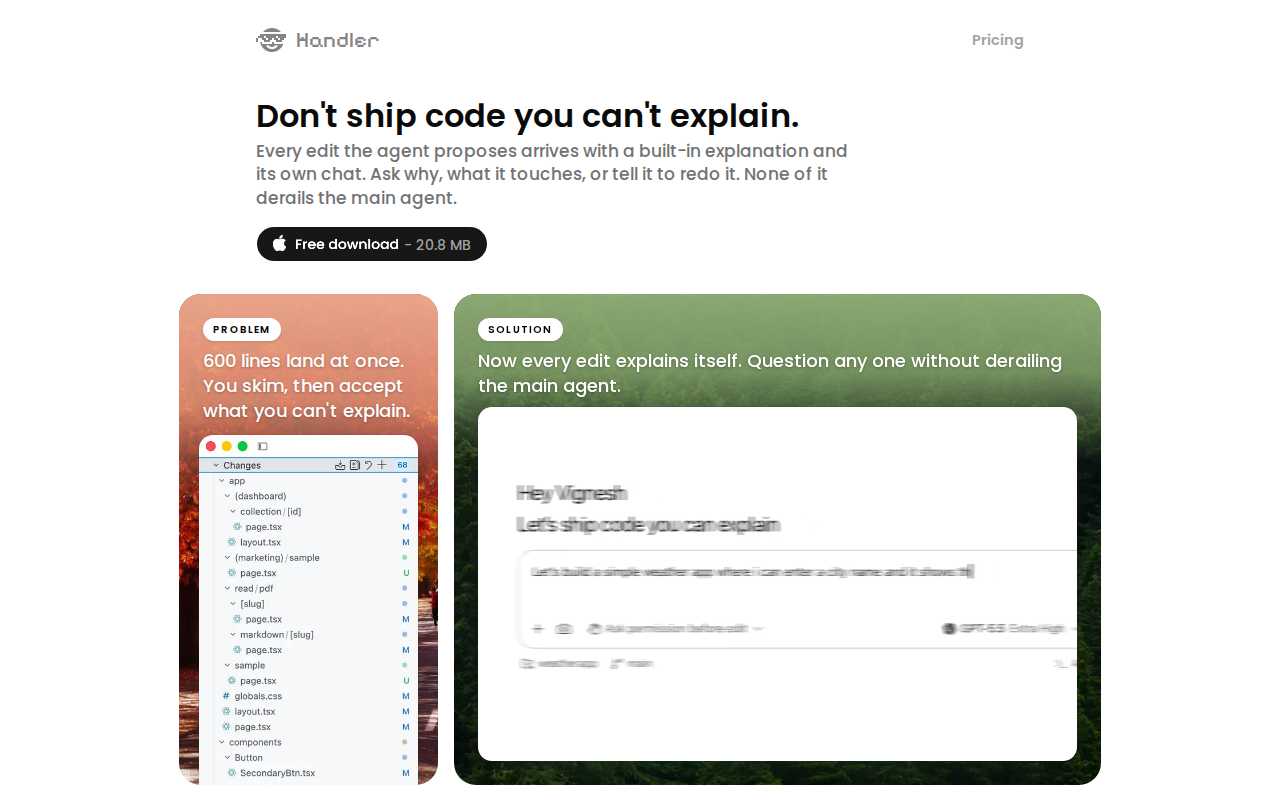
Every AI edit ships with its own explanation
WHAT IT SOLVES
AI dumps 600 lines at once. You skim, then accept what you can't actually explain
WHY IT'S INTERESTING
Each edit gets its own side chat
You can ask 'why' or 'redo this' on any single edit without polluting the main agent's context. That's how code review should work with AI
Agent reads the terminal itself
No more pasting logs to explain what broke. The agent pulls context from the terminal itself—a detail that tells you the author actually uses this daily
「Don't ship code you can't explain」
TECH GUESS
Likely Electron or Tauri wrapper, calling Codex and OpenCode APIs underneath
DEEP DIVE
\n===EN===\n## The Problem Nobody Talks About: Accepting Code You Don't Understand\n\nHandler targets a specific, uncomfortable truth about AI-assisted coding: when 600 lines land at once, most developers skim for five seconds, check that nothing obviously catastrophic happened, and hit Accept. This isn't laziness—it's rational triage. Reviewing AI-generated code line by line is exhausting, especially when the agent is also your rubber duck and pair programmer in the same chat thread. Handler's pitch is straightforward: every edit the agent proposes arrives with a built-in explanation and its own isolated chat. You can ask \"why did you use a reduce here?\" or \"redo this part\" on any single change without derailing the main agent. The author's tagline is \"Don't ship code you can't explain,\" which is less a marketing slogan and more an admission that nobody currently ships code they can explain.\n\n## Isolated Context Per Edit: The Actual Technical Insight\n\nThe killer feature isn't the explanation itself—it's architectural. Most AI IDEs run on a single conversational thread. When you start reviewing edits and asking follow-up questions, that review chatter fills the context window. The agent loses track of its original plan. Handler isolates each edit's discussion into its own side chat, borrowing the mental model of GitHub PR review comments: you comment on line 47, that conversation lives on line 47, and the overall PR description stays clean. This is a structural solution to context pollution, not a prompt engineering hack. Given that Handler is built on Codex and OpenCode, the author clearly experienced context degradation firsthand and decided the fix needed to live in the product layer, not in the model.\n\n## Terminal Auto-Read: A Small Feature That Signals Real Use\n\nOne detail stands out: the agent reads the terminal itself. No more copying error output and pasting it into the chat. Technically trivial—it's just piping stdout/stderr to the agent—but it signals something important: the author is a real user of his own product. Only someone who has been annoyed by the copy-paste-log ritual hundreds of times would think to call this out as a feature. When combined with the review-first workflow, it forms a coherent chain: you don't understand the edit → you run it → it errors → the agent sees the error → it explains or fixes it—all without you breaking flow. Whether this chain holds up in practice with complex projects is another question, but the thinking behind it is sound.\n\n## 4 Points, 0 Comments: What That Really Means\n\nHandler's Show HN landed at 4 points with zero comments. That's a very cold launch. Possible explanations: the core value prop—\"every edit explains itself\"—is experiential and hard to convey through screenshots. You need to actually use it to feel the difference. The Codex/OpenCode ecosystem is also a smaller pond compared to the Cursor/Claude Code discourse that dominates HN. And timing matters for Show HN visibility. But zero comments is worth noting—it might mean people found the idea logical but unremarkable, or it might mean the landing page didn't communicate the problem fast enough. For a solo developer product, community signal matters enormously, and right now that signal is essentially silence.\n\n## Who Should Try This (and Who Shouldn't)\n\nIf you're someone who regularly feels uneasy after accepting AI-generated code—unsure what it actually changed or why—Handler is worth a spin. It's not a full IDE replacement. Think of it as a review wrapper: Codex and OpenCode do the writing, Handler adds a layer of structured review on top. Likely built with Electron or Tauri calling APIs. The honest limitation: the explanations are only as good as the underlying model. If Codex hallucinates a justification, the side chat will just produce more confident nonsense. There's also zero community feedback to validate real-world stability. This is a classic solo dev tool—solving a real but narrow pain point, with success depending on whether the author can find early users willing to make this their daily driver. " }
Discussion (0)
- No comments yet — be the first.
Related
 #229▶ 136
Upload your textbook. AI teaches it back to you, chapter by chapter
 #228▶ 112
Someone needs to watch the AI spend meter
 #227▶ 184
Your users are kittens. Don't let them fall off the cliff