LinkJuice
linkjuice.dev/ →No-code backlink building — AI fills the forms, you track the links
WHAT IT SOLVES
The worst part of backlink outreach isn't finding targets — it's filling form after form, chasing follow-ups, and checking if links actually went live
WHY IT'S INTERESTING
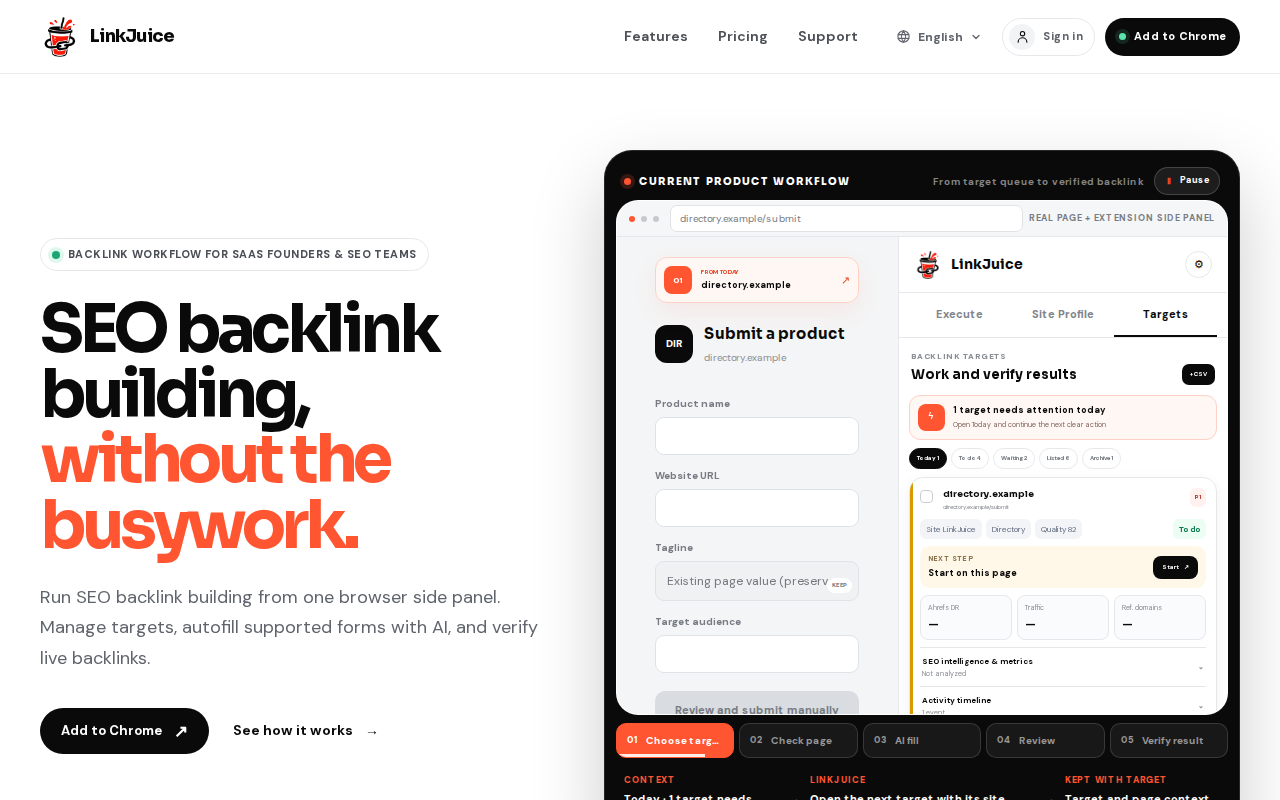
Side panel = zero context switching
Instead of a separate SaaS dashboard, everything lives in a Chrome side panel right next to the page you're submitting to — target queue, AI autofill, status tracking, all in one view. Clearly designed from the actual workflow, not a product spec
Full loop: target → submit → verify it's live
Most tools stop at finding targets or filling forms. LinkJuice closes the whole loop: manage your target queue, AI recognizes and autofills form fields, track follow-ups, then verify the backlink is actually live — end to end
「Built this Chrome extension with zero coding background, just vibing with AI」
TECH GUESS
Chrome Extension (Manifest V3) with AI-powered form field recognition, likely frontend-heavy with a lightweight backend like Supabase
DEEP DIVE
\n## The \"Form Automation\" Ambition of a Zero-Code Developer: LinkJuice Uses AI to Grunt Work out of SEO Backlink Building\n\nOn V2EX, a developer captured my attention with the line: \"No programming background, built a Chrome extension that auto-fills backlink submission forms with AI.\" This isn't just another AI-wrapped story; it's a tangible case study of how AI coding tools enable domain experts to productize repetitive workflows. LinkJuice targets a very specific pain point: in SEO backlink building, the most time-consuming and tedious part isn't finding resources, but repeatedly filling out vastly different submission forms and tracking their status.\n\n## A Sidebar-Grown Solution from Real Workflow\n\nLinkJuice's core design insight is its placement: it's a Chrome side panel extension. This means when you're on a directory or partner's submission page, you don't have to switch to a separate SaaS dashboard. All actions—managing a target queue, triggering AI form-filling, checking status—happen right beside the page you're working on. This approach clearly \"grew out of\" actual working scenarios, not boardroom brainstorming. It consolidates a workflow scattered across multiple tools (Excel sheets, browser tabs, emails) into one contextual environment.\n\n## The Real Value of AI Form-Filling: Recognizing Variance & Preserving Context\n\nThe product's core feature is \"AI autofill supported forms.\" The key here is \"recognizing variance.\" Submission forms across different websites have wildly different field names, orders, and required fields. A competent AI form-filler needs to intelligently identify semantic fields like \"Product name,\" \"Website URL,\" \"Tagline,\" and accurately populate them with preset values, while also being able to \"preserve existing page values.\" The provided UI screenshot shows it includes an option for \"Existing page value (preserved),\" indicating the developer considered the problem of overwriting non-empty fields—a critical detail.\n\n## The Full Loop: From Submission to Verification\n\nWhat sets LinkJuice apart from many point solutions is its attempt to build a complete loop. The process starts with a \"target queue,\" where users pre-compile a list of sites to submit to. Then, on the target site, they trigger AI form-filling and submission. After that, the tool enters a \"follow-up tracking\" stage, which might rely on manual tagging or simple automated checks. Most praiseworthy is the \"verify live backlinks\" feature. Backlink builders ultimately need to confirm if links were actually published and are dofollow. This verification step is the final mile of value delivery. While the technical depth of the verification (e.g., simple homepage fetch vs. deep crawl) is unknown from the description, its mere existence reflects thinking about the complete workflow.\n\n## Honest Limitations and Target Users\n\nFirst, this is a vertical tool explicitly for \"SaaS founders & SEO teams.\" Its value is highly dependent on users frequently and batch-submitting backlinks. For a casual blogger submitting one or two links occasionally, its necessity is low. Second, the success rate of \"AI autofill\" heavily depends on the standardization of the target site's form. Faced with unconventional or highly customized forms, AI may fail, requiring manual intervention. Finally, as a product built by a non-developer using AI, its long-term maintenance, feature iteration, and ability to adapt to platform changes like Chrome Manifest V3 are points to observe. Nevertheless, LinkJuice stands as an excellent example of using AI to transform a domain expert's repetitive work into a shareable, sellable automation tool." }
Discussion (0)
- No comments yet — be the first.
Related
 #229▶ 136
Upload your textbook. AI teaches it back to you, chapter by chapter
 #228▶ 112
Someone needs to watch the AI spend meter
 #227▶ 184
Your users are kittens. Don't let them fall off the cliff