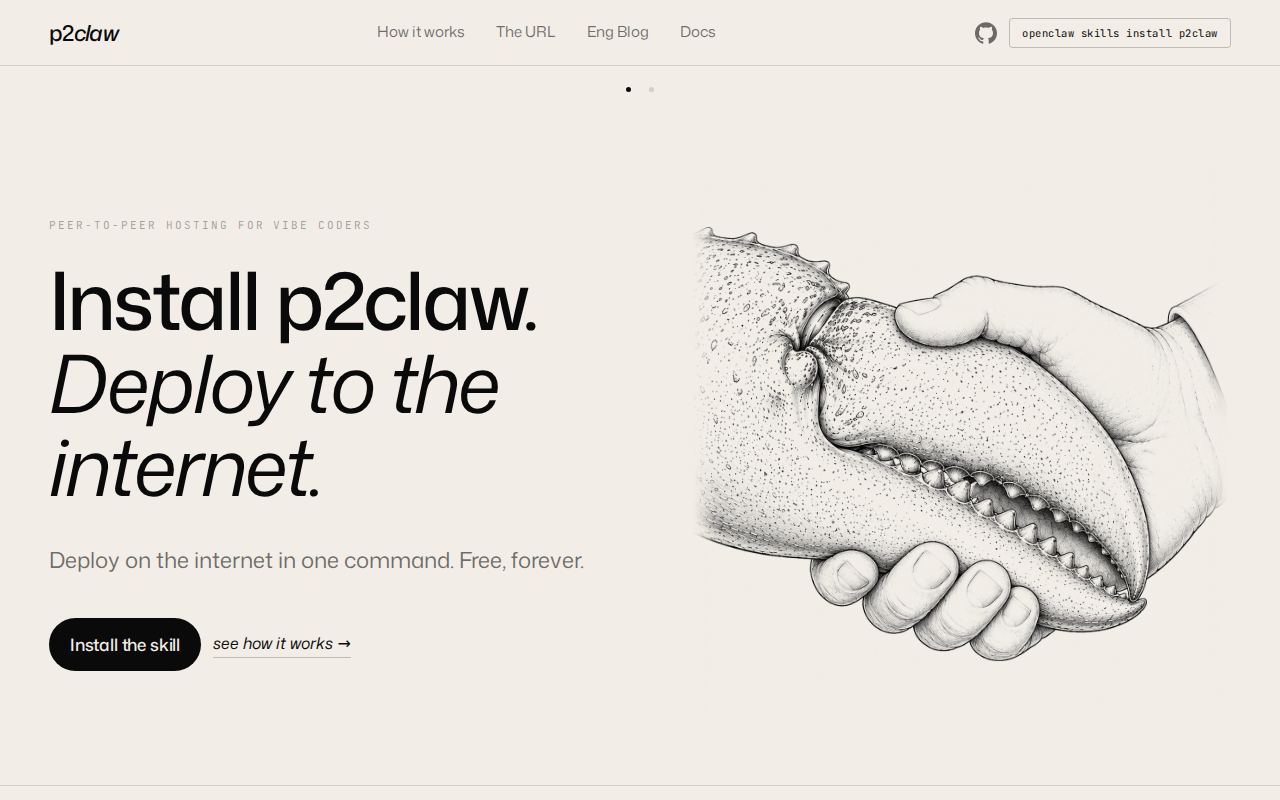
Your app, your machine, one link for your friends
WHAT IT SOLVES
You vibe-coded something cool for a friend. Then you spent the afternoon wrestling with cloud accounts, domains, and deploys
WHY IT'S INTERESTING
Targets the "show mom" moment
The demo isn't a to-do app — it's a recipe site built by Claude Code to share with mom. That person isn't setting up Vercel; she's clicking a link. p2claw strips deploy down to: your agent builds it, your friend opens a URL, WebRTC punches through directly to your machine. No server in the middle
Agent-native, not agent-adjacent
It's not just CLI-friendly — it's packaged as an agent skill. Claude Code runs `install p2claw` and handles the whole flow. Deploy stops being a manual script and becomes a step inside the agent's workflow. If agent-coding goes mainstream, this kind of native integration could outrun any "nice CLI"
「"Free, forever" — from the homepage」
TECH GUESS
WebRTC data channel for P2P tunneling, likely a lightweight signaling server for hole-punching coordination, probably React on the frontend
DEEP DIVE
The Sharing Paradox in the AI Age: Built Something Cool with AI? Now Try Showing It to Mom.
With AI coding assistants like Claude Code, a “Vibe Coder” can transform a fuzzy idea into a working application in hours. The friction of creation has drastically reduced. Yet, a more primal problem emerges: after saying “Hey Mom, I made you a recipe website, look!”, what’s the next step?
The traditional path involves signing up for a cloud service, configuring a domain, learning deployment pipelines, and possibly handling billing. The homepage slogan “Free, forever” strikes directly at this pain point. For ephemeral projects meant to be shared with friends or family, the entire operational and commercial model of cloud hosting feels burdensome. p2claw’s target user isn’t a DevOps engineer; it’s the creator who just had their “magic moment” with AI and needs a “last mile” solution for sharing.
P2P as the Solution: No Middleman, Just You and a Link
p2claw’s core idea is a return to a primitive connection: let your app run on your own machine, and have your friends’ browsers connect directly to your computer via a link. It uses WebRTC technology to establish a peer-to-peer (P2P) data tunnel.
What does this mean in practice? First, it’s forever free. Since there’s no cloud server constantly running to host your app, there’s no bill. Your computer is the server—on when you need it, off when you don’t. Second, deployment becomes trivial. The site describes the flow as “Say the word and we ship.” Deploying an app to the internet is distilled to one concept: generating a link. The entire process bypasses any cloud provider’s dashboard, domain registrar, or complex configuration files. It demotes “deployment” from a specialized operational task to a one-click, outcome-driven action.
The Agent-Native Design Philosophy: More Than a CLI, It’s an AI “Skill”
p2claw’s most compelling feature isn’t just its P2P tech; it’s its explicit “Agent-native” design. This means it’s not just a Command-Line Interface (CLI) for human developers, but a deeply integrated “Skill” within the AI coding workflow.
In the showcased workflow, a developer tells Claude Code: “make me a recipe book website to share with mom.” After completing the code, Claude Code can directly invoke the install p2claw skill to complete the deployment and generate a shareable link. The key here is: deployment is no longer a separate manual step after coding; it’s seamlessly woven into the AI agent’s task chain.
This represents forward-thinking design. If the paradigm of “AI writes code, humans define intent” becomes mainstream, every link in the toolchain (including version control, testing, and deployment) needs to be “agent-ified,” becoming a native capability that AI can understand and invoke. p2claw’s approach in this aspect is more ambitious than just offering a “good deployment CLI.”
Who It’s For, and an Honest Look at the Limitations
Ideal User Profile: A developer who has just completed a small project with an AI coding assistant (like a personal portfolio, a small interactive tool, a internal demo) and wants to quickly share it with a specific audience (friends, family, a small team) for viewing or testing. It is not suitable for production-grade applications requiring 7x24 high availability and handling significant traffic.
Honest Limitations: 1. Connection Reliability: WebRTC P2P connections are highly dependent on both parties’ network environments, especially NAT traversal success rates. In complex networks (e.g., strict corporate firewalls), connections may fail. 2. Requires Constant Uptime: The machine running the app needs to stay on, connected to the internet, and with the p2claw process running. This can be inconvenient for laptop users. 3. Performance Bottlenecks: The app’s availability and responsiveness are constrained by your home network’s upload bandwidth, which is typically much lower than that of professional cloud servers. 4. Nascent Community: The HN discussion shows 3 points, 0 comments, indicating this is an extremely early-stage project lacking community feedback and validated use cases. Its long-term viability and robustness remain to be seen.
In summary, p2claw is an intriguing and focused “problem-solver.” It doesn’t try to replace Vercel or Netlify. Instead, it cleverly targets an emerging niche in the AI era—one overlooked by traditional solutions: providing a one-time, zero-cost sharing channel for AI-assisted ephemeral creations. Its success may be deeply tied to the evolution of the “Vibe Coding” culture itself.
Discussion (0)
- No comments yet — be the first.
Related
 #229▶ 136
Upload your textbook. AI teaches it back to you, chapter by chapter
 #228▶ 112
Someone needs to watch the AI spend meter
 #227▶ 184
Your users are kittens. Don't let them fall off the cliff