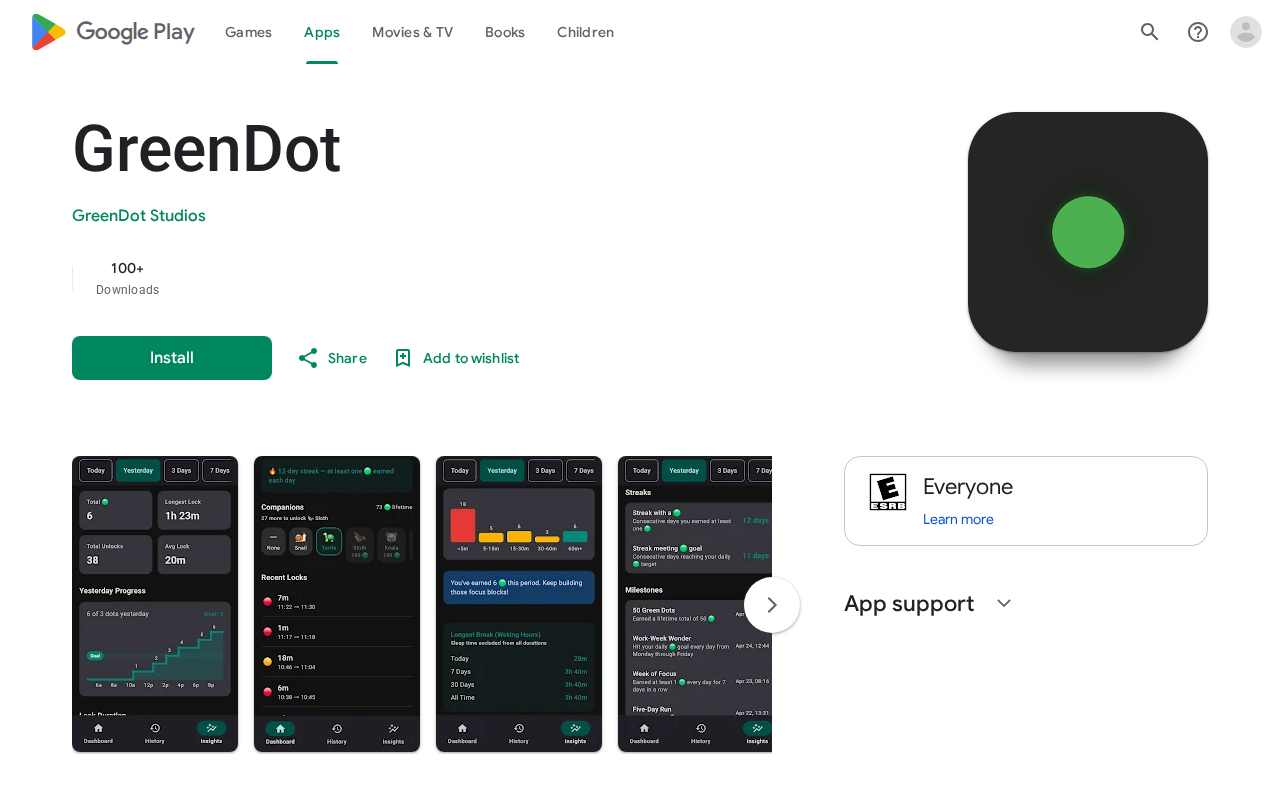
GreenDot
play.google.com/store/apps/details?id=com.greendot.phonebreaks&hl=en_US →His wife quit tracking phone-free hours. So he built an app for it
WHAT IT SOLVES
Screen-time apps tell you how much you scrolled, then make you feel guilty. Nobody rewards you for simply putting the phone down
WHY IT'S INTERESTING
Reward absence, don't punish presence
60 minutes locked = 1 Green Dot. Instead of tracking how much you scrolled, it tracks the silence between checks. Positive reinforcement over guilt — a smarter psychological frame than 90% of screen-time apps
From 'my wife tried and quit' to shipping on Google Play
The HN title says it all: wife tried logging 1k phone-free hours manually, gave up. So he vibe-coded this. 100+ downloads, unlockable companion animals, daily goals, streaks — small but complete
「「My wife tried to log 1k phone-free hours but quit. So I vibe-coded an app」」
TECH GUESS
Given 'vibe-coded' and Android-only Play Store listing, likely Flutter or React Native with heavy AI-assisted development
DEEP DIVE
When Your Wife Quits, You Build an App
Most indie dev origin stories start with "I had a problem." GreenDot's is more specific and more honest. This summer, the developer's wife set an ambitious goal: log 1,000 hours of phone-free time with family. Her method was a manual timer. The reality? "Between managing two young kids and constantly forgetting to start or log the timers, the friction just became too much effort." She quit after roughly 120 hours.
This isn't a technology problem — it's a human one. Manually tracking "time without your phone" is inherently self-defeating: you need to interact with a device to record that you're not interacting with a device. The developer vibe-coded a solution, shipping to Google Play with the kind of scrappy pragmatism that defines indie hacking: no PRD, no user research panels, just fix the problem your household actually has.
Reward the Gaps, Not the Guilt
GreenDot's core mechanic is dead simple: lock your phone for 60 minutes, earn 1 Green Dot. It doesn't track how many hours you doomscrolled. It doesn't guilt-trip you with a big red number. It only measures the space between phone checks — the "gaps."
HN commenter kailovel nailed it: "That looks like a great mental model to use for this problem. Gaps." This flips the script on every built-in screen time tool (iOS, Android, and third-party alternatives alike), which are fundamentally shame-driven: here's your number, feel bad about it. GreenDot's framing is positive — the act of putting your phone down deserves to be seen and rewarded.
The supporting features are all there: daily Green Dot goals, streaks, history and insights, and a charming hook — lifetime progress unlocks "quiet companion animals." It's a small app with 100+ downloads on Google Play, perfectly normal for a cold-start personal project. But the psychological architecture is sound.
The "Red Dot" Problem: When Real Life Breaks the Model
Here's where it gets interesting. HN commenter willx86 reported: "I have now got 30 more red dots as during my gym session I regularly change the music by opening my phone."
This reveals that GreenDot doesn't just reward lock time — it also penalizes phone pickups with red dots. A dual-motivation system, theoretically clean. In practice? It can't distinguish between a 2-second music skip and a 20-minute Instagram spiral. Scan a QR code to pay? Red dot. Reply to an urgent message? Red dot. Use your phone as a flashlight? Red dot.
This is the fundamental tension every phone-habit app faces: your phone is a tool, not a pure entertainment device. A binary "you touched it, you lose" system punishes legitimate use. willx86 was still positive ("I like it so far"), but that "One small thing" is actually a big thing. If the developer wants to scale beyond 100+ downloads, some kind of grace period — a whitelist window or a minimum pickup duration threshold — would go a long way.
Vibe-Code Speed vs. Platform Limits
The developer self-identifies as having vibe-coded this, and the speed from idea to Google Play listing suggests heavy use of AI-assisted development tools, likely Flutter or React Native. The HN thread surfaced an immediate platform question: kailovel asked "Would love to see on iOS if the OS allows for the function," and j_bum pointed to Hank Green's Focus Friend as an existing iOS alternative.
iOS's strict background execution limits make this type of passive lock-time tracking significantly harder to implement than on Android. That's a real moat for Android-first competitors, but also a ceiling on reach.
GreenDot's real value isn't technical sophistication — it's the "Gaps" mental model. It's not competing with feature-packed productivity suites. It's targeting the person who just wants to be gently reminded that time away from their phone counts too. A 1,000-hour goal is daunting. Earning 2-3 dots a day and watching a little companion animal unlock? That's the right pace.
Discussion (0)
- No comments yet — be the first.
Related
 #229▶ 136
Upload your textbook. AI teaches it back to you, chapter by chapter
 #228▶ 112
Someone needs to watch the AI spend meter
 #227▶ 184
Your users are kittens. Don't let them fall off the cliff