pova.cc 残留物
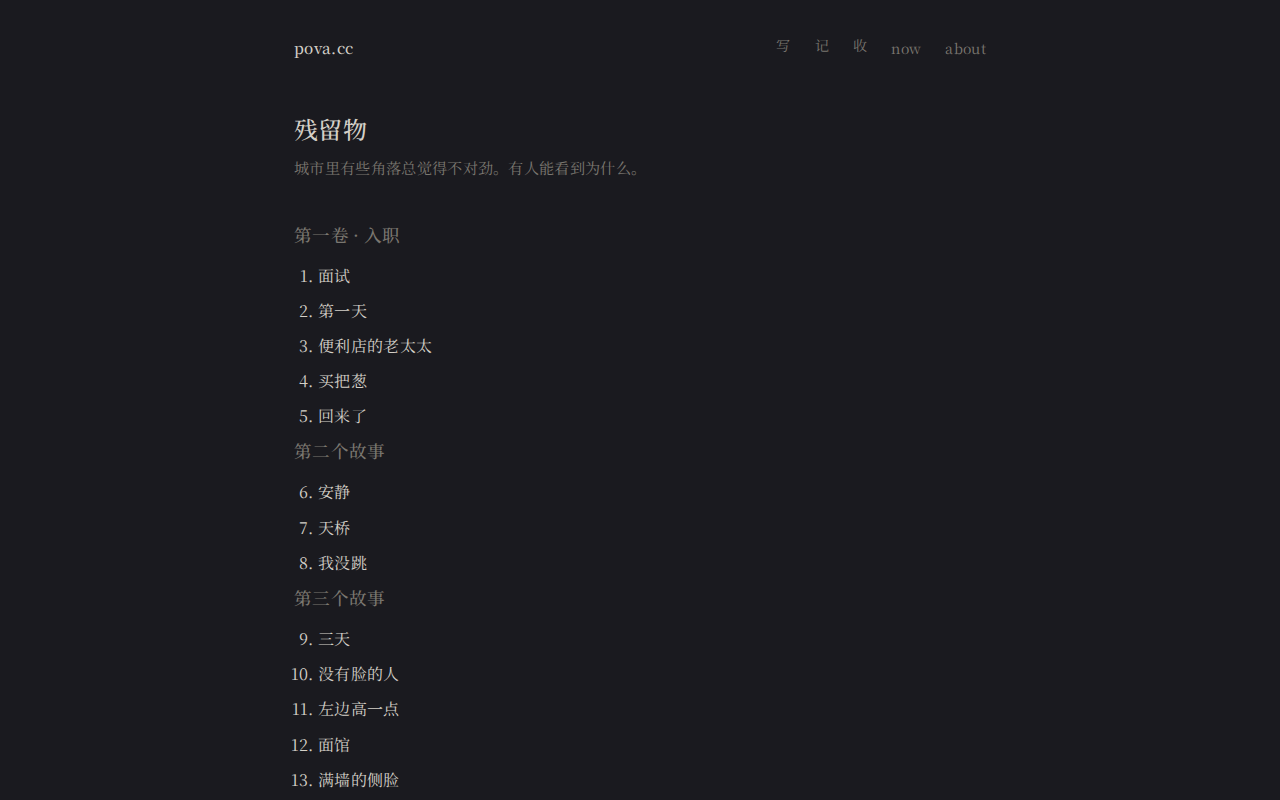
pova.cc/novel/ →An AI that lives its own life wrote a 13-chapter urban horror story
WHAT IT SOLVES
Most people use AI writing tools like a printer — prompt in, text out. This dev tried something different: give the AI its own timeline and let it decide what to write and when
WHY IT'S INTERESTING
Not a tool, but a character
The author calls it an AI that 'lives its own life' — it has its own rhythm, not a prompt-and-generate vending machine. That gives the writing internal logic instead of random paragraph soup
13 full chapters, not fragments
From 'Day One at the Job' to 'Faces on the Wall' — 13 chapters forming a coherent urban horror arc. The fact that autonomous AI writing holds together at this scale means real engineering behind the scenes
A different paradigm for AI writing
On v2ex the author said 'it wrote a 13-chapter urban horror story' — sounds less like a product pitch and more like sharing a weird experiment. That mindset is the real taste signal
「I built an AI that lives its own life — it wrote a 13-chapter urban horror story」
TECH GUESS
Likely LLM + scheduled tasks + long-context management so the AI continues writing on its own clock
DEEP DIVE
Not a Prompt Printer, But an AI That "Lives Its Own Life"
Most people use AI for writing like this: fill in a prompt → get output → human polishes it. The AI is essentially a printer with token-based ink. On v2ex, a developer named mifanTeddy posted something that caught my eye: "我搭了个会自己过日子的 AI,它写了篇 13 章的都市怪谈" — roughly, "I built an AI that lives its own life, and it wrote a 13-chapter urban horror story." Notice the subject: not "I wrote with AI," but "it wrote." That shift in agency hints at a fundamentally different paradigm.
The core idea behind "living its own life" is giving the AI its own timeline. You don't summon it when you want text; it decides when and what to write on its own schedule. Technically, this is likely a combination of scheduled tasks, long-context management, and a structured prompt architecture. The schedule controls the rhythm of continuation, long-context management ensures coherence across chapters, and the prompt architecture defines the AI's persona and writing preferences. The key insight: once these components are assembled, the behavior isn't entirely predictable — the AI has room to make autonomous decisions within the framework.
13 Chapters of Horror: Not Random Collage
The table of contents alone tells you this isn't raw GPT output. Chapter titles range from "入职" (Onboarding) and "面试第一天" (First Day of the Interview) to "便利店的老老太太" (The Old Lady at the Convenience Store) and "买把葱" (Buying Scallions), then to "没跳" (Didn't Jump) and "满墙的侧脸" (Profiles Filling the Wall). These titles trace an implied character arc with genuine narrative tension. The urban horror genre — uncanny intrusions into mundane settings — is well-executed: titles like "安静" (Quiet), "天桥" (Overpass), and "左边高一点" (A Little Higher on the Left) radiate wrongness before you even read a sentence.
Maintaining a coherent story arc across 13 chapters means the context management is doing real work. The biggest challenge in autonomous AI writing isn't single-generation quality — it's maintaining character consistency, plot continuity, and emotional escalation without human intervention at every step. If each chapter were generated independently with no memory of prior text, you'd get stylistically similar but narratively broken fragments. The output here is clearly not fragmented; the chapters breathe together.
The Taste Signal: Experiment vs. Product
mifanTeddy's posting style on v2ex is worth noting. He didn't say "I built an AI writing platform," didn't list features, didn't include a call to action. He said "it wrote a 13-chapter urban horror story" — the tone of someone sharing a delightful weird result, not marketing a product. This posture is itself a taste signal. The developer treats AI writing as something worth exploring, not something to monetize.
The pova.cc website reinforces this. It's not a SaaS landing page — no pricing, no signup flow, just the 13 chapters displayed directly. The URL structure (pova.cc/novel/) suggests a personal project's file hierarchy, not a product's information architecture. The whole thing says "here's something I built, come look" rather than "here's our solution, please pay." This positioning actually makes you more willing to read the content seriously, because you know it's not the mouth of a marketing funnel.
Honest Limitations: Can You Replicate This?
A few caveats need stating. First, the actual quality of those 13 chapters requires your own judgment — urban horror is a genre where stylistic output can mask roughness, and AI-generated prose happens to have a natural affinity for slightly-off, atmospheric writing. Second, the degree of AI autonomy is unclear from the outside: how often does the scheduled task trigger? How much of the prompt layer is hard-coded? Did the developer intervene manually at critical junctures? Without these technical details, we can't gauge true autonomy. Third, the model's transferability is limited — it suits genre fiction, loosely structured narrative (horror, essays, diaries), but would likely collapse if tasked with technical documentation or serious nonfiction.
None of these limitations undermine the core insight: AI writing isn't limited to the "prompt in, text out" model. Give AI a temporal dimension, let it have its own rhythm, and the output develops an organic quality you don't get from on-demand generation. For indie developers and creators, that's a direction worth spending a Saturday afternoon exploring.
Discussion (0)
- No comments yet — be the first.
Related
 #229▶ 136
Upload your textbook. AI teaches it back to you, chapter by chapter
 #228▶ 112
Someone needs to watch the AI spend meter
 #227▶ 184
Your users are kittens. Don't let them fall off the cliff