Recipe Ninja
www.recipeninja.ai →35k lines of code. All vibecoded
WHAT IT SOLVES
Every AI recipe tool is just a thin wrapper around ChatGPT
WHY IT'S INTERESTING
35k LoC — not a wrapper
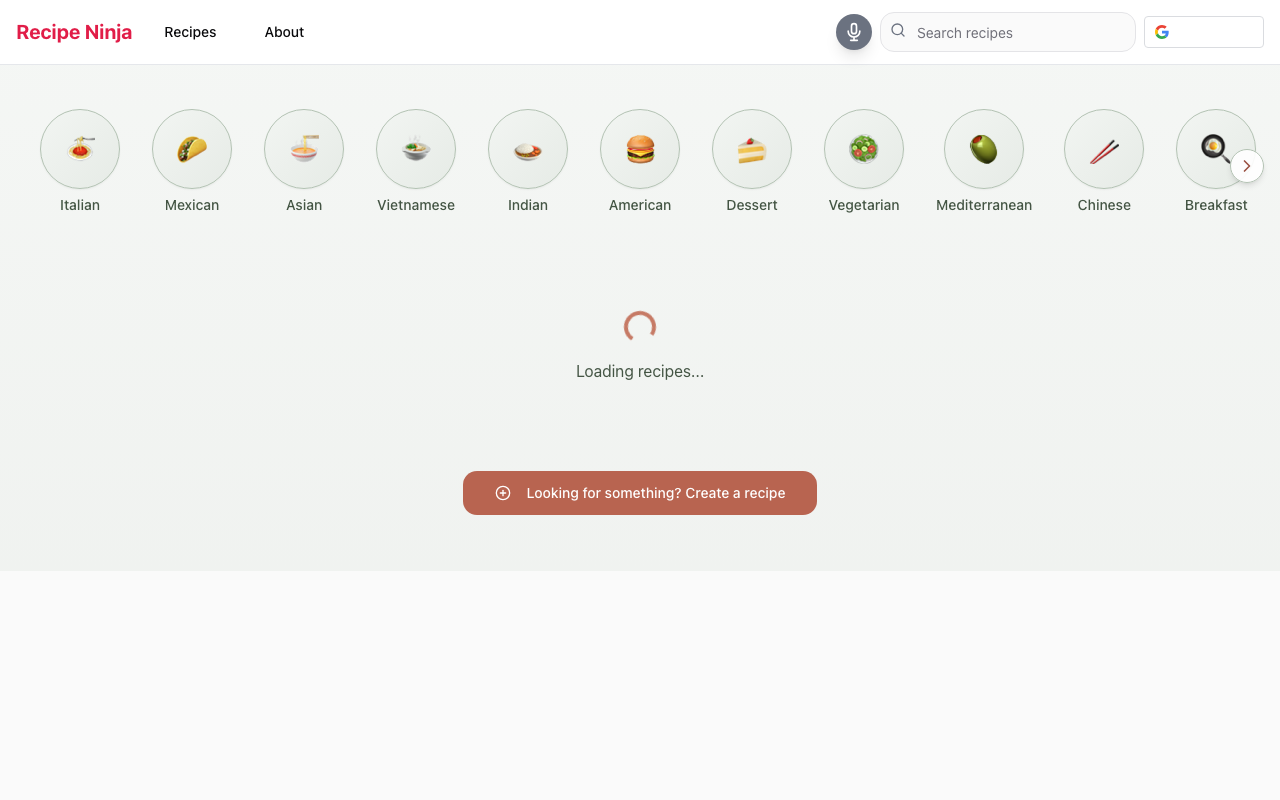
The author posted this as a vibe-coded project — 35,000 lines of actual code, not a thin prompt wrapper. It spans Italian, Mexican, Asian, Indian, American, vegetarian, seafood and more, with structured recipe data and step-by-step guidance
Doesn't just give you a recipe — walks you through it
Most AI recipe tools stop at 'here's some text.' Recipe Ninja positions itself as a cooking assistant — walking you through each step. That's a real distinction: users don't want information, they want company
「From the title: 'I vibecoded a 35k LoC recipe app'」
TECH GUESS
Frontend framework + AI inference API with structured recipe data — the 35k lines suggest more than a weekend wrapper
DEEP DIVE
35,000 Lines of Code, All 'Vibecoded': The Recipe Ninja Experiment
When a developer titles their Hacker News post "Show HN: I vibecoded a 35k LoC recipe app," it commands attention. Recipe Ninja, by tomblomfield, is a concrete demonstration that a full-fledged application spanning Italian, Mexican, Asian, Indian, and dozens of other cuisine categories—with structured recipe data and step-by-step guidance—can be built using the emerging practice of "vibe coding." The post garnered 126 points and 235 comments, sparking a community discussion on AI-assisted development efficiency. This isn't another ChatGPT wrapper generating recipe blobs; it's a 35,000-line codebase product, and its creation method is the primary case study.
The Real Problem It Solves: From Information to Companion
Most AI recipe tools stop at "giving you text": you input ingredients, it spits out recipe descriptions. Recipe Ninja positions itself as a "cooking assistant," guiding you step-by-step through the actual cooking process. Author tomblomfield clearly articulated its core value in the HN comments: "Hands-free voice control and being able to access recipe ingredients and steps without 5 pages of SEO-optimised prose." This hits the pain point of traditional recipe sites precisely: when your hands are covered in flour, you need clear step-by-step guidance, not a blog post filled with "My grandma's summers in Tuscany..." The shift from "providing information" to "providing companionship" is Recipe Ninja's true differentiator.
Technical Implementation: Function Calling as the Backbone
Tomblomfield's technical reveals in the comments show this isn't a simple prompt wrapper. He explained the architecture: "Basically you declare to the AI which functions (tools) are available for it to call... Then you handle those function calls in your javascript." He shared a code snippet where the AI calling the search_recipes function triggers frontend JavaScript to process parameters like name and difficulty and build URL search params. This means the app uses OpenAI's Function Calling to deeply integrate with frontend logic—the AI decides when to call which function, and the frontend executes and renders. The well-organized cuisine categories suggest the recipe data itself underwent independent structuring, not reliant on real-time AI generation.
Community Feedback: Praise and Skepticism
Community reaction was multifaceted. Some were impressed by the project's scale, with ada1981 inviting the author to demo at an EarthPilot.ai weekly event. Others highlighted clear stability issues. User Retr0id reported that searching "lasagne" on Firefox caused content to flash and then display a white screen. Tomblomfield candidly responded: "Hmm it seems like recipe generation might be broken on Firefox. I'll look into it - thanks! It's working in Chrome." This exposes potential testing blind spots inherent in vibe coding. A sharper critique came from nextaccountic: "The real problem of your website is that the recipes are AI generated. They just haven't done the 'now monitise it' step," he argued, questioning the fundamental limitation of AI-generated content's credibility and detail compared to recipes by professional chefs, alongside poor image quality.
Who Should Use It, and Its Honest Limitations
Recipe Ninja is suited for home cooks seeking quick, hands-free cooking guidance who don't mind the potential uncertainties of AI-generated content. Its primary value lies in the interaction experience (voice guidance, structured steps) rather than the recipe authority itself. The honest limitations are clear: First, AI-generated recipes cannot match the accuracy and detail of those by professional chefs. Second, the app exhibited browser compatibility bugs (at least at launch). Finally, as danmur joked, the monetization step hasn't been taken. This is fundamentally an engineering experiment showcasing AI programming efficiency and possibilities, not a market-validated mature product. Its significance lies in proving that an application with complete interactive logic and vast structured data can indeed be rapidly built primarily through AI-assisted coding.
Discussion (0)
- No comments yet — be the first.
Related
 #229▶ 136
Upload your textbook. AI teaches it back to you, chapter by chapter
 #228▶ 112
Someone needs to watch the AI spend meter
 #227▶ 184
Your users are kittens. Don't let them fall off the cliff