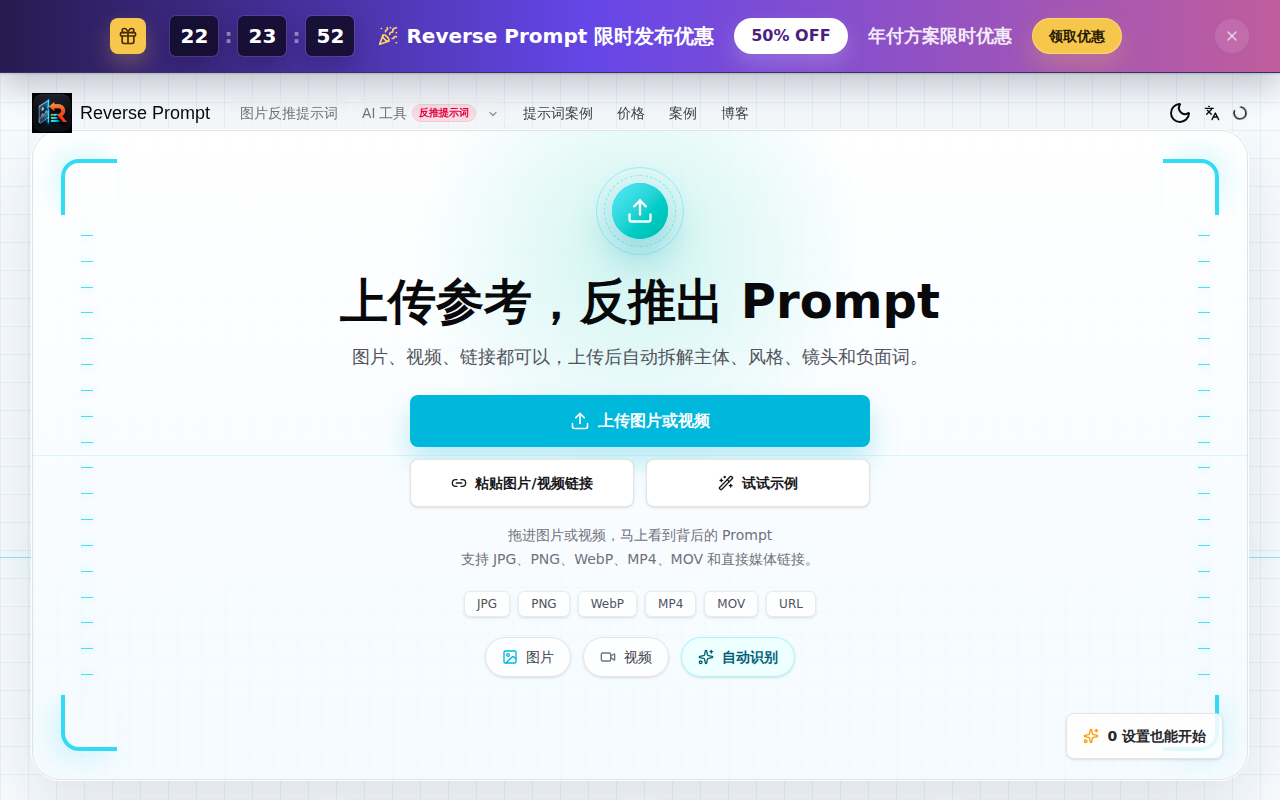
图片转提示词生成器 - AI 图片反推提示词工具
reverseprompt.art/zh/image-to-prompt?utm_source=v2ex&utm_medium=forum&utm_campaign=share →WHAT IT SOLVES
TECH GUESS
DEEP DIVE
\n## Reverse Engineering the Magic: Learning AI Art by Deconstructing It\n\nFor prompt engineers and AI art enthusiasts, the most common frustration isn't creating an image, but staring at a stunning Midjourney masterpiece wondering, \"What on earth was the prompt?\" The \"Image to Prompt Generator\" or \"Reverse Prompt\" tool directly addresses this nuance: it's not for imagining from scratch, but for reverse-engineering the structured recipe behind an existing image. It transforms visual awe into copy-pasteable text instructions, accelerating the learning curve exponentially.\n\nThe workflow is elegantly simple. Upload an image (JPG, PNG, WebP), a video (MP4, MOV), or paste a media link. Within 30 seconds (hints of a \"22 : 23 : 52\" timer suggest backend processing time), the tool outputs a structured decomposition. This typically includes the core subject, artistic style, composition, lighting, material textures, and the critical yet often-overlooked negative prompts. It's the difference between groping in the dark and having a blueprint; you can take this \"prompt recipe\" directly into Midjourney, Stable Diffusion, or ChatGPT for validation and iteration.\n\n## The Engine Inside: Wrapping Multimodal Models for a Specific Job\n\nTechnically, this tool is a brilliant application-layer wrapper around state-of-the-art Multimodal Large Language Models (MLLMs) like GPT-4V, Claude 3, or open-source alternatives. It does not perform pixel-level reverse engineering (an impossible task). Instead, it instructs a vision model to act as both an art critic and a prompt engineer. The system prompt likely guides the model to analyze the uploaded visual along predefined axes (subject, composition, light, style...) and then reformat its understanding into prompt-idiomatic language with weights and keywords. The noticeable processing delay (evident from timing clues) confirms it's running inference on complex visual models, a non-trivial cost that explains the tool's commercial Freemium/subscription model with a \"50% OFF\" annual plan.\n\n## Who It's For: Beyond the \"Cheat Code\" Misconception\n\nThis tool is ideal for learners and professionals. 1) Prompt Learners: Use it as a \"reverse tutor.\" When captivated by a specific aesthetic (e.g., \"synthwave neon,\" \"Studio Ghibli watercolor\"), use it to quickly obtain the keyword palette that builds that vibe, learning how terms are stacked. 2) Production Use Cases: For e-commerce (quickly adapting competitor image styles) or game concept art (converting reference art into batch-generatable prompts), it provides a strong \"Version 1\" prompt to skip the initial inspiration drought.\n\nHowever, its purpose is reference and learning, not precise decryption. The final image is influenced by model version, random seed, ControlNet setups, and post-processing. The tool's prompt is a high-fidelity translation of an image's content, not the original creator's exact script. The smartest use is: treat its output as a foundation. Paste it into your tool of choice (e.g., ComfyUI) and start tweaking. The real learning happens in observing how changing \"dramatic lighting\" to \"soft studio light\" alters the output yourself.\n\n## The Honest Constraints: What It Cannot Do\n\nFirst, the generated prompt will never be identical to the original creator's. Different AI models have different \"linguistic biases\" in interpreting vision. A prompt generated (likely via GPT-4V) might yield subtle variations when used in a Stable Diffusion-centric workflow. Second, it can falter on complex human poses, specific IP characters, or highly abstract artistic movements, requiring user discernment and correction. Finally, it is a commercial product. The limited free trial is for evaluation. Serious use requires a paid plan (e.g., the noted annual subscription), forcing creators to assess if the efficiency gain justifies the ongoing cost versus one's own learning time.\n\n## Conclusion: A Valuable Scaffold for the AI Art Ecosystem\n\nThe Image to Prompt Generator succeeds by using cutting-edge multimodal AI to solve a clear \"receiving-end\" problem in the creative community: understanding and learning from others' work. It lowers the cognitive barrier between admiring a result and reproducing it. While its translations have limits and it cannot control all variables in the generation pipeline, it stands as a highly practical auxiliary tool for rapid inspiration and compositional analysis. For every explorer in AI art, it's a worthy addition to the toolkit—a constant reminder that behind every magical image lies a series of deconstructable, learnable technical decisions.\n===ZH=== 限制性补充:基于提供的素材,该工具的详细用例和用户反馈并未给出,评测中的场景描述是基于其宣称功能的合理推演。" , "===EN=== Limitation Note: Based on the provided material, detailed use-case studies and user feedback for this tool were not available. The scenarios described in the review are logical evocations based on its advertised functionality."
: "content" , "follow_up_questions": "我注意到你提供的‘=== HN 讨论原文’部分是空的,我的所有分析均基于你给出的项目信息和功能描述部分。如果有关于用户的实际使用反馈、开发者的背景故事或具体的技术指标(例如准确率、速度基准),补充进来后评测可以更深入。" }
Discussion (0)
- No comments yet — be the first.
Related
 #229▶ 136
Upload your textbook. AI teaches it back to you, chapter by chapter
 #228▶ 112
Someone needs to watch the AI spend meter
 #227▶ 184
Your users are kittens. Don't let them fall off the cliff