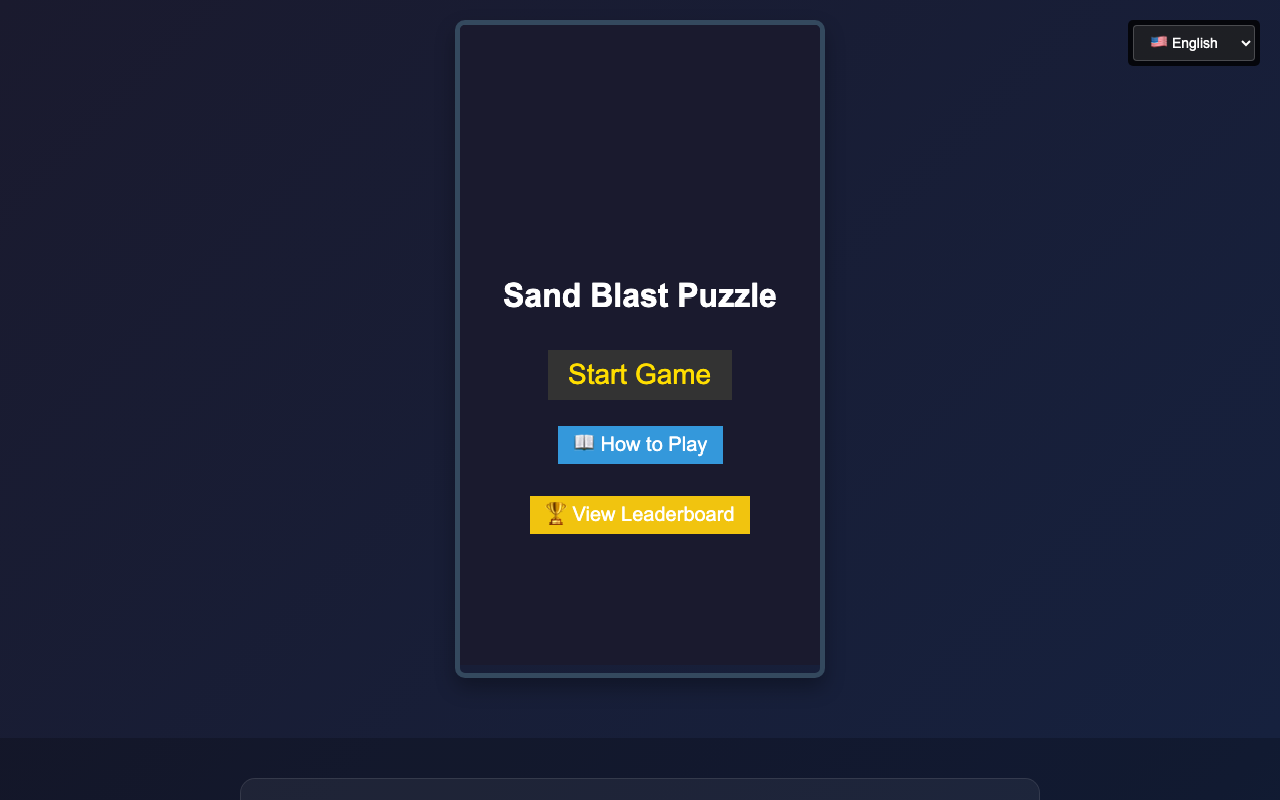
Sand Blast Puzzle
www.sand-blast-block-puzzle.net/en/ →A Tetris-like game shipped entirely with Claude Code
WHAT IT SOLVES
Can AI actually ship a real, playable game from scratch — not a demo, not a toy, but something you'd actually deploy?
WHY IT'S INTERESTING
Not a Tetris reskin — it's a sand-chain puzzle
You drag sand blocks onto a board and chain particles horizontally across the full width to clear them. Sand falls and flows — drop a piece wrong and you clog your own path. It's a different brain-feel than vanilla Tetris, and more tactical than it looks
One person + Claude Code = 6 languages, deployed and live
Full site with 6-language support, FAQ, how-to-play section, standalone domain. Whatever you think of the gameplay depth, this is a deployed product with polish. The HN title reads like a developer proudly showing their AI-built experiment to the world
「"First game built with Claude Code" — the HN post title itself says it all」
TECH GUESS
Frontend generated via Claude Code — likely React or vanilla JS with Canvas, statically deployed
DEEP DIVE
The Experiment: Can Claude Code Ship a Playable Game?
On HN, a post titled "First game built with Claude Code《sand-blast-block-puzzle》" by babyfiev sits at 3 points with 1 comment. The numbers are unimpressive, but the claim itself is worth unpacking: one person, using Claude Code, built and shipped a web game from scratch.
The game is Sand Blast Puzzle, hosted on its own domain (sand-blast-block-puzzle.net), supporting six languages (English, Chinese, German, French, Japanese, Korean), with a full FAQ and how-to-play section. This isn't a sandbox preview link — it's a deployed product on the public web.
Not a Tetris Clone — It's "Sand Merge"
Despite the "block puzzle" branding, the core mechanic diverges from Tetris. You drag sand-grain blocks onto a board and clear lines by connecting sand particles horizontally across the entire screen. Sand has physics — it flows downward — which means placing a block in the wrong spot can clog a path you needed open. This adds a layer of planning that the simple visuals undersell.
As your score climbs, random sand particles drop in to increase chaos. The game ends when blocks stack to the top. It's not Tetris-level deep, but it's not a reskin either — the drag-and-place mechanic combined with sand flow gives it a puzzle feel closer to a grid-based strategy game.
What HN Actually Said: It Runs, But It's Underwhelming
The community response was tepid — 3 points, 1 comment. The lone commenter, selfboot, was blunt: "To be honest, the function is a bit simple, and Claude code should be able to do better. I have also built games using Cursor, and I have to say that the current AI is really strong." selfboot linked their own project, puzzles-game.com, as a counterpoint built with Cursor.
That single comment carries more signal than the post itself. It concedes that AI game-building is "really strong" while implying babyfiev didn't push Claude Code anywhere near its limits. The feature set is thin, the gameplay loop shallow — and that's likely why HN gave it 3 points. The skepticism isn't about whether AI can write games; it's about whether this example demonstrates enough ambition.
The "Minimum Viable Shipped Product" of One Person + AI
Strip away judgments about game depth, and the project demonstrates a practical AI-assisted workflow: one person takes an idea from zero to a publicly deployed product. Six-language support, an independent domain, a complete UI with instructions — all of this requires human decisions about structure, copy, and deployment. Claude Code's job was translating those decisions into working code.
The tech stack is almost certainly a frontend-only setup (React or vanilla JS with Canvas), statically deployed. Claude Code handles this kind of project without breaking a sweat. The real bottleneck was never code generation — it was game design. Is this game worth playing? Does the mechanic hook you? Claude Code can't answer that.
Who Should Pay Attention
Two groups. First, indie developers validating whether "AI writes complete projects" is a real workflow: yes, it works, but don't expect the AI to invent a killer game mechanic for you. Second, product people evaluating AI coding tools: selfboot's comparison is telling — Cursor can do this too, possibly better. The tool isn't the differentiator; product polish is.
babyfiev's post title reads "First game built with Claude Code" with the excitement of someone running an experiment. Honestly, this isn't a game that will keep anyone up at night. It's more of a proof-of-concept — AI can absolutely help you ship a complete product from scratch. Whether anyone plays it a second time is entirely on you.
Discussion (0)
- No comments yet — be the first.
Related
 #229▶ 136
Upload your textbook. AI teaches it back to you, chapter by chapter
 #228▶ 112
Someone needs to watch the AI spend meter
 #227▶ 184
Your users are kittens. Don't let them fall off the cliff