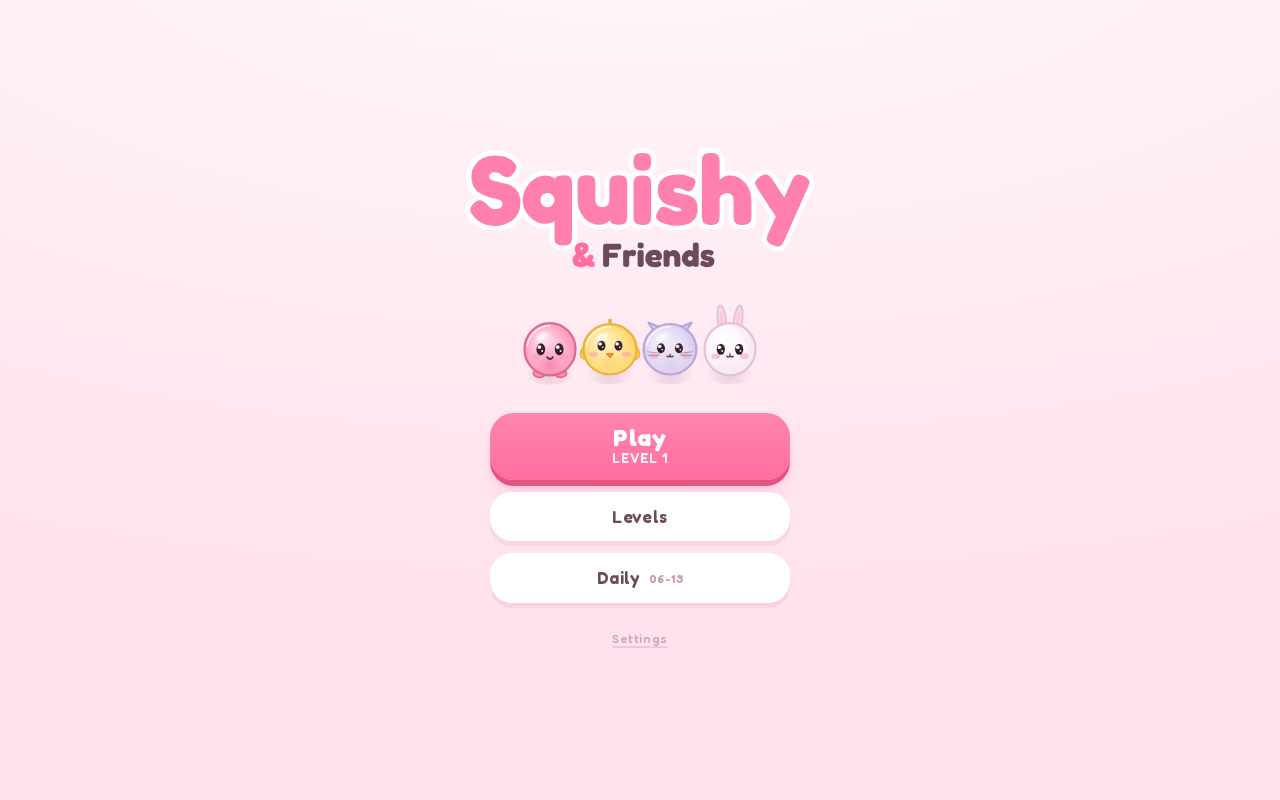
Squishy & Friends
squishy.franzai.com/ →Claude coded an entire game and it's actually fun
WHAT IT SOLVES
AI-generated demos are everywhere, but almost none are polished, shipped games you'd actually play
WHY IT'S INTERESTING
Not a demo — an actual game
35 levels, daily challenges, undo/retry/hint, sound toggle — these aren't vibe-coding defaults, they're the boring polish work that separates a shipped product from a weekend demo
Small and complete, not bloated
Swipe-to-merge puzzle onto a heart. Rules are instant, but 35 hand-tuned levels give it legs. While most AI projects try to shove GPT into everything, this one is deliberately restrained — do one thing, ship it right
UI details that show someone cared
Level-select progress display, hint button interaction logic, sound toggle — none of this gets auto-generated by Claude. Someone sat there and iterated
TECH GUESS
Likely Claude-generated frontend code, statically deployed as a subpage under franzai.com
DEEP DIVE
\n## AI-Generated Games Are Everywhere — But How Many Are Actually Playable?\n\nScroll through Show HN and you'll find no shortage of "Claude/GPT built me a XXX" projects. Click through, and most turn out to be barely functional demos with rough interactions, logic bugs, and zero replay value. What makes Squishy & Friends different isn't the premise — it's the execution. Author franze is upfront: \"Game Logic and Engine is Claude Fabel 5, Design is Claude.ai/Design Opus 4.8.\" But the real story is that this game ships with 35 levels, daily challenges, undo/retry/hint systems, and a sound toggle — features that don't emerge from vibe coding by accident.\n\nThe HN numbers are modest: 4 points, 1 comment. Not a breakout. But Show HN cold starts rarely are. What's more telling is OP's follow-up: \"Fable 5 did not give good designs in this case.\" This isn't a "one-click generates a complete game" fairy tale. It's two pipelines doing their respective jobs — one model for logic, another (Opus 4.8 Design) for visuals — and a human connecting the dots.\n\n## Simple Rules, Real Depth — 35 Levels That Actually Earn Their Place\n\nThe core mechanic is a swipe-based puzzle where you merge squishies onto a heart-shaped target. It sounds like a match-3 variant, but in practice it plays closer to a Sokoban-style logic exercise — you're nudging pieces into position with limited moves. The 35 levels aren't procedurally generated filler; they follow a deliberate difficulty curve that introduces new mechanics progressively. Pair that with the daily challenge (the \"Daily 06-13\" date label is a nice touch), and you've got a retention loop that feels intentional.\n\nMany AI-powered projects suffer from scope disease — they cram in a chatbot, a recommendation engine, voice recognition, and a kitchen sink. Squishy does the opposite. One puzzle type, executed with enough level design depth to sustain extended play. For indie developers, this is the real lesson: the constraint isn't technical ability, it's product judgment telling you what not to build.\n\n## The UI Details Betray the Human-AI Collaboration Rhythm\n\nThe level selector shows progress. The Hint button has clear interaction logic. The sound toggle sits quietly in settings. These details are visible in screenshots, but they're precisely the things that \"AI-generated code\" won't nail automatically. Claude Fabel 5 can produce a working game engine, but "what color should the progress bar be," "what happens when you tap Hint," "is sound on or off by default" — these micro-interaction decisions require a human to iterate on.\n\nThe author's choice to use Opus 4.8 specifically for design reveals a clear understanding of model boundaries: logic layer to one model, design layer to another, human orchestration and polish in between. This isn't a prompt engineering win — it's a product sense win. AI generated the bulk of the code, but 80% of the experience quality comes from the 20% a human manually tuned.\n\n## Who Should Care, and Where the Honest Limits Are\n\nSquishy & Friends' biggest value isn't the game itself — it's as a case study in how a solo developer uses AI coding tools to ship a real, publishable product. If you're an indie dev wondering "can AI help me build something complete," this is your answer: yes, but only if you have the product judgment to fill the gaps AI can't.\n\nThe limits are equally honest. HN's 4 points and 1 comment suggest the project didn't capture the community's imagination in the Show HN context — it's a small-category casual puzzle, not a front-page phenomenon. The franzai.com subpage is statically deployed with no backend, no leaderboards, no social sharing. It demonstrates the floor of AI-assisted development (one person can ship a complete game) without challenging the ceiling (building something that becomes genuinely addictive). But for indie developers, finishing something — shipping it, making it real — is the hardest step of all, and Squishy clears that bar.\n"}
Discussion (0)
- No comments yet — be the first.
Related
 #229▶ 136
Upload your textbook. AI teaches it back to you, chapter by chapter
 #228▶ 112
Someone needs to watch the AI spend meter
 #227▶ 184
Your users are kittens. Don't let them fall off the cliff