Perfumed Palaces
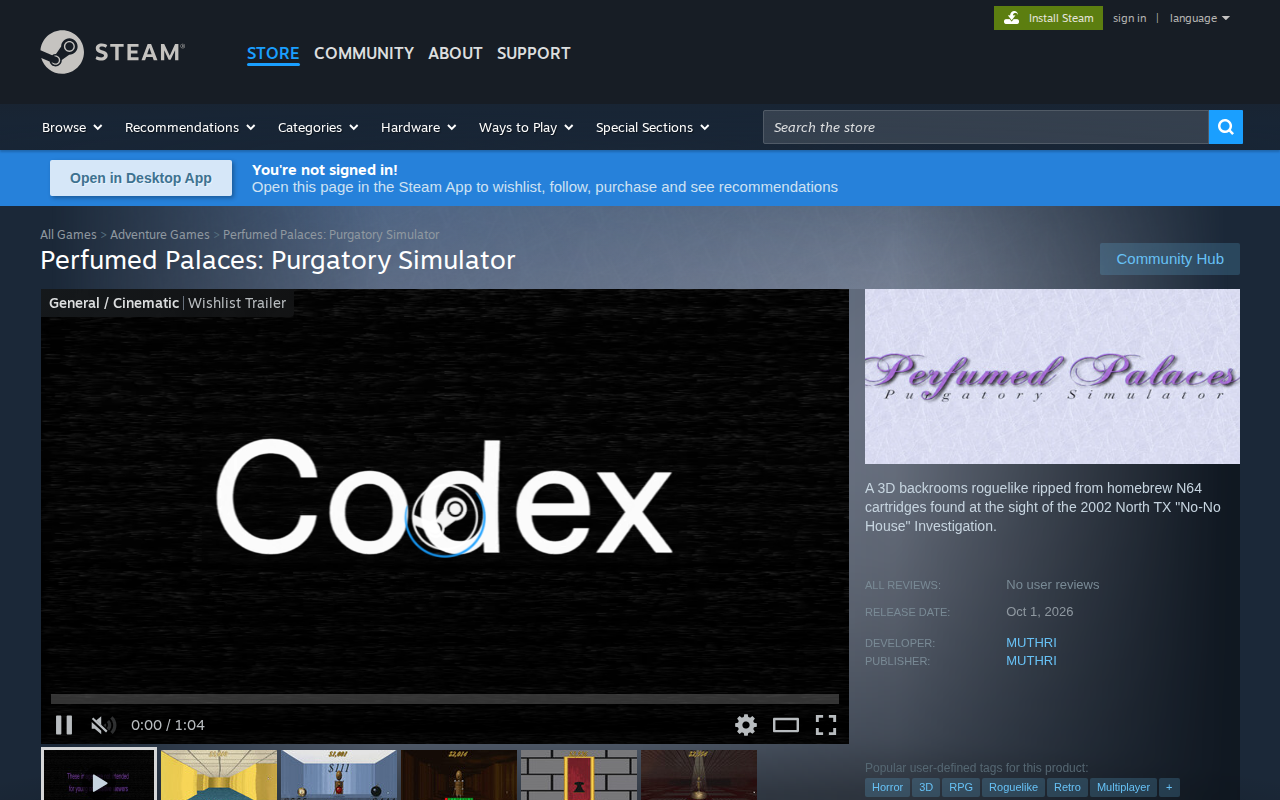
store.steampowered.com/app/4802100/Perfumed_Palaces_Purgatory_Simulator/ →A 30-day VHS nightmare roguelike
WHAT IT SOLVES
Most indie horror leans on jump scares or 'liminal space' aesthetics. Almost nobody actually makes something that feels like it was ripped from a crusty VHS tape
WHY IT'S INTERESTING
Held up by one hell of a backstory
The entire game is framed as a 'homebrew N64 cartridge found at the 2002 North TX No-No House Investigation site.' Even the Steam page reads like an archival document. It's committed to the bit
Zero to Steam in 30 days
The HN title literally says 'vibe-coded in 30 days.' Not a 30-day prototype — 30 days to a live Steam page. That kind of velocity usually means heavy AI assistance or aggressive asset reuse, but the result looks legit
Intentionally ugly in the best way
Deliberately low-poly, blurry textures, VHS scanlines. This kind of 'ugly' is actually harder to nail than polished graphics — and it looks like they nailed it
「"vibe-coded in 30 days"」
TECH GUESS
Likely Unity or Godot with AI-generated textures and heavy use of prefab assets
DEEP DIVE
\n## A 30-Day VHS Nightmare: How One Developer Vibe-Coded an N64 Horror Game\n\nIn a market flooded with jump scares and \"new weird\" narratives, MUTHRI took a different approach. Instead of polished modern horror, he spent 30 days making something that looks like it was ripped from a dirty VHS tape found in a thrift store.\n\nPerfumed Palaces: Purgatory Simulator is a 3D backrooms roguelike, but its selling point isn't mechanical depth—it's the entire \"found artifact\" packaging.\n\n## Not a Game, but \"Evidence\"\n\nThe Steam page reads: \"A 3D backrooms roguelike ripped from homebrew N64 cartridges found at the sight of the 2002 North TX 'No-No House' Investigation.\"\n\nThis isn't just flavor text. MUTHRI packaged the entire game as an archaeological discovery—an N64 cartridge allegedly found at a crime scene in North Texas. The Steam page itself reads like an archival document, with no flashy marketing copy, just cold description.\n\nThis approach is more effective than any jump scare because it builds unease before the player even launches the game: you're not playing a horror game—you're accessing something that shouldn't exist.\n\n## Vibe-Coded: From Zero to Steam in 30 Days\n\nMUTHRI said it directly in the HN post title: \"vibe-coded in 30 days.\" Not a 30-day prototype—a 30-day finished product on the Steam store.\n\nThis speed usually means heavy AI assistance or aggressive asset reuse. Looking at the visuals—low-poly models, blurry textures, VHS scanlines—these N64-era visual tropes aren't born from technical limitation but deliberate choice. This kind of \"ugliness\" requires aesthetic intentionality, which is harder to nail than polished graphics.\n\nThe tech stack isn't public, but it's likely Unity or Godot with AI-generated texture assets. The key insight: this low-fidelity aesthetic actually lowers the art barrier, letting a solo developer ship something in 30 days.\n\n## It Solves a Real Problem\n\nThe indie horror market has a gap: either cheap jump scares or \"new weird\" concepts wearing modern game visuals. Few developers actually make things that look like they were excavated from old videotapes.\n\nMUTHRI didn't innovate technically—he found an aesthetic niche. N64-era visuals combined with backrooms spatial horror is a rare combination on Steam.\n\n## Who Should Play This?\n\nIf you enjoyed Anatomy or Iron Lung—low-tech, high-concept indie horror—or if you're into liminal spaces and found footage aesthetics, this is worth a look.\n\nBut honesty check: 0 reviews (at time of writing), 4 HN points, 0 comments—this suggests virtually no community traction so far. A 30-day project's quality and depth remain unknown quantities.\n\n## A Bigger Observation\n\nMUTHRI's approach represents an emerging pattern: use AI assistance to rapidly ship a \"concept-over-content\" piece, then rely on packaging and narrative to carry it. This isn't necessarily bad, but it means indie horror may increasingly resemble performance art—variable polish, concept-first.\n\nFor developers, the takeaway isn't technical—it's about framing: sometimes a good story about a game is more memorable than the game itself."}
Discussion (0)
- No comments yet — be the first.
Related
 #229▶ 136
Upload your textbook. AI teaches it back to you, chapter by chapter
 #228▶ 112
Someone needs to watch the AI spend meter
 #227▶ 184
Your users are kittens. Don't let them fall off the cliff