Tail Panic
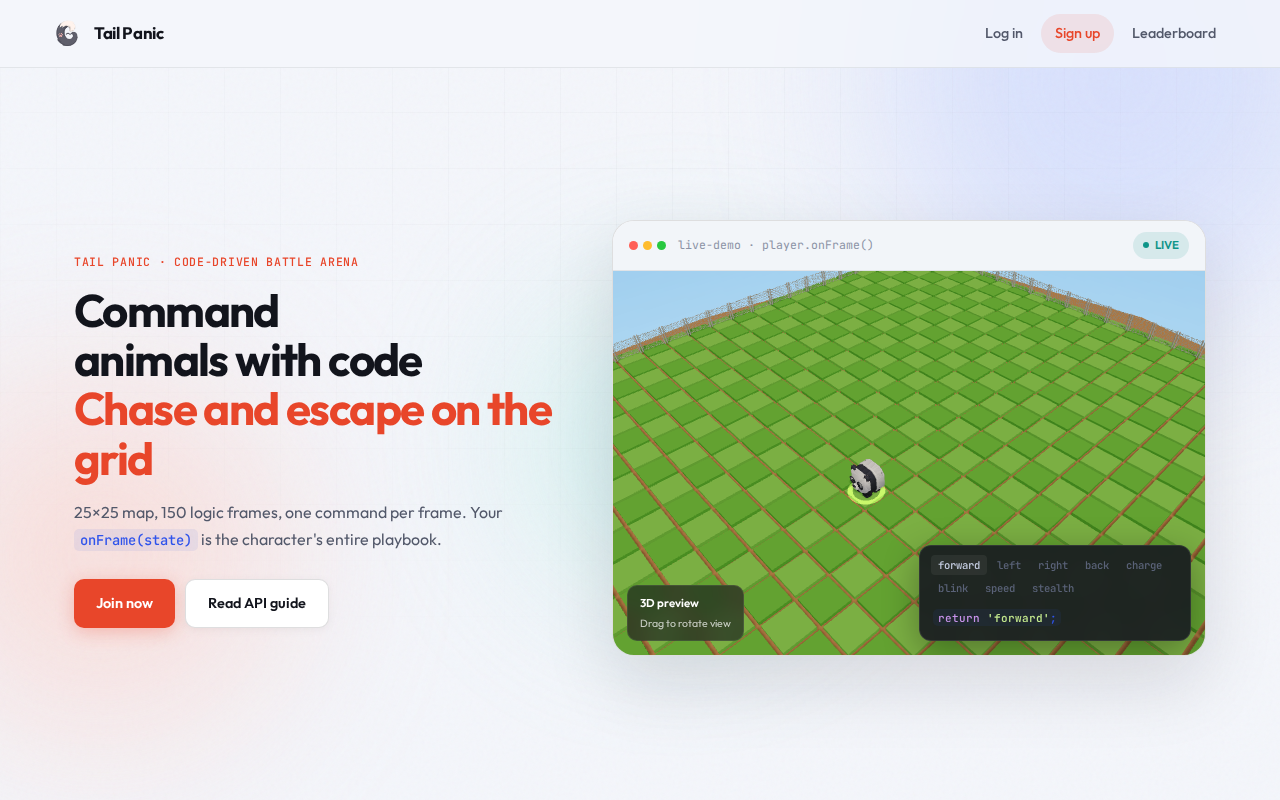
tailpanic.com/ →Prompt AI to write your bot. Then watch it chase or run for its life.
WHAT IT SOLVES
Everyone says AI can code. But can it write strategy that actually wins a competitive match? You need a sandbox where bots fight, not just compile.
WHY IT'S INTERESTING
Code battles that feel like an actual game
Chasers vs evaders on a 25×25 grid with real skills—charge, blink, speed, stealth. This isn't LeetCode. It's writing a playbook that keeps your animal alive. And yes, there's a 3D replay viewer you can drag to rotate—for a 2D grid game.
One action per frame. 150 frames to live or die.
Your code runs sandboxed. The onFrame function returns one action string per frame—that's it. init, chooseSkills, onFrame: three hooks, tight constraints. The author baked AI-assisted coding into the gameplay loop itself—have GPT draft your strategy, throw it in, see if it survives.
「A little game where you get AI to write code for chasing and escaping—anyone want to play?」
TECH GUESS
React + Three.js on the frontend, Node.js backend, user code sandboxed via web worker or isolate
DEEP DIVE
\n## The AI Strategy Proving Ground: More Than Just Another Demo\nTail Panic answers a very specific, timely question: When you prompt an AI to write code for a complex task, how good is the resulting strategy, really? The creator states the mission plainly: \"made a small game where AI writes code for escaping and chasing, anyone wants to play?\" (original v2ex post). This isn't another \"use AI to build Flappy Bird\" demo. It's a standardized arena where your AI-generated (or hand-coded) logic is pitted against others in a constrained, observable environment. The premise—commanding animals on a 25×25 grid, with each script limited to one action per frame across 150 frames—transforms abstract code generation into a tangible, competitive sport. The key insight is providing a closed, rule-based system where the output of AI coding tools can be meaningfully evaluated beyond syntactic correctness.\n\n## The Elegant Constraint: Three Scripts, One Action Per Frame\nThe design philosophy is elegant in its simplicity. Scripts are structured into init, chooseSkills (pick from abilities like charge, blink, speed, stealth), and the core onFrame(state) function. The brutal constraint? This function must return exactly one action string per frame (e.g., 'forward'). This does two brilliant things: it forces strategic clarity and extreme prioritization, and it creates a perfect benchmark for AI. An LLM must understand the game state, weigh skill cooldowns against positional data, and distill its strategy into a single, discrete movement command. The 150-frame limit means the script is a finite playbook, not an infinite loop. The 3D replay viewer (powered, I'd guess, by Three.js) is a slightly incongruous but welcome feature that elevates tactical analysis and spectatorship for this 2D grid game.\n\n## From Generation to Verification: Closing the AI Coding Loop\nWhere Tail Panic truly shines is in closing the AI coding feedback loop. Today, tools like Copilot can generate code instantly, but verifying its robustness—especially in adversarial, dynamic scenarios—remains difficult. This arena provides a battlefield for exactly that. The HN discussion (score 23, 6 comments) hints at its appeal to the technically inclined. User kord shared a concrete strategy: their ClawBot \"analyzes the state and creates a chaser that will skip obstacles if aligned with a target, else calculates distance to nearest enemy.\" More tellingly, a deeper game-theoretic discussion emerged: user p4bl0 questioned if an \"asymptotic best strategy\" exists where the chaser, who can always mimic the evader's logic, will eventually always win. This progression from tactical sharing to analyzing fundamental equilibrium shows the platform is fostering genuine depth, not just novelty.\n\n## Current Limitations and the Honest Path Forward\nAs an indie project, Tail Panic's community is nascent, and its limitations are honest. First, the developer toolchain. p4bl0 highlighted a critical pain point: \"testing the script in the browser is painful... I would have expected a Node.js CLI to test it locally.\" This is a non-negotiable for serious iteration. Without robust local simulation and debugging, the cycle of prompt-debug-test-deploy is too slow. Second, is the risk of a solved meta-game. If the community, aided by AIs, quickly converges on one dominant strategy, the competitive ecosystem collapses. Whether the skill set (charge, blink, etc.) has enough rock-paper-scissors depth to sustain diversity is a existential question for the platform's longevity. Finally, while the 3D replay is cool, it feels slightly disconnected from the core 2D logic puzzle that defines the game's heart.\n\n## Who Should Play This?\nTail Panic is a must-try for two groups. 1) Developers and researchers stress-testing LLM coding capabilities in a constrained, logic-heavy domain. You can design progressively harder prompts and measure outcomes. 2) Coders who find LeetCode dry but love algorithmic puzzles with a visual, competitive payoff. It’s more engaging than abstract challenges. However, if you dislike debugging via console.log in a browser, or crave immediate, slick gameplay without writing a line of code, this isn't for you. It’s a specialized tool—a fantastic proving ground for AI strategy, a fun coding challenge—but still early in its journey to becoming a robust, enduring competitive platform.", "status": "success" }
Discussion (0)
- No comments yet — be the first.
Related
 #229▶ 136
Upload your textbook. AI teaches it back to you, chapter by chapter
 #228▶ 112
Someone needs to watch the AI spend meter
 #227▶ 184
Your users are kittens. Don't let them fall off the cliff