tmppr
tmppr.com/ →When AI agents need to do code review on each other
WHAT IT SOLVES
You spin up 10 coding agents to work in parallel. Who reviews the code? Who decides what merges? You can't keep up
WHY IT'S INTERESTING
GitHub workflows, but local and built for agents
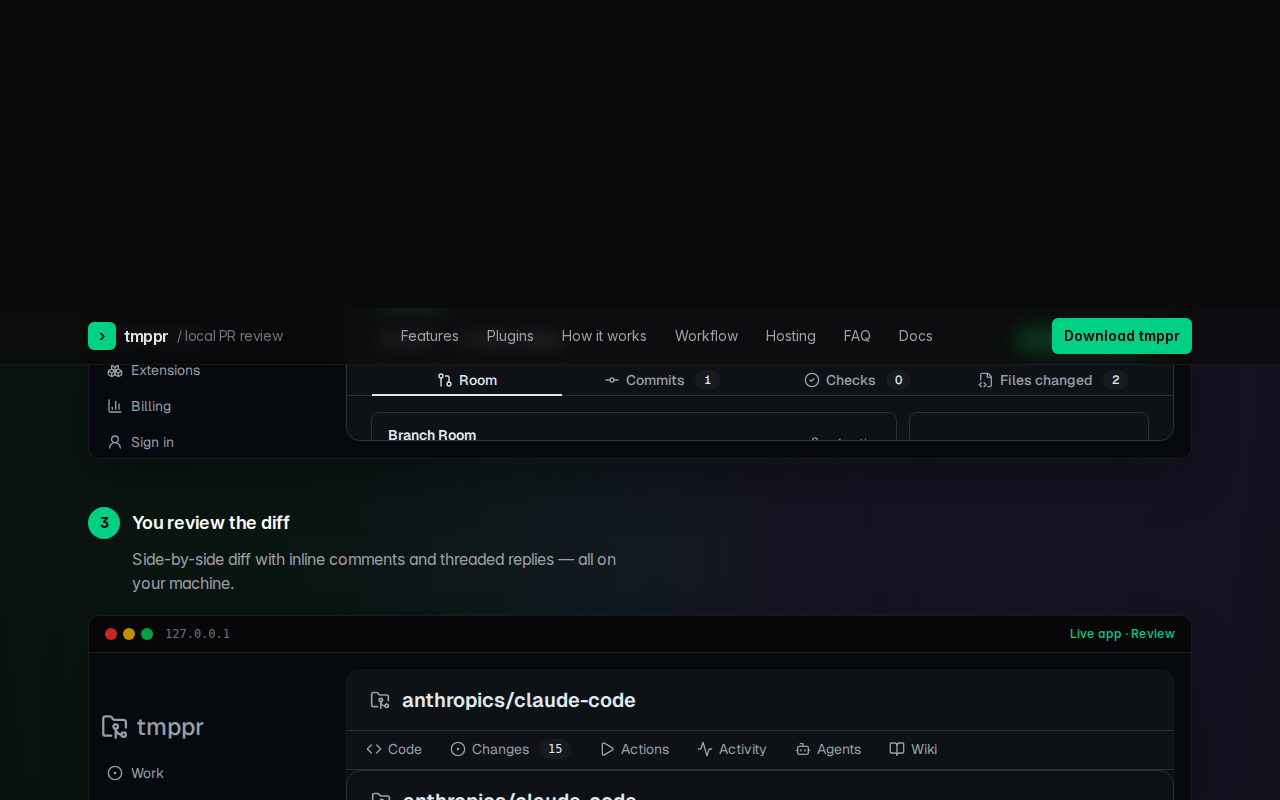
PRs, CI, review, issues, automations, merge rules — all the collaboration primitives devs already know, but running locally so agents coordinate with each other. Not another CLI wrapper — it redefines how agents divide work
The plugin SDK is real, not just a YAML with delusions of grandeur
The plugin SDK lets you add agent providers, automation triggers, merge rules, hook executors, event subscribers — the author actually thought about extensibility instead of hardcoding everything and calling it a day
TECH GUESS
Node.js/TypeScript, Git-backed local repos, plugins distributed as npm packages
DEEP DIVE
\n## The Agent Pipeline Problem Nobody Talks About\n\nIf you're serious about using AI coding assistants like Cursor, Windsurf, or Claude Code, you'll hit a wall fast: you spin up 3-5 agents working on different modules in parallel, and then what? Who merges the branches? Who runs CI? Who reviews the machine-generated pull requests? A human staring at the screen line-by-line can't keep pace with agent output speed — this isn't hypothetical, it's the actual bottleneck every developer running multi-agent workflows encounters. tmppr's thesis is sharp: take GitHub's collaboration primitives (PRs, CI, reviews, issues, automations) local, but serve AI agents instead of human teams.\n\n## What It Actually Solves\n\ntmppr isn't another Git CLI wrapper. It creates a local forge where multiple agents coordinate through a unified collaboration surface. Concretely: Agent A finishes a feature and opens a local PR. Agent B gets triggered to review that PR and run local CI. If the review passes and CI is green, the system auto-merges according to your preset rules, then triggers Agent C to tackle the next issue. The entire pipeline reuses GitHub workflow semantics developers already understand — PRs, reviews, CI gates, merge rules — but runs locally with zero latency and full control, no GitHub dependency required.\n\nThe design is clever because it doesn't invent new concepts. It ports existing consensus to a new context. Developers don't need to learn a new collaboration paradigm; they just need to accept that \"agents also need a PR process.\"\n\n## The Plugin System Is Where the Real Ambition Lives\n\nOn the surface tmppr is a local PR tool, but author douglaswlance clearly has bigger plans. The @tmppr/plugin-sdk exposes six extension dimensions: agent providers (plugging in different LLM/agent frameworks), automation triggers (custom trigger conditions), merge rules (custom merge strategies), hook executors, and event subscribers. This means you can integrate any agent provider (not just Cursor or Claude Code), define arbitrarily complex merge rules (e.g., \"Agent A's PR must have Agent B's approval and test coverage above 80%\"), and subscribe to events for monitoring or logging. This isn't a config-file problem — the author is building a genuinely extensible platform, not a hardcoded tool.\n\n## Honest Limitations and the Cold-Start Dilemma\n\nHere's the reality check: as of writing, this Show HN post has exactly 2 points and 0 comments. The community either hasn't discovered it or hasn't been convinced. Technically, tmppr faces real challenges: built on Node.js/TypeScript with plugins distributed via npm, non-JS developers face extra onboarding costs. Running locally means no built-in remote collaboration (though that's arguably the selling point). And the review quality between agents depends entirely on the LLMs you plug in — if Agents A and B use the same model, having them review each other might just produce mutual head-nodding without genuine adversarial scrutiny. Additionally, tmppr requires you to build your own agent orchestration logic; it provides collaboration infrastructure, not an end-to-end solution. For developers who just want to use AI to write code quickly, this abstraction layer may be premature.\n\n## Who Should Actually Use This Right Now?\n\ntmppr fits a specific profile: you're already running multiple AI agents in parallel, your output volume exceeds what you can manually review, and you need local, controllable, extensible collaboration infrastructure to manage agent coordination. If you only occasionally use Cursor to autocomplete a few lines, this tool is overkill. But if you're the kind of \"AI-native developer\" running 3 agents across 3 modules simultaneously and manually checking conflicts and tests on every merge, tmppr's described workflow is exactly the missing piece. The catch: it's very early — no community feedback, no large-scale adoption stories. You'll need to judge for yourself whether the learning investment is worth it right now." }
Discussion (0)
- No comments yet — be the first.
Related
 #229▶ 136
Upload your textbook. AI teaches it back to you, chapter by chapter
 #228▶ 112
Someone needs to watch the AI spend meter
 #227▶ 184
Your users are kittens. Don't let them fall off the cliff