Trails
trails.pieterma.es/ →Fed 100 books to Claude Code — it found the hidden threads between them
WHAT IT SOLVES
You read 100 books but the connections between them live only in your head. Pieter wanted AI to draw the map for him
WHY IT'S INTERESTING
Not summarizing books — finding the threads between them
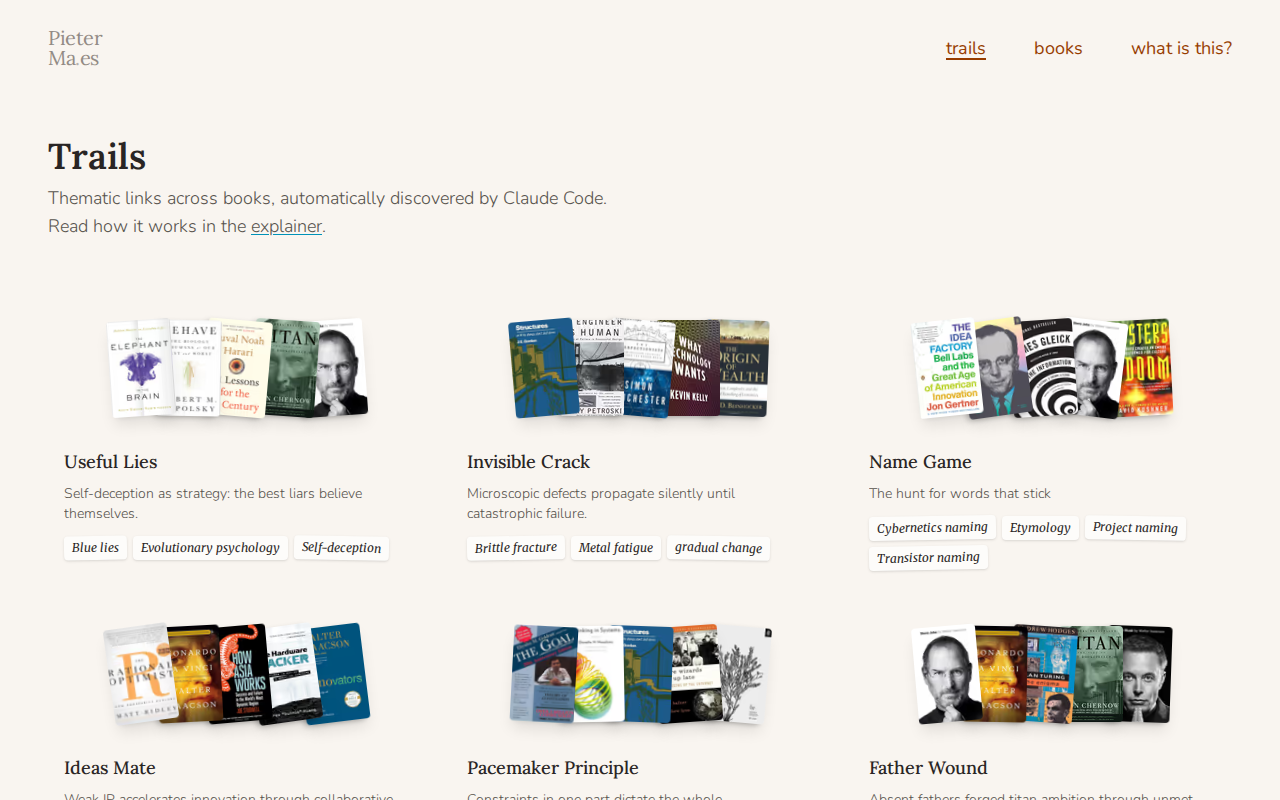
Most people point LLMs at one book. Pieter flipped it — feed 100 books, ask for thematic trails across all of them. 'Useful Lies' threads game theory, evolutionary psych, and self-deception into one trail. 'Invisible Crack' links metal fatigue to systemic collapse. Not summaries — a cross-disciplinary topology of ideas
Trail names and descriptions that actually hold up
'Pacemaker Principle — constraints in one part dictate the whole.' Each trail gets a punchy name and a one-liner that reads like a chapter title from good nonfiction, not AI-generated mush. He also published an explainer showing exactly how the pipeline works
「I used Claude Code to discover connections between 100 books」
TECH GUESS
Claude Code for the analysis pipeline, likely a static site for the frontend
DEEP DIVE
Cross-Book Threads, Not Single-Book Summaries
Most people using LLMs for reading assistance want "summarize this book for me." Pieter Maes (pmaze) inverted the premise: he fed 100 books into Claude Code and asked it to find thematic trails that cut across all of them. The result is a set of cross-disciplinary intellectual topologies — "Useful Lies" links game theory, evolutionary psychology, and self-deception; "Invisible Crack" connects metal fatigue to systemic collapse; "Pacemaker Principle" explores how a constraint in one part dictates the whole. These read like chapter titles from a good nonfiction book, not generic AI summaries. The Show HN post landed 524 points and 132 comments, which signals real interest.
Claude's Obsession With Secrets Reveals Model Aesthetics
Pieter noted in his explainer an amusing side effect: Claude kept getting drawn to themes of secrecy, conspiracy, and hidden systems — as if the task itself summoned a Foucault's Pendulum mindset. HN user joe_the_user quoted this directly and warned: "It's all fun and game 'till someone loses an eye/mind/even-tenuous-connection-to-reality," arguing the themes Claude found are "all pretty grim." This isn't a bug — it's a mirror. The model's training data associates "depth" with "darkness" in nonfiction, and it gravitates there instinctively. Anyone using LLMs for cross-text analysis should be aware of this aesthetic bias.
Pretty Lines, But Do They Mean Anything?
Trails' visual design is a major draw: text excerpts are connected by lines that suggest deep structural links. But multiple HN users flagged the same concern — are those lines semantic or decorative? User smusamashah wrote: "In 'Father wound' the words 'abandoned at birth' are connected to 'did not.' Which makes it look like those visual connections are just a stylistic choice and don't carry any meaning at all." Aurornis agreed: "the connections don't seem correct." Pieter himself admitted the descriptions have a "distinct LLM flavour" but chose to keep them, saying "the recombination of human-written text to be the main interest." It's an honest tradeoff: the visual "connectedness" creates intellectual pleasure, but it may be more fragile than it looks.
Who Should Use This — And What It Actually Solves
Trails is for a specific reader: someone who has read widely in nonfiction but finds that cross-book connections depend entirely on their own recall and intuition. Pieter's goal is a cross-book thought map — not replacing reading, but offering a "so these two books were talking about the same thing" perspective after the fact. The tech is straightforward (Claude Code for backend analysis, likely a static site for the frontend), and the explainer is public. The limitations are real: LLM-flavored descriptions, unverified cross-book links, and the model's own thematic biases. But as a sample of "indie dev running an intellectual experiment with AI," it's more interesting than most AI reading tools — because it asked a better question.
Discussion (0)
- No comments yet — be the first.
Related
 #229▶ 136
Upload your textbook. AI teaches it back to you, chapter by chapter
 #228▶ 112
Someone needs to watch the AI spend meter
 #227▶ 184
Your users are kittens. Don't let them fall off the cliff