Guildly
www.tryguildly.com/ →Your AI team, in a Slack-like workspace
WHAT IT SOLVES
The real pain with multi-agent workflows isn't model quality — it's juggling terminals, tabs, and prompts while context evaporates between each hop
WHY IT'S INTERESTING
Agents aren't chatbots — they're employees
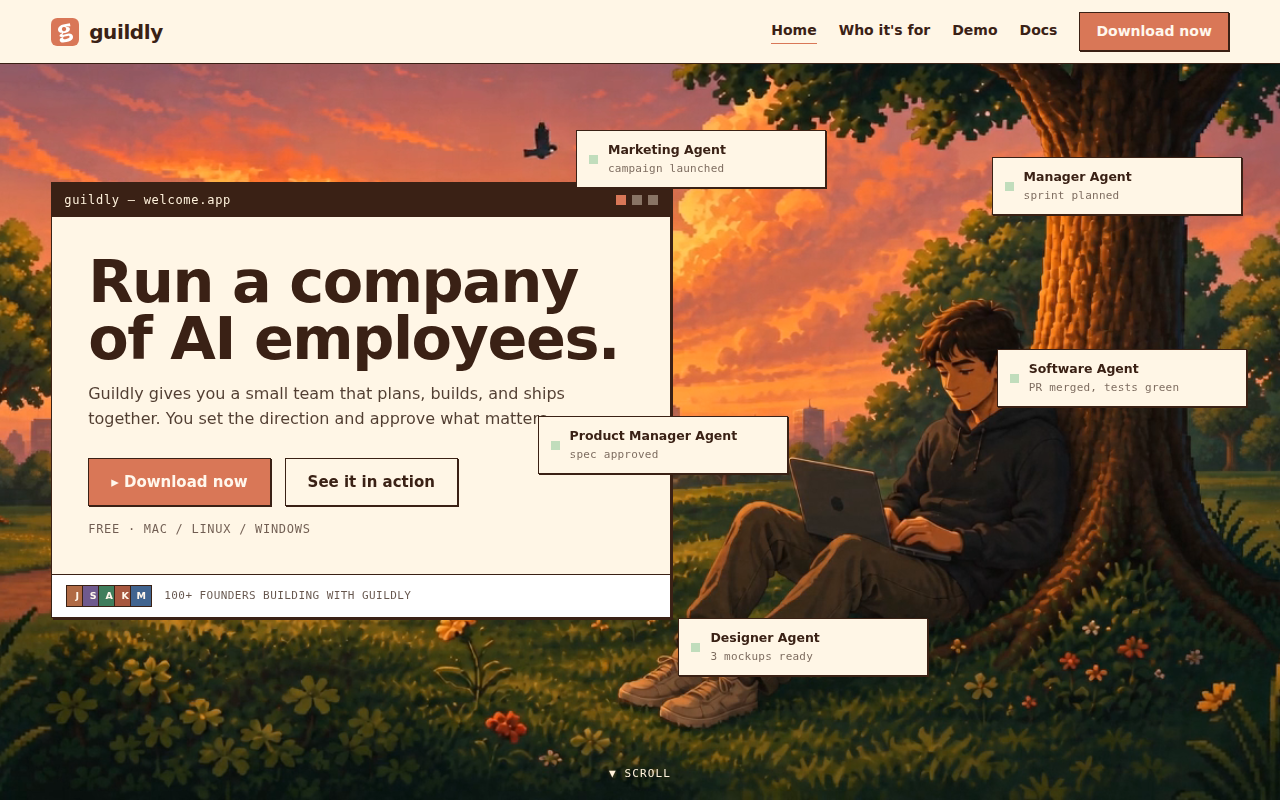
Each agent has a role and a concrete deliverable — Marketing launches campaigns, Software merges PRs, Designer ships mockups. The UI is an org chart, not another chat window. That reframing changes how you think about what AI can own
Shared context that actually chains a pipeline
Sprint planned → spec approved → PR merged → mockups ready — this isn't five agents running in parallel. It's a pipeline where upstream output feeds downstream. Most multi-agent tools can't do this because isolated context is the default
「「A Slack-like interface to run a company of AI employees」」
TECH GUESS
Electron desktop shell + LLM APIs (likely OpenAI/Anthropic), with a custom orchestration layer handling role routing and context handoff between agents
DEEP DIVE
The Real Bottleneck: Context Switching in Multi-Agent Systems
While AI coding assistants are ubiquitous, a more stubborn problem emerges when orchestrating multiple AI agents: the friction isn't in the model's intelligence, but in the collaboration workflow itself. As developer spiken23 pointed out in their Show HN post, you're forced to jump between terminals, tabs, and prompts. Every switch breaks context. Agent A's analysis is unknown to Agent B, and you become a manual "context router," copying and pasting outputs. This turns multi-agent systems into a collection of isolated chat windows, not a cohesive team.
The Solution: From Chat UI to an "Org Chart"
Guildly's core insight is to design agents as "employees" with clear roles and deliverables, not as chatbots. The interface resembles an organizational chart or project board more than a chat window. A Marketing Agent "launches campaigns," a Software Agent "submits PRs," a Designer Agent "delivers mockups." Each role has a dedicated workflow and tangible outputs ("sprint planned," "spec approved," "PR merged"). This aligns better with human mental models of division of labor than a single, all-purpose chatbot.
More crucially, it champions shared context. In Guildly's workflow, upstream outputs (e.g., a spec approved by the Product Manager Agent) automatically feed into downstream agents (e.g., the Software Engineer Agent). This enables a pipeline-style collaboration instead of isolated efforts. As the site states: "One workspace. Shared context. No juggling." This directly attacks the default "context isolation" pain point in most multi-agent tools.
Architecture Guess: A Lightweight Client with an Orchestration Layer
As an Electron desktop app for Mac, Linux, and Windows, Guildly's heavy lifting likely happens in a client-side agent orchestration layer. It probably calls mainstream LLM APIs (like OpenAI or Anthropic) for the "thinking" part, while the application itself focuses on the harder problem: role definition, task routing, and managing context flow between roles. This architecture lets developers focus on the "managing an AI team" layer without rebuilding fundamental LLM interaction plumbing.
Target User: The Solo Founder Tormented by Tab-Switching
Guildly clearly targets independent developers and solo founders. Its website explicitly calls out "Solo founders." For a one-person operation handling code, design, and marketing, switching context between multiple AI tools is a massive efficiency drain. Guildly aims to let you "hire" and manage multiple AI specialists in a unified interface, collaborating on shared project information. You shift from being an "operator" to a "manager" and "decision-maker," intervening only at key gates (approving specs, merging PRs).
Honest Limitations: The Gap Between Vision and Reality
Despite the compelling vision, a sober assessment is necessary. First, community validation is minimal. As of the provided material, the Show HN post had only 2 points and 0 comments, indicating the product is very new and lacks broad feedback from real-world developers. Second, the depth of "shared context" is questionable. Maintaining context consistency and accuracy across multiple agents handling complex, long-horizon tasks without information corruption or loss is a monumental technical challenge. Finally, its effectiveness is tightly coupled to the underlying LLM's capability and stability. If one agent (e.g., the Software Agent) generates inconsistent code, the entire pipeline's reliability suffers. Currently, it's more of a compelling proof-of-concept (PoC) than a battle-tested production tool.
Discussion (0)
- No comments yet — be the first.
Related
 #229▶ 136
Upload your textbook. AI teaches it back to you, chapter by chapter
 #228▶ 112
Someone needs to watch the AI spend meter
 #227▶ 184
Your users are kittens. Don't let them fall off the cliff