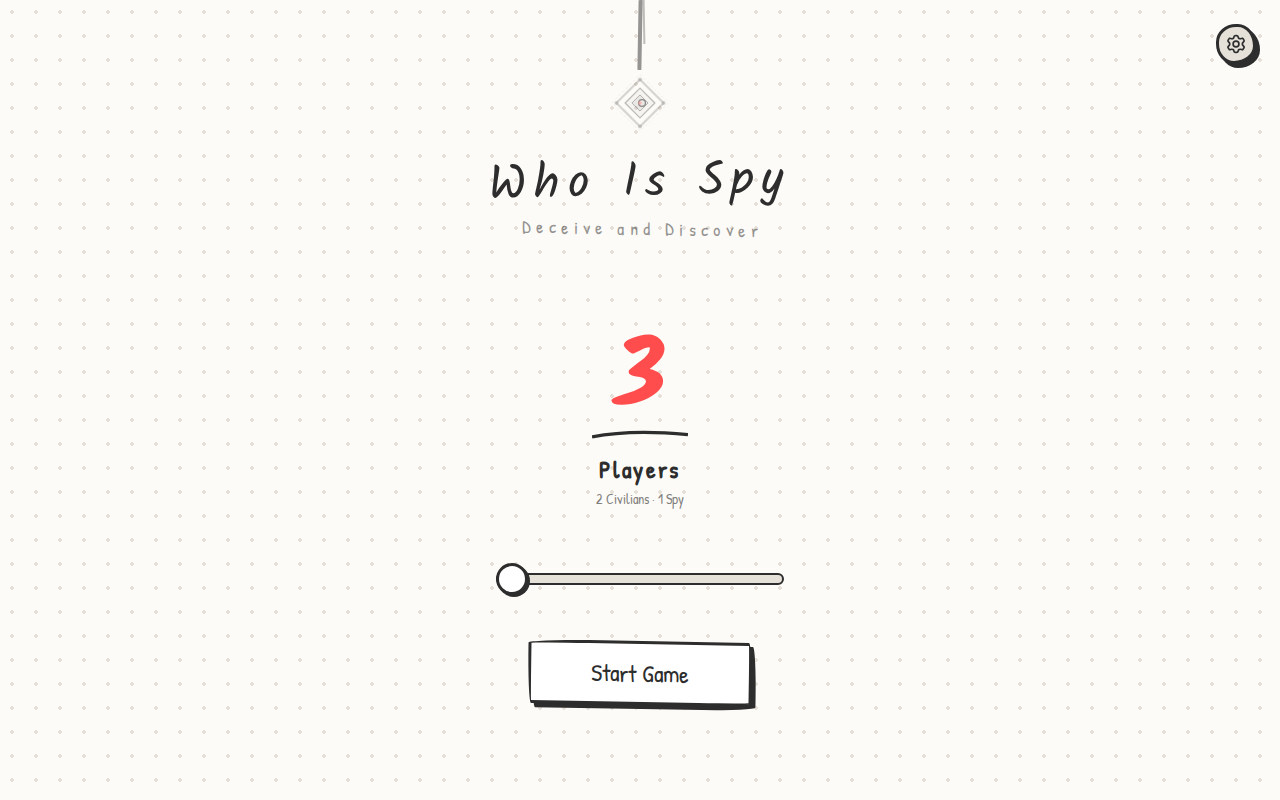
Who Is Spy
undercover-family.github.io/ →A kids' party needs a 'Who Is the Spy' game that just opens and works
WHAT IT SOLVES
The classic party game 'Who Is the Spy' usually needs printed cards, role assignments, and a designated host — not exactly kid-friendly. The online alternatives are buried in ads or locked behind app installs
WHY IT'S INTERESTING
Automates the host's job entirely
Role assignment, word dealing, turn order, voting — all the stuff that normally needs a designated host is handled by the page itself. Kids can run a round completely on their own, no adult hovering required
3-player minimum, word list tuned for kids
Minimum 3 players (2 civilians + 1 spy) means you don't need a full crowd to start. The author also curated a kid-friendly word list so nothing goes over their heads
「A little game I made for the kids for Children's Day」
TECH GUESS
Static frontend hosted on GitHub Pages — no backend needed
DEEP DIVE
A Static Frontend That Replaces the Game Host
zhbhun put it plainly in the V2EX post: "A little Children's Day game prepared for my kid." Behind that sentence lies a real pain point—the classic party game "Who Is the Spy" requires a knowledgeable adult to act as host, handing out words, managing speaking turns, and running the vote. For kids, that's a significant barrier.
What makes Who Is Spy clever is how it automates every host responsibility: role assignment, word distribution, turn control, and voting flow are all handled by the page. Children can start a game with just 3 players—no adult supervision needed. The developer even curated a child-friendly word bank to avoid memes or references kids wouldn't understand.
Technically, this is a pure static frontend hosted on GitHub Pages with zero backend dependencies. That means instant access, no registration, no ads, and no server downtime concerns. For a Children's Day gift, that "opens instantly, plays immediately" experience is the biggest show of care.
The Minimum Viable Party Game
The 3-player minimum is the most pragmatic design decision in this project. Traditional "Who Is the Spy" typically needs 5-8 players to feel fun, but kids' gatherings often can't muster that many. The 2 civilians + 1 spy minimum configuration means any small group can start a round immediately.
This design philosophy echoes what indie developers often say: "solve your own problem first." zhbhun wasn't building a generic "Who Is the Spy" platform—they were solving a specific scenario: kids at a party, a handful of friends, wanting to play a game. Clear goals, restrained features.
Honest Limitations
The project has clear boundaries. First, it's a pure frontend app—game state depends entirely on browser refreshes. If someone exits or closes the page mid-game, the current round is lost. Second, while the word bank is tailored for children, the project structure offers limited extensibility—if you want more themed word lists, you'd likely need to modify the code manually.
Additionally, pure static hosting means it's entirely client-dependent. If two kids share one device to check words, secrecy becomes an issue; while the multi-device, multi-player scenario requires everyone to open the same link, which might be a usability hurdle for younger children.
Who Should Use It
If you're a parent or teacher looking for a zero-barrier game for a kids' gathering, Who Is Spy is a link worth bookmarking. It's not perfect, but it solves the trickiest problem: "who gets to be the host?" A GitHub Pages link, open and play, no ads, no downloads, no sign-ups. For an indie developer's Children's Day gift to their kid, that's good enough.
Of course, if you need more complex gameplay—multi-round elimination, custom word banks, game history—this project probably isn't for you. But for its target scenario, it does exactly enough.
Discussion (1)
- anon119d ago
i'll give a try this weekend
Related
 #229▶ 136
Upload your textbook. AI teaches it back to you, chapter by chapter
 #228▶ 112
Someone needs to watch the AI spend meter
 #227▶ 184
Your users are kittens. Don't let them fall off the cliff