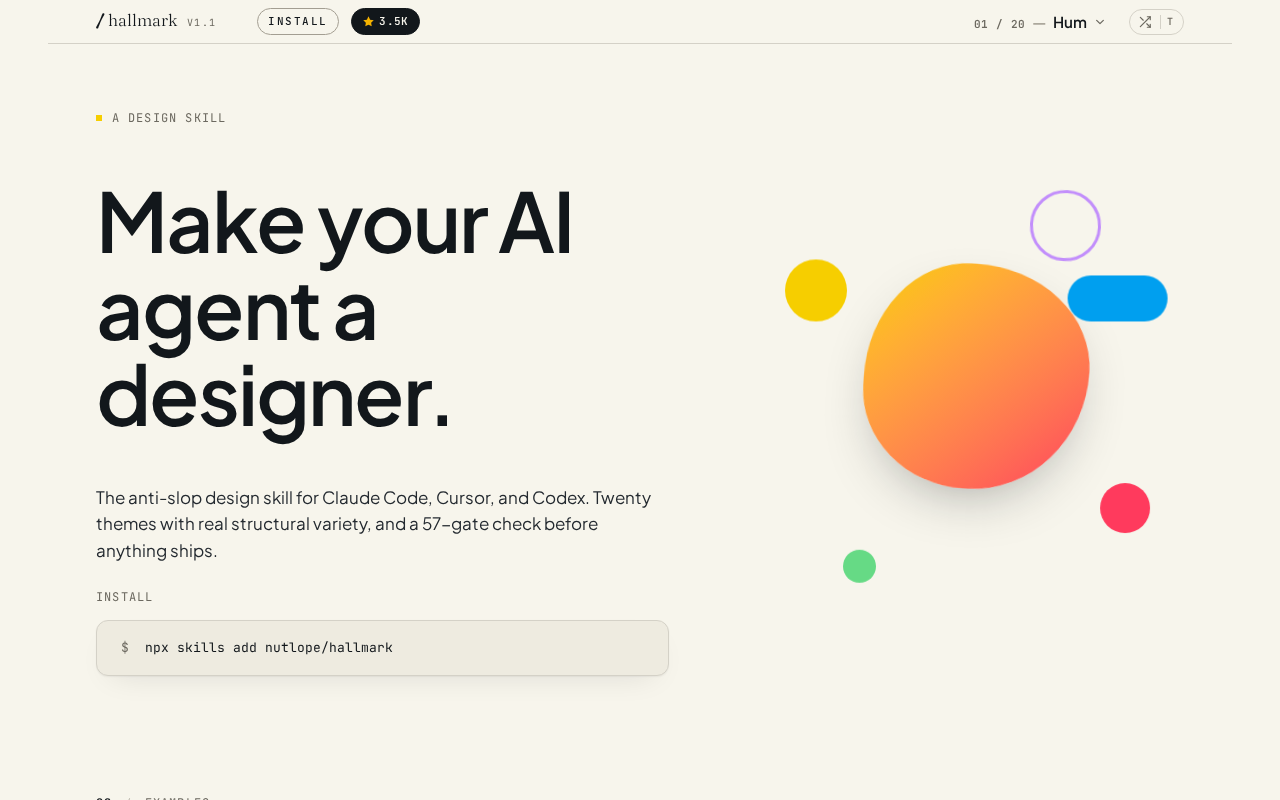
Hallmark
www.usehallmark.com/ →One ruleset to kill AI slop design
WHAT IT SOLVES
AI-generated UIs have that unmistakable plastic feel — fonts, colors, spacing all 'close enough.' Hallmark takes the anti-AI-slop consensus and encodes it into an executable ruleset your coding agent must pass before anything ships
WHY IT'S INTERESTING
57-gate taste check
Not just 'make it look nice.' 57 specific gates covering typography, color, layout, motion, interaction — each one a concrete rule an agent must satisfy. 3.5K installs on V1.1 suggest it's beyond proof-of-concept
20 themes, zero structural overlap
The site shows worked examples — sourdough guide app, repair-café poster, honey farm landing page — each structurally distinct, not just a color swap pretending to be a new theme
TECH GUESS
NPM-distributed skills ruleset backed by Together AI for inference
DEEP DIVE
\n## The Uncanny Valley of AI-Generated UI\n\nIf you've used Cursor or Claude Code to generate front-end pages, you know the feeling. The layout works, the code runs, but something is off. Font weights are too uniform, line heights feel mechanical, color saturation is always slightly wrong, and spacing looks like it was measured with a ruler — just not the right one. Teddy (teddyX), Hallmark's creator, calls this \"AI slop.\" Not ugly, just sterile. Characterless. On HN, he described Hallmark as encoding the \"anti-slop consensus\" into rules your AI assistant will \"actually follow.\" That word \"actually\" tells you everything: he's been burned by AI ignoring design guidance before.\n\n## 57 Gates: Not Vibes, but Brute Enforcement\n\nHallmark's core mechanism is a 57-gate check that runs before any code ships. These gates span typography, color, layout, motion, and interaction — each a concrete checkpoint, not a vague prompt instruction. Most developers try to fix AI aesthetics by writing better prompts. It's unstable, breaks across models, and requires constant re-tuning. Hallmark ships as an npm-distributed skill (npx skills add nutlope/hallmark) that Claude Code, Cursor, and Codex can all read. The 20 bundled themes aren't reskins either — the showcased one-shots (a sourdough tutorial app, a repair-café poster, a honey farm landing page, an indie risograph print portfolio) demonstrate genuinely different structural layouts, suggesting real diversity control at the layout layer.\n\n## 3,500+ Installs with Almost No Buzz\n\nV1.1 has crossed 3,500 installs, yet the HN post landed at only 2 points with 1 comment. That gap is revealing. It suggests sticky adoption among people who've actually hit the problem — developers generating lots of front-end pages who got tired of fighting AI's aesthetic defaults. For them, 57 gates are a lifesaver. For everyone else, \"design skill\" sounds too abstract to click on. The tool hasn't broken into mainstream developer consciousness yet, but its retention numbers imply it's solving a real, recurring pain.\n\n## Together AI: The Hidden Dependency\n\nHallmark is labeled \"Powered by Together AI,\" meaning some pipeline — likely theme generation or gate-check inference — depends on Together's model API. The ruleset itself is local and auditable, but the reasoning layer is remote. If Together's latency spikes or pricing shifts, Hallmark's UX follows. There's no mention of offline mode or self-hosting, which could be a blocker for enterprise adoption. More importantly, the full 57-gate specification isn't published as inspectable documentation. You're trusting Teddy's definition of \"anti-slop\" without the ability to audit or customize each rule individually. For a tool that positions itself as a design authority, that's a notable gap.\n\n## Who Should Actually Use This\n\nIf you're an indie developer batch-generating landing pages, demos, or portfolio sites with AI, Hallmark is worth trying. It won't make you a designer, but it'll push AI output from \"functional\" to \"not embarrassing.\" If you already have a mature design system or strong custom UI requirements, this generic ruleset will likely clash with your existing standards. Its sweet spot is rapid prototyping, side projects, and situations where you need a visually decent page in ten minutes without hand-tuning every CSS property. The honest verdict: it's a solid starting constraint, not a destination.", "role": "assistant"}
Discussion (0)
- No comments yet — be the first.
Related
 #229▶ 136
Upload your textbook. AI teaches it back to you, chapter by chapter
 #228▶ 112
Someone needs to watch the AI spend meter
 #227▶ 184
Your users are kittens. Don't let them fall off the cliff