Vibefolio
vibefolio.link/ →You've vibe-coded 20 projects. Now what?
WHAT IT SOLVES
Vibe-coders are shipping projects faster than ever — a weekend game here, a Claude expense tracker there. But there's no good place to show it all off. GitHub is too technical, a personal site is too much work, and Linktree doesn't know what a 'vibe-coded project' even means
WHY IT'S INTERESTING
Not a generic portfolio — built for the vibe-coding era
Each project card slots in the AI tool used (Claude, GPT-4.1, Cursor) right next to the launch date. That's not an accident — it's saying: what you built it with and how fast you shipped it ARE part of the story. Generic portfolio templates don't think like this
2-minute setup, but the card design is surprisingly dense
Each card packs emoji, project name, live URL, description, tags, and launch date — just enough for someone to grok what you've built without scrolling. It reads like a curated changelog, not a dump of links
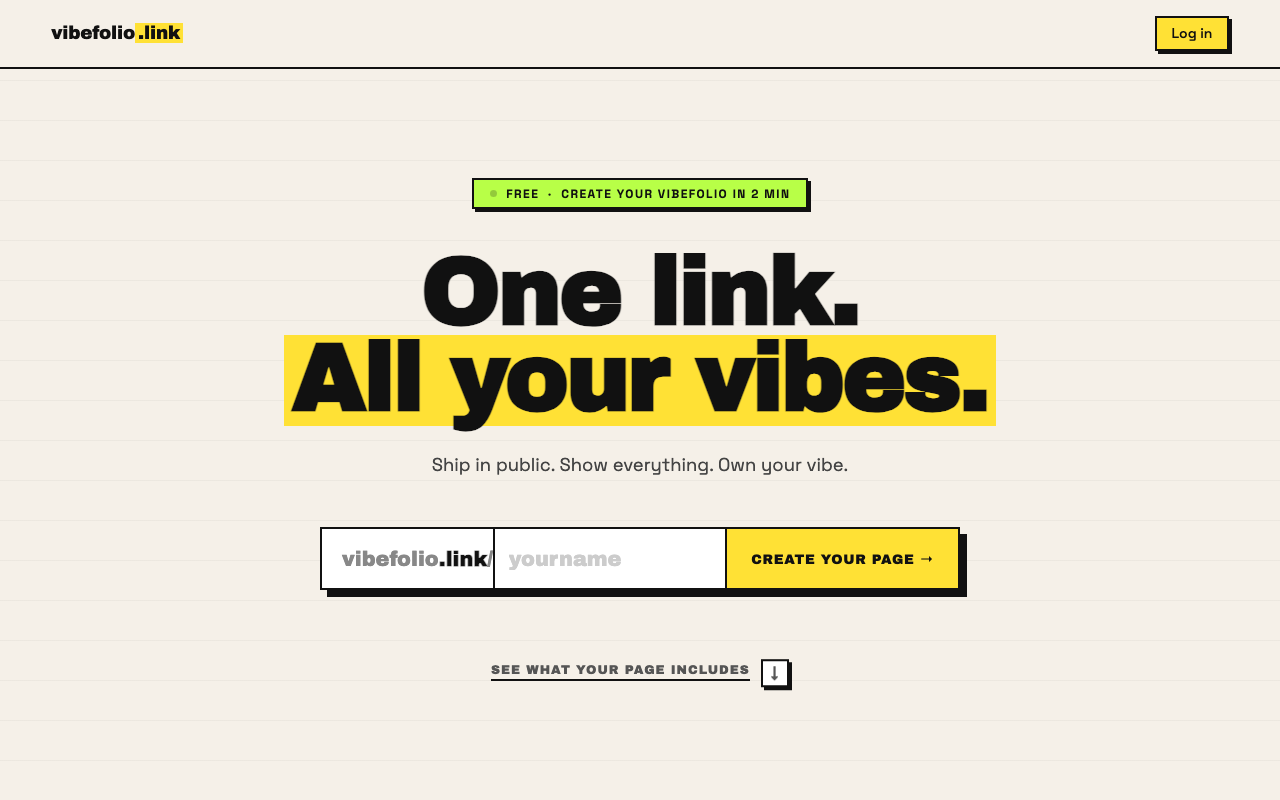
「Ship in public. Show everything. Own your vibe」
TECH GUESS
Likely Next.js or similar on Vercel — the backend is light, it's essentially a page builder with auth
DEEP DIVE
You've Vibe-Coded 20 Projects. Now What?
Vibe coding has made it trivially easy to ship a working product in a single evening using Cursor or Claude. But there's a gap between "it runs" and "anyone sees it." Your weekend projects live scattered across GitHub repos, Vercel deployments, and Twitter threads with no single place to tell the full story. Vibefolio aims to fill that gap: a public portfolio page built specifically for vibe coders, one link to showcase everything you've shipped.
The Show HN post by Gooblebrai landed 13 points and 11 comments — modest numbers, but notably, several commenters created pages on the spot. That kind of immediate conversion in a Show HN thread signals the product is scratching a real itch.
Every Project Card Is Making a Statement: The Tool and the Speed Are the Work
The most interesting design decision in Vibefolio is the project card structure: emoji, project name, live URL, description, tags, and launch date — with dedicated slots for AI tool labels. Look at the official example: "🤖 Claude expense tracker — Track spending with plain English. Built in a weekend with Claude. Claude React Feb 2026."
This is deliberate. It sends a signal: what tool you used and how fast you shipped are part of your portfolio. Traditional portfolio templates don't think this way. Behance and Dribbble showcase visual polish. GitHub showcases code depth. Vibefolio showcases "I built something functional in one evening with Claude." That's a genuinely new dimension of capability that roughly 90% of existing portfolio tools have no paradigm for.
The information density is well-calibrated, too. Each card gives just enough for someone to judge what you built, what you used, and when — without overwhelming them. It reads like a well-formatted changelog, not a dump of links.
Community Feedback Exposes Real Issues
Two pieces of HN feedback are worth noting. User sanjosanjo tried the product immediately and flagged: "Category dropdown doesn't seem to be populated when I'm adding/editing projects." Gooblebrai acknowledged the UX problem — categories must be edited from the profile page first, then assigned to projects, a flow that's not at all obvious to new users. It's a small bug, but it reveals a classic developer blind spot: the creator's mental model doesn't match the first-time user's.
User doc_ick left a more revealing comment: "I may end up vibe coding my own showcase page." Using vibe coding to build a tool for showcasing vibe-coded projects — the meta-ness highlights the platform's core vulnerability. The barrier to entry is so low that someone could clone Vibefolio in two hours. Where's the moat?
Two-Minute Page Creation, Lightweight Stack Behind It
From the product's shape, Vibefolio is essentially a page generator with authentication. The frontend is most likely Next.js deployed on Vercel; the backend is minimal — core functionality is just project card CRUD plus public page rendering. That's why one person could build it. Gooblebrai didn't mention using AI-assisted coding in the post, but given the timing and the vibe coding context, it's a safe bet the product itself was vibe-coded. Using vibe coding to build tools for vibe coders is arguably the best form of user validation.
Who Should Use It — And Honest Limitations
Right fit: independent developers with many weekend projects who want people to see what they built, not how elegant their code is. If you're already shipping in public on Twitter/X, Vibefolio works as a structured supplement — one link and someone can see your full project timeline.
Wrong fit: developers wanting to showcase polished UI design or deep technical projects. The card template is a fixed structure — you can't customize layouts, embed demo videos, or display architecture diagrams. It solves a density problem, not a depth problem.
Another honest limitation: Gooblebrai himself admitted, "I don't know about employers or how they would perceived vibecoding." That's a real market question. If hiring managers don't value AI-assisted rapid output, Vibefolio's value stays limited to community presence and personal branding — not a hard currency for job hunting anytime soon.
Overall, Vibefolio is a small, precise product. It doesn't try to be a universal portfolio; it targets one specific pain point of the vibe coding era. 13 points and 11 comments on Show HN isn't a breakout, but the immediate on-platform actions from commenters suggest genuine demand. The open question: when vibe coding becomes the default workflow, will larger platforms like Vercel or GitHub simply absorb this use case?
Discussion (0)
- No comments yet — be the first.
Related
 #229▶ 136
Upload your textbook. AI teaches it back to you, chapter by chapter
 #228▶ 112
Someone needs to watch the AI spend meter
 #227▶ 184
Your users are kittens. Don't let them fall off the cliff