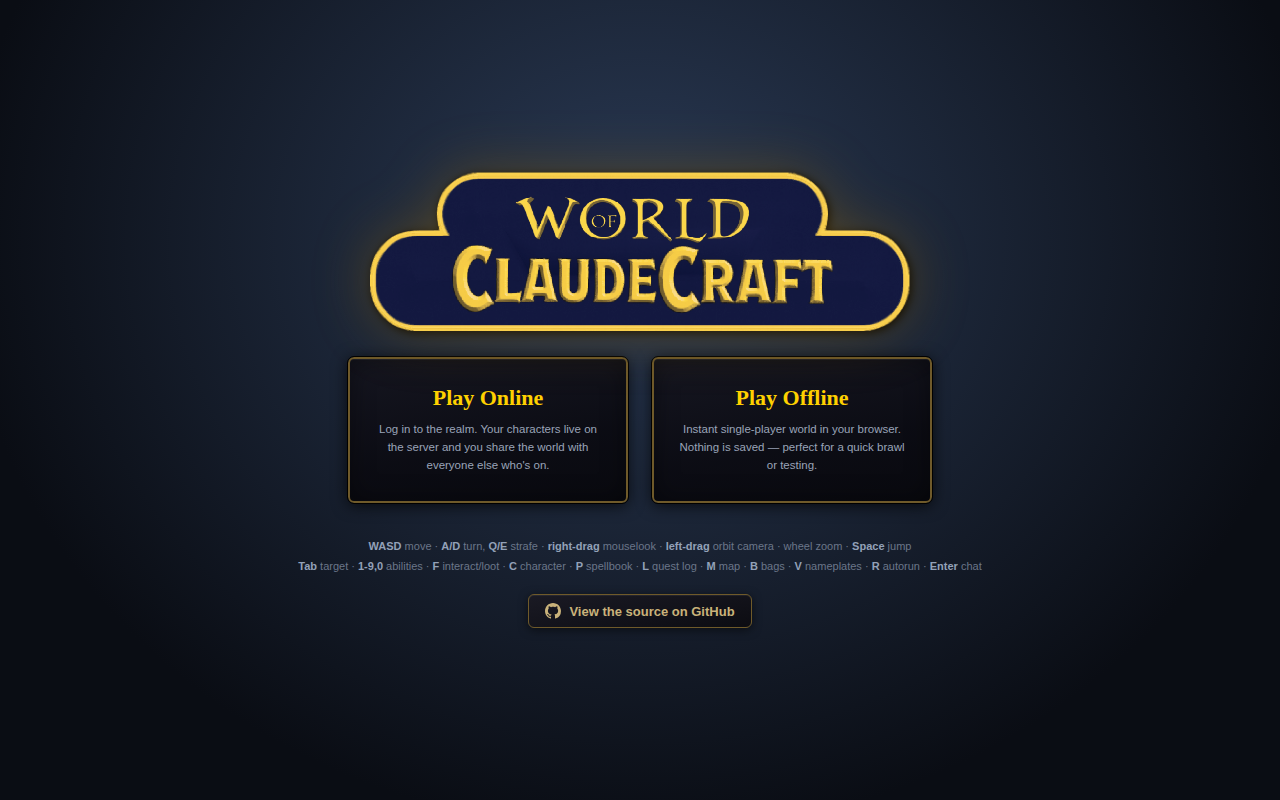
World of ClaudeCraft
worldofclaudecraft.com/ →Someone vibe-coded an actual MMO with Fable 5
WHAT IT SOLVES
How far can vibe coding actually go? Someone built a persistent multiplayer RPG in a browser
WHY IT'S INTERESTING
It's more than a tech demo
Persistent characters, multiplayer server, offline mode, full WASD controls, action bars, quest log, inventory — this isn't a cube in a 3D scene shipped for karma
The UI isn't AI slop
Damage numbers in the combat log, tab targeting, F to interact/loot, V for nameplates — this is a real MMO control scheme, not a one-click demo
TECH GUESS
Fable 5 (3D engine), frontend-heavy, server-side multiplayer sync, open source on GitHub
DEEP DIVE
\n## Testing the Limits of Vibe Coding: An MMO in Two Days\n\n“Vibe coding” — writing software by describing requirements in natural language — is no longer novel in 2024. But when someone claims to have built an MMO this way, skepticism is natural. World of ClaudeCraft, shared by developer ls-sadboy on Reddit’s r/ClaudeAI and later on Hacker News (86 points, 94 comments), does exist and is playable.\n\nThe developer clarified in HN comments: “I built this with Fable over a couple of days, on the side. It’s a vanilla-WoW-flavoured micro-MMO in the browser.” The project includes nine classic classes, three zones, a 5-player instanced dungeon, parties/duels/trades, and persistent characters. Crucially, the entire development used Fable 5 (a 3D engine), and the developer claimed to have “used like 93% of my Max plan over the course of 2 days to get the initial version running.” This proves vibe coding is no longer a toy: when AI tools are powerful enough, a solo developer can build structurally complex multiplayer online games.\n\n## Beyond the Demo: A Real MMO Control Scheme\n\nMany AI-generated “games” are just a cube moving in a static scene. World of ClaudeCraft’s UI design reveals deliberate effort: a real-time combat log with specific damage numbers in the lower left; Tab to target; number keys 1-9 for abilities; F to interact/loot; V to display player names; even autorun (R键) and a chat box (Enter key). This is a fully mature MMO keybinding scheme, not a crude click demo.\n\nThe control logic is also thoughtful: WASD movement, right-click to attack, left-drag to orbit camera. Some users complained this isn’t trackpad-friendly (“right-click attack isn’t friendly to clickpad configurations”), but this shows the developer referenced real MMO interaction paradigms rather than cutting corners. The project offers both an online mode (characters saved on server, shared world) and an offline mode (single-player in-browser, no saving, good for quick testing), demonstrating consideration for actual use cases.\n\n## Developer Profile: A Side Project Testing Fable\n\nDeveloper ls-sadboy stated on HN this was “a side project built with Fable over a couple of days.” Structurally, it’s frontend-heavy, with the GitHub repo fully open-source (MIT license). Multiplayer functionality clearly requires server synchronization, but the developer didn’t detail the architecture. Notably, their Reddit account was banned (HN users speculated “spamming en bulk” or “other platform ban”), adding some mystery to the project.\n\nThe community was more curious about the development process. User noworriesnate asked: “Was a lot of this Fable orchestrating sub-agents with cheaper models?” The developer replied: “No this was all running on Fable.” This implies Fable 5 itself can handle complex game logic, rather than relying on layered agents. Another user requested prompts to gauge developer involvement, but got no reply. This raises a key question: where are the limits of vibe coding? Did the developer guide the process throughout, or just write prompts and wait?\n\n## Who Should Use This? Honest Limitations?\n\nWorld of ClaudeCraft suits two audiences: developers wanting to understand AI coding tool boundaries — it proves building complex systems with persistent state and multiplayer interaction via natural language is feasible; and indie game developers — it offers an open-source micro-MMO framework to build upon.\n\nLimitations are equally clear. First, it’s currently desktop-only; multiple users reported “can’t interact on mobile.” Second, as a “couple of days” output, its content depth is limited (three zones, nine classes), incomparable to mature MMOs. Most importantly, the developer didn’t reveal specific prompts or dev logs, so we can’t judge how much vibe coding truly “generated” core game logic versus just assembling existing modules. One user commented sharply: “You did a great job writing a prompt. Congratulations.” This skepticism isn’t unwarranted: if AI merely translated high-level design docs, vibe coding’s innovation diminishes.\n\nStill, it’s a milestone experiment: when a solo developer can build a playable multiplayer MMO prototype in two days with one Max subscription and natural language, game development democratization takes another step forward." }
Discussion (0)
- No comments yet — be the first.
Related
 #229▶ 136
Upload your textbook. AI teaches it back to you, chapter by chapter
 #228▶ 112
Someone needs to watch the AI spend meter
 #227▶ 184
Your users are kittens. Don't let them fall off the cliff