agentry
agentry.run →Your AI can write code now. But who deploys it?
WHAT IT SOLVES
AI coding agents can build usable tools now, but you still have to manually wire up containers, ports, and environments. Either you hand your data to a cloud platform, or you maintain fragile one-off scripts
WHY IT'S INTERESTING
The last mile of AI coding nobody talks about
Everyone's racing on how fast AI can write code. Nobody's seriously solving what happens after — how do you actually run it, serve it at a URL, keep it sandboxed? agentry owns that entire last mile, on hardware you control
Your data never leaves your box
This isn't a tagline — agentry runs the sandbox, packs the container, and serves the URL all on your own Linux box. Bring your own model, zero token markup. One curl to install. For teams handling sensitive internal data, 'self-hosted' isn't marketing, it's a requirement
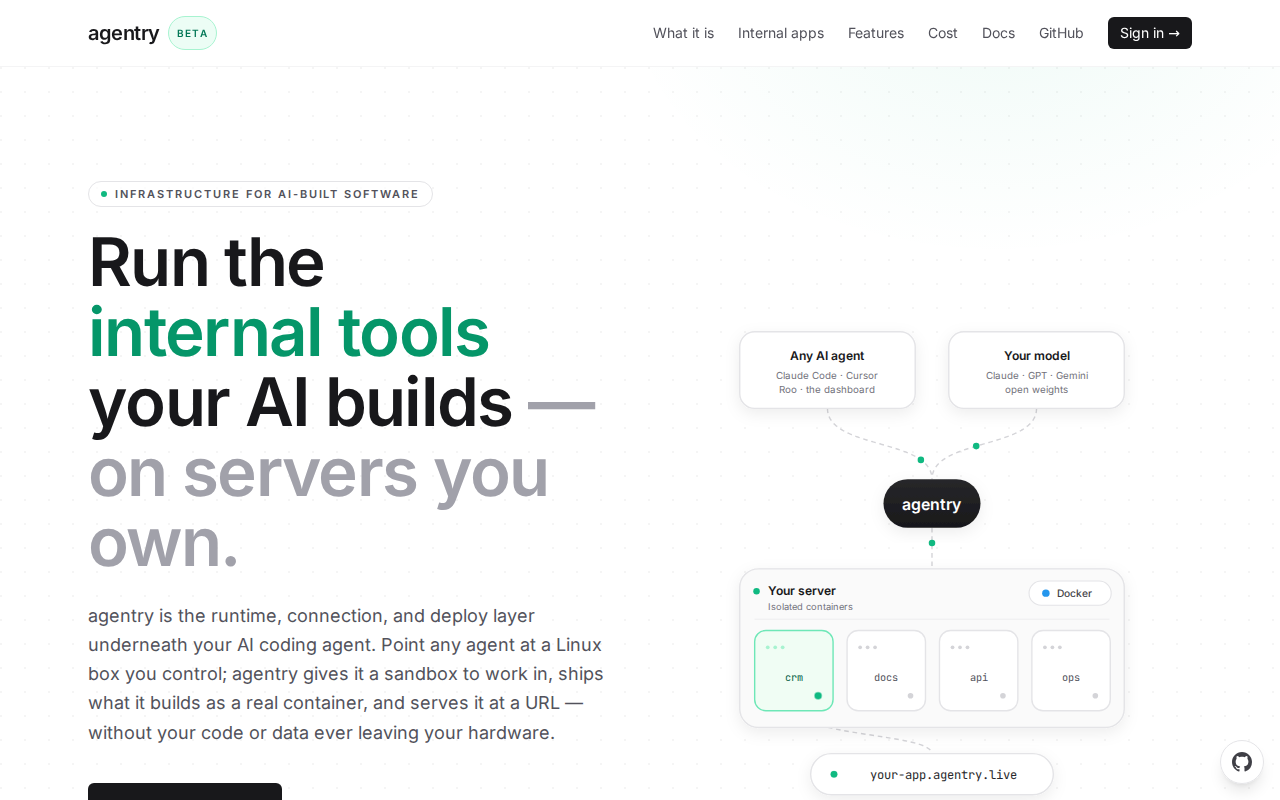
「Point any agent at a Linux box you control; agentry gives it a sandbox to work in, ships what it builds as a real container, and serves it at a URL — without your code or data ever leaving your hardware」
TECH GUESS
Likely Go or Rust runtime + direct container/OCI orchestration + lightweight reverse proxy for URL routing — feels like one person built it tight and right
DEEP DIVE
The Last Mile of AI Coding: Who Deploys What Your Agent Builds?
Your AI coding agent can write code now. That's not even news anymore. Cursor, Devin, Windsurf — the competition is fierce. But here's the awkward part: once the code is generated, you still have to deploy it yourself. Spin up containers, configure ports, manage environment variables, set up reverse proxies. Either you hand your data to someone else's cloud, or you maintain a pile of brittle one-off scripts.
agentry targets exactly this gap. It's not another AI coding tool — it's the "runtime, connection, and deploy layer" underneath whatever AI agent you already use. You point it at a Linux box you control, and agentry gives your agent a sandbox, packages what it builds into a container, and serves it at a real URL. Your code and data never leave your hardware.
The project launched on HN as "Show HN: Build and Host AI apps on your own servers" by winash83. Currently sitting at 4 points and 0 comments. Frankly, that means the community hasn't engaged yet — this thing is fresh.
One curl, Then What?
The getting-started experience is deliberately minimal: curl -fsSL https://agentry.run/install, point it at your Linux server, done. Free during early access, BYOM (Bring Your Own Model), no token markup.
The core value proposition has three layers:
- Sandbox isolation: Your AI agent operates inside agentry's sandbox, so it can't wreck your host environment.
- Containerized packaging: Build artifacts automatically become container images (likely using low-level OCI/Docker operations under the hood) — no need to hand-write Dockerfiles.
- URL mounting: Once the container runs, it gets a real, accessible URL via what appears to be a lightweight reverse proxy setup.
Together, these three layers handle all the grunt work between "AI generated some code" and "it's running and accessible." For teams building internal tools, this means no one needs to set up a CI/CD pipeline — the AI agent can complete the loop from generation to deployment on its own.
Self-hosted Is Not a Marketing Word — It's a Hard Requirement
agentry hammers the "data never leaves your server" message, putting it front and center. This isn't posturing. Teams handling sensitive internal tools (finance, healthcare, enterprise backends) simply cannot route data through third-party cloud platforms. The traditional options are either building DevOps from scratch or using PaaS like Railway/Render while accepting that data transits their servers.
agentry takes the right approach for this audience: BYOM + BYOS (Bring Your Own Server). Your model, your machine — agentry just provides the glue layer. For security-sensitive teams, this is the only correct posture.
Cold Start Problems and Honest Limitations
Let's be blunt: 4 points and 0 comments on HN means essentially zero community validation so far. As a beta product, there are real concerns here.
First, "point it at any Linux box" sounds simple, but real-world environments have network configs, firewall rules, and DNS resolution to deal with. The gap between "one curl install" and "actually works" might be an entire ops manual. Second, AI agent output quality varies wildly — agentry takes whatever the agent produces. If the agent generates garbage code, the best deployment pipeline in the world just delivers garbage to a server faster. Third, technical specifics (runtime language, container orchestration strategy, security sandbox implementation) are barely disclosed on the site. For engineers evaluating reliability, the information density is too low.
Who Should Watch This?
If you're an indie developer or small team using AI coding agents to build internal tools, and you have security or compliance requirements that prevent outsourcing data, agentry is worth tracking. The problem it solves is real, and there are almost no competitors specifically targeting this "AI-generated code to self-hosted deployment" handoff.
But if you're expecting a mature, production-ready solution today, it's too early. Stay on the sidelines, wait for community feedback to accumulate, and revisit when there's more signal than a 4-point Show HN post with zero discussion.
Discussion (0)
- No comments yet — be the first.
Related
 #229▶ 136
Upload your textbook. AI teaches it back to you, chapter by chapter
 #228▶ 112
Someone needs to watch the AI spend meter
 #227▶ 184
Your users are kittens. Don't let them fall off the cliff