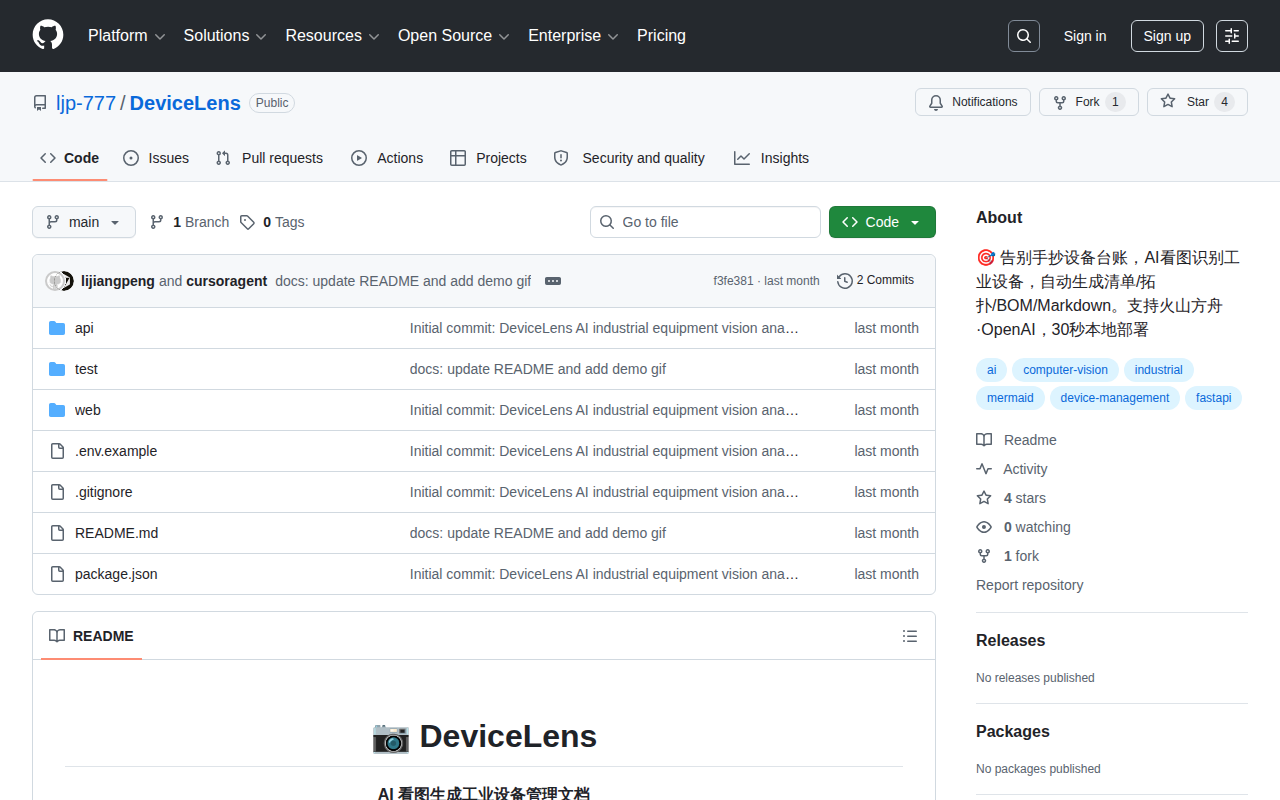
DeviceLens
github.com/ljp-777/DeviceLens →The era of hand-copying device ledgers is over
WHAT IT SOLVES
Field engineers photograph cabinets full of equipment, then manually transcribe every model and spec. One rack photo might contain 20-30 devices — a full afternoon of handwriting, still riddled with errors
WHY IT'S INTERESTING
Goes beyond detection — outputs structured docs
Snap a rack photo and DeviceLens doesn't just identify devices — it auto-generates an equipment list, network topology, BOM table, and even a Markdown doc. From photo to archived record in one step
30-second deploy, two LLM backends to choose from
Author hooked up both Volcano Engine and OpenAI as vision backends. Domestic users skip the API key hassle. Local deploy is just clone + configure .env — even the demo gif is in the README, clearly written after fighting through the setup themselves
「My Cursor subscription is about to expire, so I used it to build a fun project」
TECH GUESS
Web frontend + Python API backend, vision model via Volcano Engine or OpenAI, local deploy with .env config
DEEP DIVE
A "Rushed" Utility: AI Does Your Device Inventory
DeviceLens carries the distinct stamp of an indie developer's hustle. Its creator, ljp-777, stated plainly on V2EX: "Cursor was about to expire, so I used it to develop an interesting project." This reveals two key facts: the development cycle was likely a sprint before an AI coding assistant subscription ran out, and it stems from a very specific, even "unsexy" pain point—industrial site equipment ledger logging. Imagine a technician facing a server rack packed with servers, switches, and routers, needing to check each unit's model, serial number, and port connections, then handwrite or type it all. A single photo might contain twenty or thirty devices. This work is tedious, time-consuming, and error-prone. DeviceLens aims to eliminate this manual process entirely.
Beyond "Recognition": A Pipeline from Image to Structured Document
Many image recognition demos stop at "telling you what this is." DeviceLens's value lies in constructing a complete automated pipeline. A user uploads a front-facing photo of an equipment rack. The AI doesn't just identify all the devices inside (e.g., H3C switch, Huawei router, Dell server); it automatically generates four key outputs: 1) A device inventory with model, quantity, etc.; 2) A network topology map, attempting to infer logical relationships from physical connections; 3) A Bill of Materials (BOM), useful for procurement and asset management; 4) A Markdown document, ready for reports or wikis. This compresses the workflow from "taking a photo" to "archiving into the system" into minutes, offering value far beyond simple identification.
"Grounded" Engineering Choices: Volcengine & 30-Second Deployment
The author's technical choices demonstrate a deep understanding of the domestic development environment. The project supports both Volcengine Ark and OpenAI vision model interfaces. For users in China, using Volcengine directly means no hassle with network configurations or API keys—it works out of the box, significantly lowering the barrier to entry. Deployment is designed to be "30-second local setup"—clone the repo, configure a simple .env file, and run. The Demo GIF in the README indicates the author went through the entire usage flow themselves; the documentation is written for others after having "tripped over the pitfalls," not from an ivory tower. The project uses a classic Python API + Web UI architecture—simple and practical.
Who Should Use It? And Honest Limitations
DeviceLens's most direct users are industrial site operations and maintenance technicians, inspectors, and IT administrators who manage large hardware assets. Any scenario requiring the digitization of physical device information but plagued by manual entry is worth a try. However, as an early-stage project (currently only 4 Stars, 0 Forks on GitHub), it has clear limitations. First, recognition accuracy heavily depends on image quality and model capability. Performance may drop significantly for blurry device labels, cluttered cables blocking views, or side-angle shots. Second, it currently handles standard front-facing rack layouts best. For non-standard deployments or complex connections, the generated topology may require substantial manual correction. It's an excellent "assistant" tool, not a fully "automated" solution that can completely replace human review.
An Indie Dev Case Study for the AI Era
DeviceLens is a textbook example of an indie developer's work in the AI era. It demonstrates: 1) How AI tools (like Cursor) empower individuals to rapidly realize ideas, compressing development cycles to "before the subscription expires"; 2) Solving a "small" but sufficiently "painful" specific problem has more survival potential than chasing grand concepts; 3) "Grounded" engineering decisions (like supporting local models, minimal deployment) are key to whether a product gets used. It's not perfect, but it genuinely solves a problem and leaves a clear path for future iteration. For other developers, its lesson is this: look for the "handwritten ledger" tedium around you, and think about how to use AI to pipeline it.
Discussion (0)
- No comments yet — be the first.
Related
 #229▶ 136
Upload your textbook. AI teaches it back to you, chapter by chapter
 #228▶ 112
Someone needs to watch the AI spend meter
 #227▶ 184
Your users are kittens. Don't let them fall off the cliff