Tower of Time
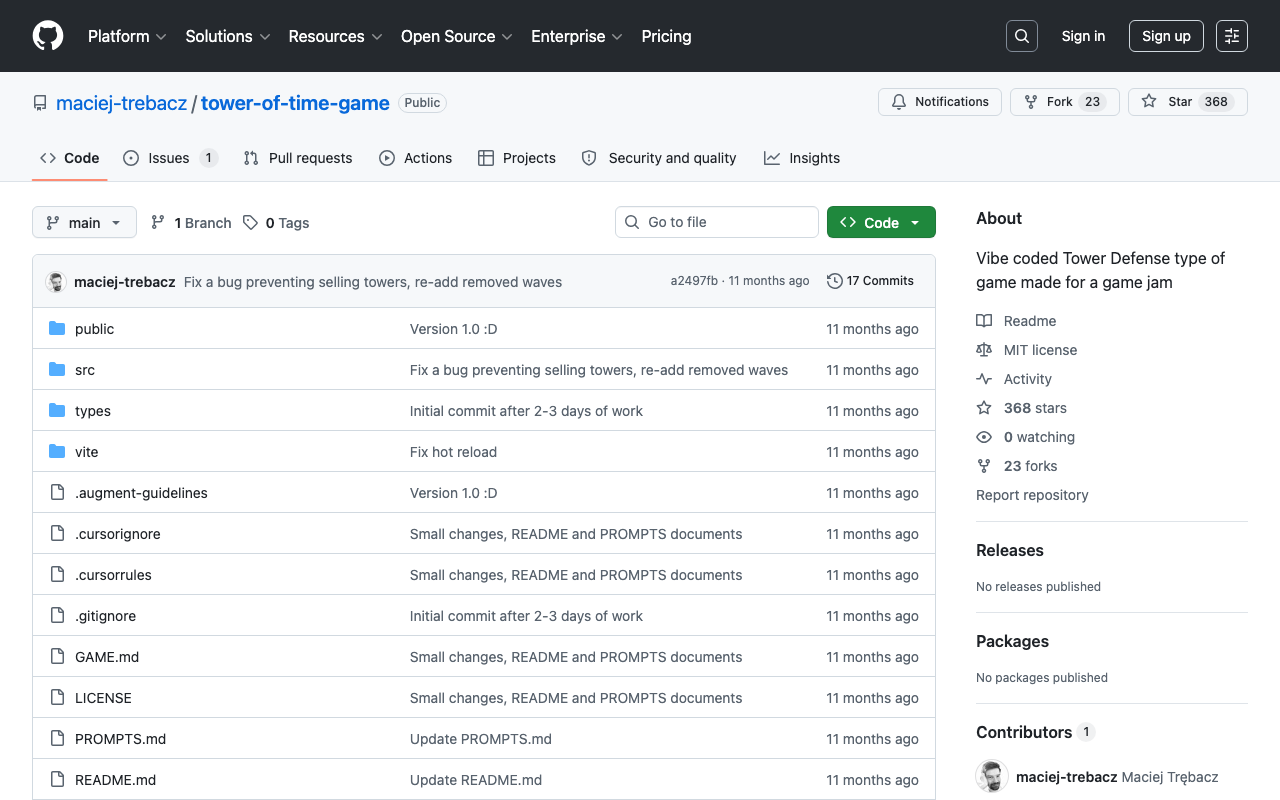
github.com/maciej-trebacz/tower-of-time-game →AI-coded a tower defense game in 2 days — and documented the entire process
WHAT IT SOLVES
Game dev has always been this intimidating wall for indie makers. AI coding tools are changing that — but how far can you actually get? This project is a real-world data point
WHY IT'S INTERESTING
Not a toy demo — a playable tower defense game
Full game loop: build towers, sell towers, multiple enemy waves. 17 commits from zero to playable in about 2 days. The repo still has .augment-guidelines in it — proof the author was actively figuring out an AI-assisted workflow, not just vibing blindly
The process itself became part of the deliverable
Most AI-coded projects just show the end result. This author documented the whole journey. For anyone wondering 'what can AI actually help me build' — the documentation is more valuable than the game itself
Called it 'vibe coded' right in the title
Didn't dress it up as 'full-stack indie dev.' Straight up called it vibe coding, made for a game jam. That self-awareness is its own kind of taste — knowing what you're doing and why
「I AI-coded a tower defense game and documented the whole process」
TECH GUESS
Vite + TypeScript, coded with Cursor + Augment
DEEP DIVE
Vibe Coding: An Honest Development Approach
The Show HN title says it plainly: "I AI-coded a tower defense game and documented the entire process." Developer Maciej (HN ID: M4v3R) doesn't dress this up as "full-stack indie dev" — he embraces "AI-coded" and the community term "vibe coded." This isn't false modesty; it's self-awareness. He knows his role was director, not craftsman, and that the project's value lies in the process documentation, not the code quality. For developers wondering "what can AI actually help me build," this write-up is more instructive than the game itself.
Two to Three Days, 17 Commits, a Playable Tower Defense
The GitHub history shows 17 commits, a Vite + TypeScript stack, and a journey from zero to "Version 1.0" in roughly two to three days. This isn't a toy demo — it has a complete gameplay loop: building towers, selling towers, multi-wave enemies, even gamepad support (the author noted in HN comments: "the game actually supports gamepads too but I didn't have enough time to put in proper instructions for that"). There's a time-rewind mechanic and keyboard controls. HN user edgarneto commented: "I love the twists of rewinding time and playing with the keyboard," and even suggested building a level editor for Reddit-style UGC. When a game jam project gets feedback like that, it's clearly hit the "actually playable" bar, not just a tech demo.
Tool Stack and Cost: Two Subscriptions, Zero Additional Spend
When asked about token usage and cost in the HN comments, M4v3R was specific: Augment Code Developer plan ($50/mo) and Cursor Pro plan ($20/mo), no additional charges. Augment doesn't provide detailed token stats, but from the provider dashboard he saw 7,667 lines of Agent Edits. The .augment-guidelines file in the repo confirms he was using Augment's context engineering features to steer AI behavior. Two tools totaling $70/month to produce a publishable game jam entry — that's a concrete, defensible cost proposition.
The Real Skill: Directing AI, Not Writing Code
M4v3R's core comment captures it: "the leverage you get out of it is exponentially proportional to the quality of your instructions, the structure of your interactions, and the amount of attention you pay to the outputs." HN user mgdev echoed this — 20+ years in software, recently built a ~34k SLOC app primarily with AI, reaching similar conclusions. But imiric pushed back immediately: "The only required skills for working with these tools are basic reading and writing skills any decent English speaker would have." This debate is itself informative — "is prompt engineering a real skill" is moving from theoretical question to practical disagreement. M4v3R's project is a data point: someone who can effectively "direct" AI produces something of quality, but the directing threshold is genuinely lower than writing code from scratch.
Honest Limitations: This Isn't a Silver Bullet
First, the author didn't track token consumption, which tells you the vibe coding workflow is still rough around the edges — lacking observability. Second, HN user qsort offered a sobering observation about the gap between what AI tools are sold as and what they actually deliver. The game's code structure (a single src folder with no obvious modular decomposition) likely isn't following production-grade maintainability practices. This is a game jam project — its lifecycle is probably "gets played a few times after release, then forgotten." If you're hoping to use the same approach for a production product requiring long-term maintenance, this sample doesn't transfer directly. But as a concrete, honest proof point that "two to three days + $70/month gets you from zero to a playable game," it's specific enough to be useful.
Discussion (0)
- No comments yet — be the first.
Related
 #229▶ 136
Upload your textbook. AI teaches it back to you, chapter by chapter
 #228▶ 112
Someone needs to watch the AI spend meter
 #227▶ 184
Your users are kittens. Don't let them fall off the cliff