Backplanes Spotlight
www.backplanes.com:443/ →What did your AI agent actually do?
WHAT IT SOLVES
Claude Code finishes a task, you get a result — but you have no idea what files it opened, commands it ran, or whether it drifted off-scope
WHY IT'S INTERESTING
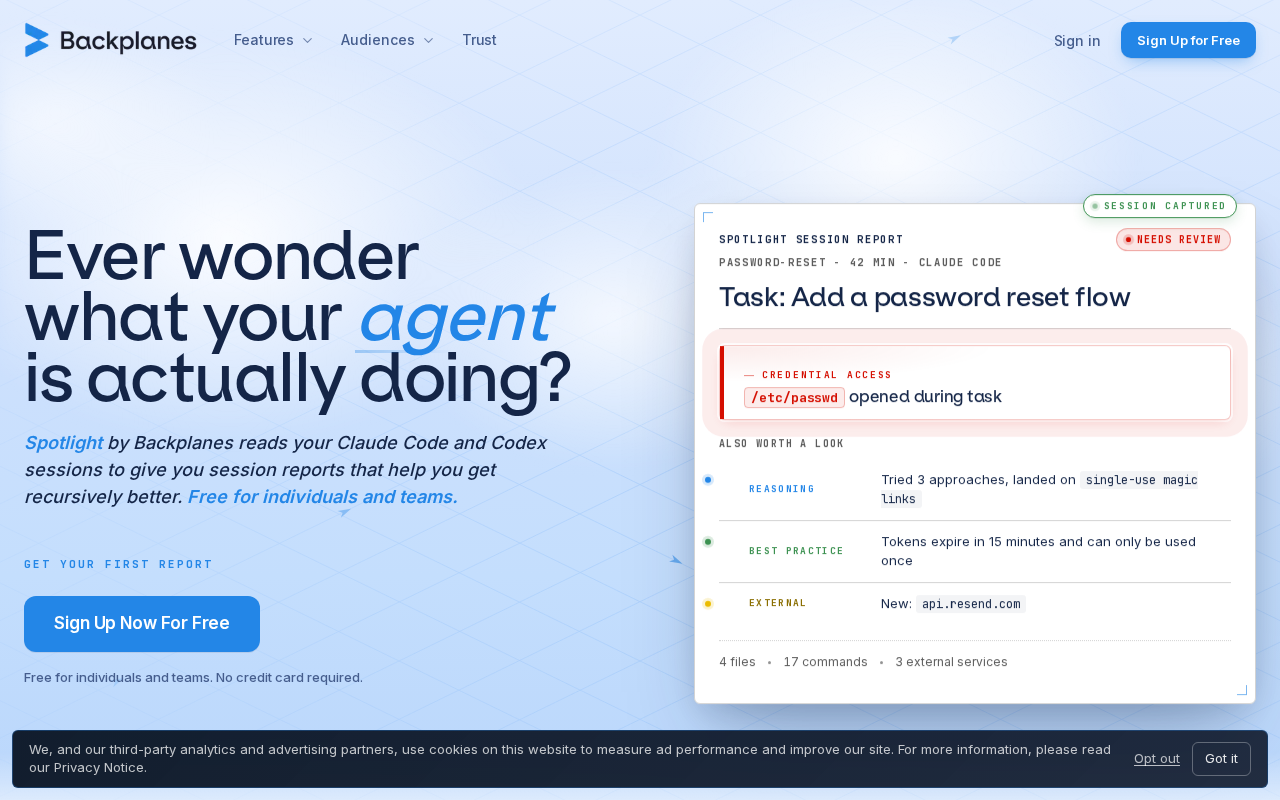
It flags when your agent opens /etc/passwd
In a password-reset task, Spotlight flagged /etc/passwd access as CREDENTIAL ACCESS and labeled the task's scope drift. This isn't a dumb log — it's doing security-theater triage for you
It surfaces the agent's reasoning, not just the output
The report shows 'Tried 3 approaches, landed on single-use magic links.' You're not staring at a black box — you see the decision chain. That changes how you debug and how you guide the AI next time
TECH GUESS
Likely hooks into Claude Code/Codex session logs at the terminal level, processes them server-side, delivers reports via a web dashboard
DEEP DIVE
\n\n## Your AI Coding Assistant Is an Unsupervised Intern\n\nYou prompt Claude Code to add a password reset flow. A few minutes later, it hands you working code. You run the tests, they pass, you merge. But did it open any sensitive files? Did it run shell commands you didn't authorize? Did it drift from the original task and refactor something unrelated?\n\nYou have no idea. You got the deliverable, but zero visibility into the process.\n\nThat's the gap Backplanes Spotlight is built to fill. It reads your Claude Code and Codex session logs and generates structured session reports — showing what files were touched, what commands ran, what external tools were accessed, and how far the agent drifted from the original scope. Created by a three-person team (nickv, Seth, Neil), it launched free for individuals and teams with no credit card required.\n\n## What Actually Matters in These Reports\n\nSpotlight isn't a fancy log viewer. The demo report on their site reveals three design decisions worth noting:\n\nSecurity annotations: In the password reset task example, Spotlight flagged the agent reading /etc/passwd as \"CREDENTIAL ACCESS\" — not just \"file opened.\" This is security-aware analysis, not a dumb file listing. For teams running AI-generated code in production, this kind of annotation has real teeth.\n\nScope drift measurement: The report includes a dedicated \"scope drift\" indicator showing how much the agent deviated from the original task intent. Anyone who's watched an AI agent \"helpfully\" refactor half a module when asked to fix one bug knows exactly why this matters. Without an explicit drift metric, catching this requires manual diff review.\n\nReasoning path visibility: The report literally states: \"Tried 3 approaches, landed on single-use magic links.\" This is the information that actually helps you debug and improve your prompts — not \"agent opened 47 files\" but \"here's why it chose approach C over approach A.\"\n\n## The Technical Play (and Its Limits)\n\nSpotlight almost certainly hooks into Claude Code / Codex session logs at the terminal level. Claude Code stores session records; Spotlight reads them, runs backend analysis, and serves the results through a standard web app.\n\nThe clever part: no plugins, no agent injection, no modifications to Claude Code or Codex internals. You run your task, then you check the report. Low friction is what makes developer tools actually get adopted.\n\nThe flip side: analysis depth is bounded by whatever Claude Code / Codex session logs actually capture. If the agent makes decisions at a granularity the logs don't cover, Spotlight is blind to it too.\n\n## Who Should Sign Up Today\n\nIf you're a solo developer using Claude Code on real projects and you want to know what the AI did inside your codebase — try it. If you're a small team starting to let AI coding into your production pipeline but you don't have security review beyond standard code review — try it. If you subscribe to \"trust but verify\" when it comes to AI agents — try it.\n\nIf you only use Claude for throwaway scripts and never ship AI-generated code, this won't move the needle for you.\n\n## An Honest Assessment and One Hard Question\n\nThe HN post sits at 8 points with 1 comment. That's not a condemnation, but it's not traction either. The target audience (serious Claude Code / Codex users) may simply be too small right now, or the free launch hasn't generated enough user stories to spark discussion.\n\nHere's the hard question: when Anthropic and OpenAI inevitably build session monitoring, security annotations, and drift detection into their own dashboards, what's Spotlight's moat? Third-party observability tools thrive when the platform vendor leaves a gap. The question is whether that gap persists.\n\nNickv noted the team would \"be around all day to answer questions\" on HN. The community barely engaged. For a developer tool, the quality of your launch-day conversation often determines the quality of your early adopters. This was a lukewarm start."}
Discussion (0)
- No comments yet — be the first.
Related
 #229▶ 136
Upload your textbook. AI teaches it back to you, chapter by chapter
 #228▶ 112
Someone needs to watch the AI spend meter
 #227▶ 184
Your users are kittens. Don't let them fall off the cliff